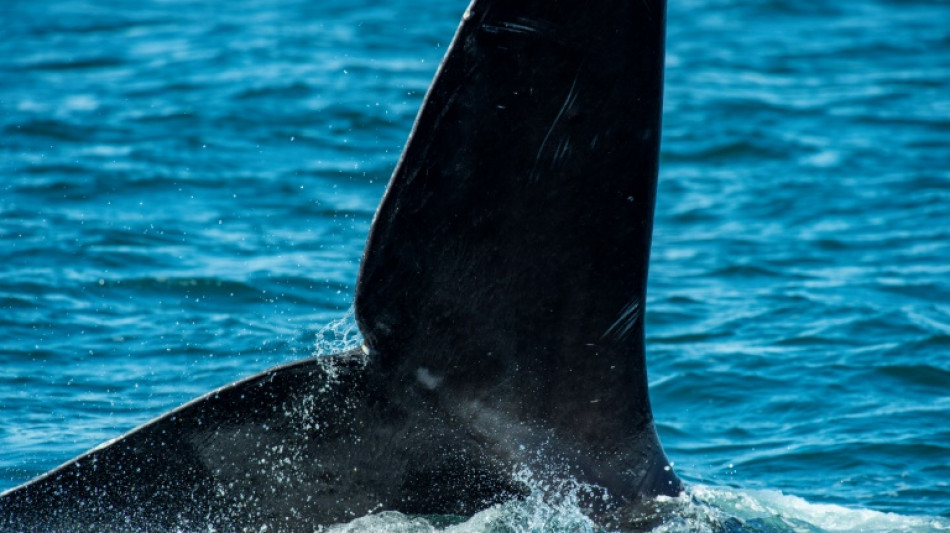
Speeding boats risk killing off North Atlantic right whales: study / Photo: © AFP/File

 Equitas Small Finance Bank rebounds after naming interim chief executive

 Titan quarterly profit seen rising as jewellery business drives growth

 Kuwait finance minister holds economic cooperation talks at COMCEC

 82-Year-Old American Transforms 2003 Mercedes Sprinter into Permanent Home

 Abdul El-Sayed declares victory in Michigan Senate contest

 Democrats capture US Congress in sweeping midterm victory

 Manchester United rallies past Roma as PSG dominates in Champions League

 Qatar prime minister advances mediation through diplomatic calls

 Greenland parliament approves security agreement with United States

 Qatar envoy meets incoming UN General Assembly president

 Trump Signals Willingness to Work With Democrats After Midterm Defeat

 Pitches and Keynote Speakers Are Confirmed for Blue Magic Netherlands on November 17
An overwhelming majority of large boats off the US East Coast are speeding through slow-zones designed to protect critically endangered North Atlantic right whales, of which only around 340 remain.
That's according to a new analysis of vessel tracking data published Thursday by the nonprofit Oceana, which called for stronger safeguards and greater enforcement to save the species from extinction.
"Boats are speeding and whales are dying -- it's that simple," said Oceana's campaign director Gib Brogan.
Boat strikes are one of the two leading causes of death for the whale species, alongside fishing rope entanglements. Collisions kill them through blunt force trauma or propeller cuts.
Since 2008, the US National Oceanic and Atmospheric Administration (NOAA) has imposed mandatory 10-knot limits for vessels 65-feet (19.8 meters) or longer in zones where the whales are expected to be present, and suggested the same speed for areas where they have been sighted.
But data collected from ship transceivers found that from November 2020 through July 2022, 84 percent sped through the mandatory zones and 82 percent sped through the voluntary zones.
"What we've been told by people in the maritime industry is it comes down to balancing the risk of a minimal fine from the government versus the reality of the fines for getting their cargo to port behind schedule," Brogan told AFP.
Notably, for the 9,358 vessel trips over the speed limit made from November 2021 through July 2022, NOAA issued fines in only 46 cases. The average fine was about $15,600.
Right whales, which can grow up to 60 feet (18 meters) in length and have human-like lifespans, are thought to have once numbered up to 20,000 before commercial whaling wiped out their population.
They were considered the "right whale" to hunt by whalers who sought their blubber for whale oil and their baleen plates, which the whales use to filter their food, as a strong, flexible material used in the pre-plastic era.
Commercial hunting of North Atlantic right whales was banned by the mid-20th century, leading to a recovery, with a peak of 483 individuals by 2010.
Since 2017 however, they have been experiencing an "unusual mortality event."
The most recent documented killing from a boat strike was in February, when a 20-year-old male washed ashore with a broken spine in the mid-Atlantic Virginia Beach.
Since the population is already so low, even a few deaths can drive a downward spiral.
The whales' calving rate is also down as a result of chronic stress on mothers, and their traditional foraging grounds are changing as a result of climate change.
Oceana's report called for updating the slow-zones to reflect the whales' current distribution, an end to voluntary speed limits, and expanding the rules to ships 35-feet long.
"We know what we need to do to save the species -- so it's a matter of just doing it and letting the whales come back," said Brogan.
S.Spengler--VB