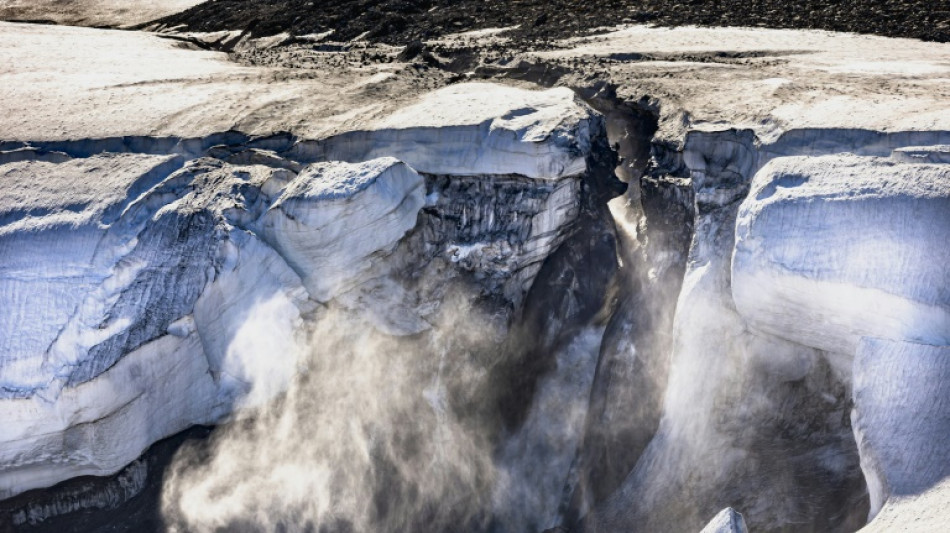
Reversing warming may stop Greenland ice sheet collapse: study / Photo: © AFP

 Indonesia accepts Malaysia's help to tackle wildfires

 Indians living in Japan on stand-by to house Asian Games athletes
 Trump signs bill authorizing sweeping Russia sanctions

 Protesters form human chain at Kennedy Center after Trump threat

 Death toll from attack at police HQ in Pakistan rises to 31

 Trump says Denmark to give US 'permanent control' over Greenland security

 Kennedy Center: future unclear for iconic Washington arts hub

 Trump claims 'infinite' Greenland security deal with Denmark

 Helicopters battle wildfire threatening Ecuador's capital

 Brentford batter Chelsea to undo Alonso's promising start

 Kane hits Bundesliga century as Bayern rout Union
 Trump says CNN, MS NOW, Politico banned from White House

 Hushing and hedging: US companies retreat on climate

 Springboks to face Fiji before 2027 Rugby World Cup

 Nigeria miners struggled to breathe in cell before 37 died: survivors

 McIlroy on the charge at PGA Championship as Reed withdraws

 McIlroy on the charge at PGA Championship

 Crisis-wracked Volkswagen warns of 10-bn-euro hit to profits

 Costa Rica's Grynspan tops third informal poll for UN chief: diplomat

 Stock markets retreat after central bank rate hikes

 Russia labels director of Cannes Grand Prix winner a 'foreign agent'

 Macron warns of Russian 'hybrid' threat after meeting presidential hopefuls

 UN holds third informal poll for new chief

 Kulusevski return can spark Spurs: De Zerbi

 Shakira to cap off world tour with Madrid 12-gig run

Breaching the global warming limits of the world's climate goals could see the melting of Greenland's ice sheet add more than a metre to rising sea levels, according to new research on Wednesday.
But the study by an international team of researchers found there would still be hope to prevent a collapse of the ice sheet -- if warming is reversed and brought back to the safer level.
The melting of Greenland's vast ice sheet -- the world's second-largest after Antarctica -- is estimated to have contributed more than 20 percent to observed sea level rise since 2002.
Rising sea levels threaten to intensify flooding in coastal and island communities that are home hundreds of millions of people, and could eventually submerge whole island nations and seafront cities.
A study published in the journal Nature on Wednesday used two models to simulate how Greenland's ice sheet would respond to future temperature increases over timescales ranging from hundreds to thousands of years.
Researchers suggested abrupt ice sheet losses would be triggered if global average temperatures reached a range of 1.7C-2.3C above pre-industrial levels.
That would risk a permanent "tipping point" that would see near-complete melting of the Greenland ice sheet over hundreds or thousands of years and could lift oceans by seven metres (23 feet), redrawing the world map.
But if the temperature increases were rolled back to the Paris deal 1.5C limit quickly enough -- by removing planet-heating pollution from the atmosphere using vast reforestation or technologies to capture carbon and permanently store it -- then the worst could be avoided.
"We found that the ice sheet reacts so slowly to human-made warming that reversing the current warming trend by cutting greenhouse gas emissions within centuries may prevent it from tipping," said study co-author Niklas Boers from the Potsdam Institute for Climate Impact Research.
"Yet, also just temporarily overshooting the temperature thresholds can still lead to a peak in sea level rise of more than a metre in our simulations."
- Tipping points breached -
Other tipping points in the Earth system may be breached far sooner, the researchers said, including rainforests and ocean current systems that change in much shorter timeframes.
"The Greenland ice sheet is likely more resistant to short-term warming" than previously thought, said Nils Bochow, a researcher at the Arctic University of Norway and lead author of the study.
But the researchers stressed that returning temperatures to below the "safe" threshold for the Greenland ice sheet would be far harder than keeping them below the limit in the first place.
World leaders will gather in Dubai from November 30 for crunch UN talks on slashing planet-warming greenhouse gas emissions, adapting to and financially bracing for the impacts of climate change.
Technologies to reduce temperatures on such a vast scale may not exist, Bochow told AFP.
"We should try everything today to keep the temperatures in a safe range rather than betting that we can reduce them later," he said.
G.Haefliger--VB