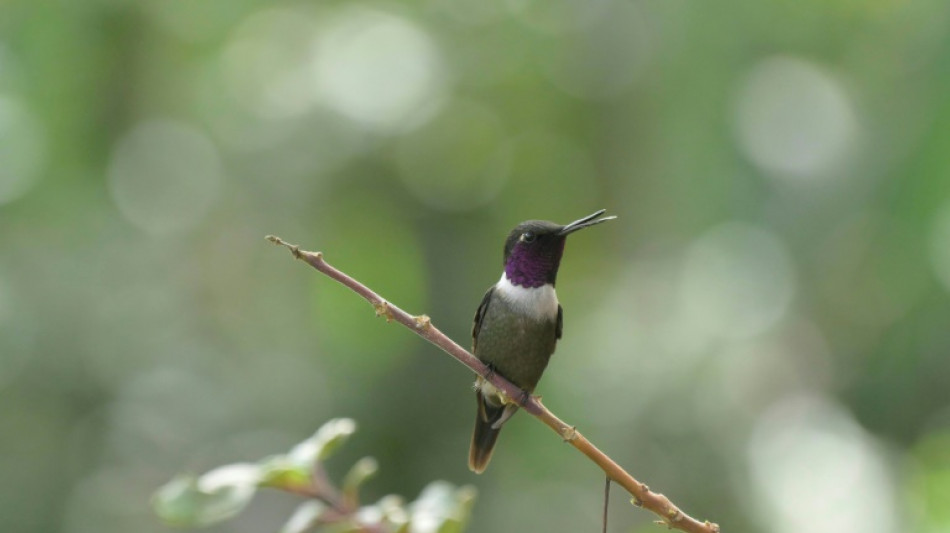
To find out how wildlife is doing, scientists try listening / Photo: © AFP/File

 Indonesia accepts Malaysia's help to tackle wildfires

 Indians living in Japan on stand-by to house Asian Games athletes
 Trump signs bill authorizing sweeping Russia sanctions

 Protesters form human chain at Kennedy Center after Trump threat

 Death toll from attack at police HQ in Pakistan rises to 31

 Trump says Denmark to give US 'permanent control' over Greenland security
 Kennedy Center: future unclear for iconic Washington arts hub

 Trump claims 'infinite' Greenland security deal with Denmark

 Helicopters battle wildfire threatening Ecuador's capital

 Brentford batter Chelsea to undo Alonso's promising start

 Kane hits Bundesliga century as Bayern rout Union

 Trump says CNN, MS NOW, Politico banned from White House

 Hushing and hedging: US companies retreat on climate

 Springboks to face Fiji before 2027 Rugby World Cup

 Nigeria miners struggled to breathe in cell before 37 died: survivors

 McIlroy on the charge at PGA Championship as Reed withdraws

 McIlroy on the charge at PGA Championship

 Crisis-wracked Volkswagen warns of 10-bn-euro hit to profits

 Costa Rica's Grynspan tops third informal poll for UN chief: diplomat

 Stock markets retreat after central bank rate hikes

 Russia labels director of Cannes Grand Prix winner a 'foreign agent'

 Macron warns of Russian 'hybrid' threat after meeting presidential hopefuls

 UN holds third informal poll for new chief

 Kulusevski return can spark Spurs: De Zerbi

 Shakira to cap off world tour with Madrid 12-gig run

A reedy pipe and a high-pitched trill duet against the backdrop of a low-pitched insect drone. Their symphony is the sound of a forest, and is monitored by scientists to gauge biodiversity.
The recording from the forest in Ecuador is part of new research looking at how artificial intelligence could track animal life in recovering habitats.
When scientists want to measure reforestation, they can survey large tracts of land with tools like satellite and lidar.
But determining how fast and abundantly wildlife is returning to an area presents a more difficult challenge -- sometimes requiring an expert to sift through sound recordings and pick out animal calls.
Jorg Muller, a professor and field ornithologist at University of Wurzburg Biocenter, wondered if there was a different way.
"I saw the gap that we need, particularly in the tropics, better methods to quantify the huge diversity... to improve conversation actions," he told AFP.
He turned to bioacoustics, which uses sound to learn more about animal life and habitats.
It is a long-standing research tool, but more recently is being paired with computer learning to process large amounts of data more quickly.
Muller and his team recorded audio at sites in Ecuador's Choco region ranging from recently abandoned cacao plantations and pastures, to agricultural land recovering from use, to old-growth forests.
They first had experts listen to the recordings and pick out birds, mammals and amphibians.
Then, they carried out an acoustic index analysis, which gives a measure of biodiversity based on broad metrics from a soundscape, like volume and frequency of noises.
Finally, they ran two weeks of recordings through an AI-assisted computer programme trained to distinguish 75 bird calls.
- More recordings needed -
The programme was able to pick out the calls on which it was trained in a consistent way, but could it correctly identify the relative biodiversity of each location?
To check this, the team used two baselines: one from the experts who listened to the audio recordings, and a second based on insect samples from each location, which offer a proxy for biodiversity.
While the library of available sounds to train the AI model meant it could only identify a quarter of the bird calls the experts could, it was still able to correctly gauge biodiversity levels in each location, the study said.
"Our results show that soundscape analysis is a powerful tool to monitor the recovery of faunal communities in hyperdiverse tropical forest," said the research published Tuesday in the journal Nature Communications.
"Soundscape diversity can be quantified in a cost-effective and robust way across the full gradient from active agriculture, to recovering and old-growth forests," it added.
There are still shortcomings, including a paucity of animal sounds on which to train AI models.
And the approach can only capture species that announce their presence.
"Of course (there is) no information on plants or silent animals. However, birds and amphibians are very sensitive to ecological integrity, they are a very good surrogate," Muller told AFP.
He believes the tool could become increasingly useful given the current push for "biodiversity credits" -- a way of monetising the protection of animals in their natural habitat.
"Being able to directly quantify biodiversity, rather than relying on proxies such as growing trees, encourages and allows external assessment of conservation actions, and promotes transparency," the study said.
J.Marty--VB