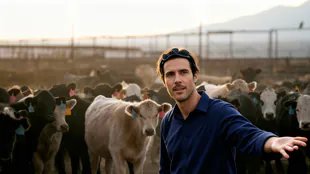
Is planting trees to combat climate change 'complete nonsense'? / Photo: © AFP/File

 Indian crude-sensitive shares gain after 13% oil-price decline

 Stocks and dollar fall as Democratic election gains reshape markets

 Abdul El-Sayed Wins Michigan Senate Seat, Becoming First Muslim in US Congress

 Kuwait marks key events and anniversaries from national history

 Trump congratulates Democrats and signals willingness to cooperate

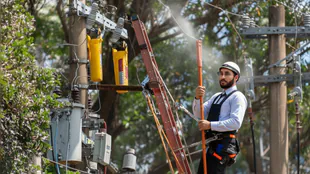 Enel to Install Solar Panels at Niterói Waste Management Facility

 Qatar sees tentative opening for renewed regional diplomacy

 Qatar Tourism joins Pacific Asia Travel Association at London travel market

 Abdul El-Sayed Wins Michigan Senate Seat in Historic Election

 Qatar media bodies discuss support for humanitarian initiatives

Bill Gates is emphatic: "I don't plant trees," he declared recently, wading into a debate about whether mass tree planting is really much use in fighting climate change.
The billionaire philanthropist was being probed on how he offsets his carbon emissions and insisted he avoids "some of the less proven approaches."
The claim that planting enough trees could solve the climate crisis is "complete nonsense", he told a climate discussion organised by the New York Times last week.
"Are we the science people or are we the idiots?"
Gates' polemical pronouncements made headlines and prompted criticism from backers of reforestation (planting trees in damaged forests) and afforestation (planting in areas that were not recently forest).
"I have dedicated the last 16 years of my life to making forests part of the climate solution," wrote Jad Daley, head of the American Forests NGO.
"This kind of commentary can really set us back," he said on X, formerly known as Twitter.
Mass tree planting schemes have been gaining ground for years as a way to suck carbon from the atmosphere at scale.
Even notoriously climate change-sceptical US Republicans have introduced legislation to support planting a trillion trees worldwide.
But Gates is far from alone in doubting the benefits of such ambitious plans.
A group of scientists warned on Tuesday that mass tree planting risks doing more harm than good, particularly in tropical regions.
That's primarily because it can replace complex ecosystems with monoculture plantations.
"Society has reduced the value of these ecosystems to just one metric -- carbon," the scientists from universities in Britain and South Africa wrote.
Carbon capture is "a small component of the pivotal ecological functions that tropical forests and grassy ecosystems perform," they said in an article in the Trends in Ecology and Evolution journal.
Jesus Aguirre Gutierrez, an author of the paper, pointed to examples in southern Mexico and Ghana, where once diverse forests "have now transformed into homogenous masses".
This makes them "highly vulnerable to diseases and negatively impacts local biodiversity," the senior researcher at the University of Oxford's Environmental Change Institute told AFP.
- 'Not just running around planting' -
Major tree planting commitments often involve agroforestry or plantations, where the trees will eventually be felled, releasing carbon.
And they are dominated by five tree species chosen largely for their timber and pulp value, or growth speed.
Among them is teak, which can overtake native species, "posing additional risks to native vegetation and the ecosystem", said Aguirre Gutierrez, who is also a Natural Environment Research Council fellow.
Other critiques include the lack of space globally for the many proposed mass planting projects and the risk of competition between smallholder agriculture and planting.
Misclassification of grassland and wetland as suitable for forest and planting poorly adapted or cared-for seedlings have also been problems highlighted by scientists.
So does planting trees really have no value?
Not so fast, says Daley, whose American Forests organisation says it has planted 65 million trees.
It's Gates' premise that is wrong, Daley said.
"Literally no one is saying... that forests alone can save our environment," he told AFP.
He argues that critics ignore carefully calibrated projects involving native species in areas that need reforestation and focus instead on a few poorly conceived schemes.
"This broad brush critique has ignored the fact that much reforestation is driven by the loss of forests that won't regenerate without help."
"We are not just running around planting trees wherever we feel like it to capture carbon."
There are efforts to bridge the gap between critics and proponents, including 10 "golden rules for restoring forests", proposed by Britain's Royal Botanic Gardens, Kew and Botanic Gardens Conservation International.
They advise avoiding grasslands or wetlands, prioritising natural regeneration, and selecting resilient and biodiverse trees.
But they start with a rule that perhaps everyone can agree upon: protect existing forests first.
"It can take over 100 years for these forests to recover, so it is crucial that we protect what we already have before planting more."
S.Gantenbein--VB