Climate change boosts risk of extreme wildfires 25%: study / Photo: © AFP

 Indians living in Japan on stand-by to house Asian Games athletes
 Trump signs bill authorizing sweeping Russia sanctions

 Protesters form human chain at Kennedy Center after Trump threat

 Death toll from attack at police HQ in Pakistan rises to 31

 Trump says Denmark to give US 'permanent control' over Greenland security
 Kennedy Center: future unclear for iconic Washington arts hub

 Trump claims 'infinite' Greenland security deal with Denmark

 Helicopters battle wildfire threatening Ecuador's capital

 Brentford batter Chelsea to undo Alonso's promising start

 Kane hits Bundesliga century as Bayern rout Union
 Trump says CNN, MS NOW, Politico banned from White House
 Hushing and hedging: US companies retreat on climate

 Springboks to face Fiji before 2027 Rugby World Cup

 Nigeria miners struggled to breathe in cell before 37 died: survivors

 McIlroy on the charge at PGA Championship as Reed withdraws

 McIlroy on the charge at PGA Championship

 Crisis-wracked Volkswagen warns of 10-bn-euro hit to profits

 Costa Rica's Grynspan tops third informal poll for UN chief: diplomat

 Stock markets retreat after central bank rate hikes

 Russia labels director of Cannes Grand Prix winner a 'foreign agent'

 Macron warns of Russian 'hybrid' threat after meeting presidential hopefuls

 UN holds third informal poll for new chief

 Kulusevski return can spark Spurs: De Zerbi

 Shakira to cap off world tour with Madrid 12-gig run

 Isolated Syrian-Druze city blames Damascus for shortages

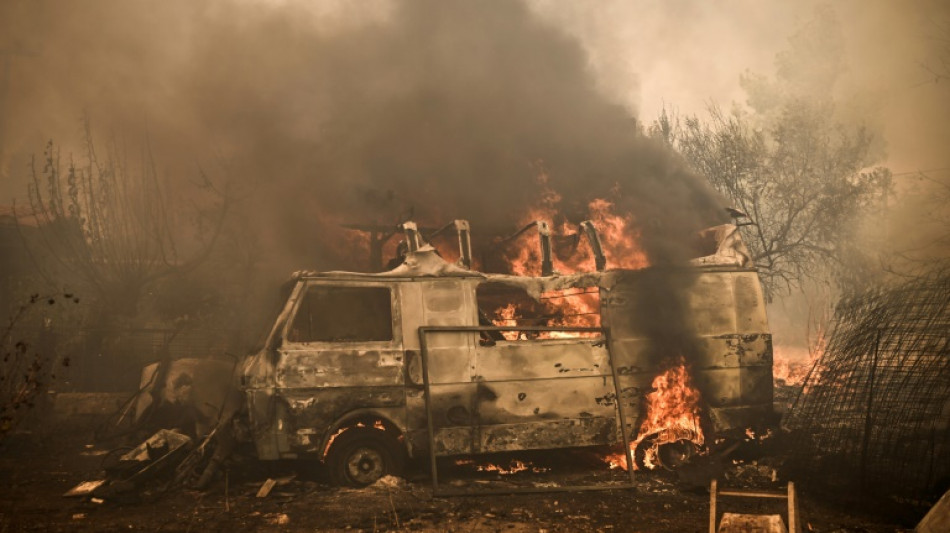
Climate change has sharply boosted the risk of fast-spreading wildfires, according to a Californian study published Wednesday that offers lessons for prevention after recent disasters in Canada, Greece and Hawaii.
Scientists at the Breakthrough Institute, a non-profit research centre, found that human-caused warming increased the frequency of "extreme daily wildfire" by 25 percent on average compared to the pre-industrial era, in a study in the journal Nature.
Examining a series of blazes from 2003 to 2020, they used machine learning to analyse the link between higher average temperatures, dryer conditions and the fastest-spreading blazes -– ones that burn more than 10,000 acres (4,000 hectares) a day.
The impact of climate change varied from fire to fire.
In certain partly dry conditions, global warming pushed the area beyond key thresholds, making extreme fires much more likely. In very dry conditions, the impact was less.
"This means that we should pay the closest attention to the places and times that historically have experienced conditions just on the moist side of these thresholds, but which are being pushed over these thresholds onto the dry side by background warming," lead author Patrick Brown told AFP.
- Fierce wildfire season -
The researchers calculated that the risk could increase on average by 59 percent by the end of the century under a "low-emissions" scenario where global warming is limited to 1.8 degrees Celsius above preindustrial levels, and up to 172 percent in an unbridled high-emissions scenario.
Earth's surface has already warmed 1.2C.
Using data from recorded fires, the researchers measured the probability of a given blaze turning into an "extreme" one. Then they used computer models to calculate how far the post-industrial rise in temperatures had increased that risk.
The study controlled for variables such as precipitation, wind and absolute humidity and the researchers warned that changes in these could make the risk from global warming even worse.
California has suffered a string of extreme wildfires in recent years.
In 2020, more than 30 people died and four million acres were devoured by flames in some of the biggest fires in the state's history. The November 2018 "Camp Fire" killed 86 people.
The study's publication followed a summer of wildfires that killed at least 115 people in Hawaii and forced 200,000 from their homes in Canada.
Greece is battling what EU officials called the bloc's biggest wildfire on record along a 10-kilometre (six-mile) front. It has killed 20 people.
A 2022 United Nations Environment Programme report on wildfires said they are becoming more common due to hotter, dryer conditions caused by climate change, including in regions not traditionally prone to them.
- Fire prevention -
Nature study author Brown said the insights into dryness thresholds could aid prevention measures, for example by indicating the best spots for thinning and prescribed burning of vegetation to reduce the dry natural matter that wildfires feed on, known as "hazardous fuel".
"We are finding that under most conditions, the impact of hazardous fuel reductions can completely negate the impact of climate change," he said.
"It is plausible to have a future of much less wildfire danger despite climate change if we conduct these fuel treatments at scale."
He said the findings could also inform precautions regarding power lines and indicate where monitoring and awareness campaigns should be focussed, and firefighting resources deployed.
Other wildfire experts said awareness of fire risks will become increasingly important for authorities and even holidaymakers.
In a separate briefing by wildfire specialists on Wednesday not related to the study, Andrew Sullivan of Australia's national science agency CSIRO said expenditure was typically "skewed" towards responding to wildfires with not enough money allocated for preventing them.
He said there was a "global need to rebalance expenditure to improve risk mitigation" measures such as managing vegetation and fire-danger forecasting.
W.Lapointe--BTB