Squeezed out: Bulgaria lavender oil makers fear EU laws / Photo: © AFP/File

 Indians living in Japan on stand-by to house Asian Games athletes

 Trump signs bill authorizing sweeping Russia sanctions

 Protesters form human chain at Kennedy Center after Trump threat

 Death toll from attack at police HQ in Pakistan rises to 31

 Trump says Denmark to give US 'permanent control' over Greenland security
 Kennedy Center: future unclear for iconic Washington arts hub

 Trump claims 'infinite' Greenland security deal with Denmark

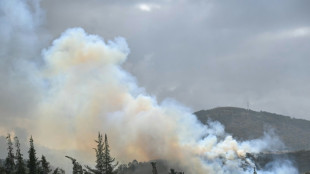 Helicopters battle wildfire threatening Ecuador's capital

 Brentford batter Chelsea to undo Alonso's promising start

 Kane hits Bundesliga century as Bayern rout Union

 Trump says CNN, MS NOW, Politico banned from White House

 Hushing and hedging: US companies retreat on climate

 Springboks to face Fiji before 2027 Rugby World Cup

 Nigeria miners struggled to breathe in cell before 37 died: survivors

 McIlroy on the charge at PGA Championship as Reed withdraws

 McIlroy on the charge at PGA Championship

 Crisis-wracked Volkswagen warns of 10-bn-euro hit to profits

 Costa Rica's Grynspan tops third informal poll for UN chief: diplomat

 Stock markets retreat after central bank rate hikes

 Russia labels director of Cannes Grand Prix winner a 'foreign agent'

 Macron warns of Russian 'hybrid' threat after meeting presidential hopefuls

 UN holds third informal poll for new chief

 Kulusevski return can spark Spurs: De Zerbi

 Shakira to cap off world tour with Madrid 12-gig run

 Isolated Syrian-Druze city blames Damascus for shortages

As a successful harvesting season yielding several hundred tonnes of lavender oil wraps up in Bulgaria -- the world's top producer -- the industry's future looks more grey than purple.
With a global production glut already weighing on prices, Bulgarian distillers now fear new EU regulations will further crimp business.
While the European Union has offered to pause the implementation of the bloc's revised regulations restricting harmful chemical substances, the clock is ticking.
Nikolay Nenkov, head of Galen-N distillery -- one of the biggest in Bulgaria -- is worried that he will soon have to affix health warning labels featuring off-putting slogans to his vials of lavender oil.
"We fear that such measures will lower consumption, curb production and (thus) the sector might disappear in some regions, which is very bad considering it's a long-standing tradition," he told AFP.
In an industry already reeling from low prices, labour shortages, climate change and pests, the planned revisions would "create further tension", he added.
- 'Big step forward' -
From the famous lavender fields surrounding Zelenikovo in central Bulgaria to France's Provence, producers and farmers have teamed up to defend their product against what they see as unfair laws from Brussels.
Other major producers include China, Moldova and Greece.
Across the EU, essential oils are regulated by two main chemical laws known as REACH and CLP.
The upcoming revision of both laws seeks to provide consumers and companies with better information about the possible existence of endocrine disruptors and components that cause cancer or allergic reactions in products.
The review of REACH -- which deals with the registration, evaluation, authorisation and restriction of chemicals -- has been postponed until the fourth quarter of 2023.
But the EU Commission's proposal to clarify the classification and labelling of substances under the CLP, particularly for online sales, is due to be put to a plenary vote in October.
Faced with the producers' resistance, the EU Council has proposed a four-year exemption from the entry into force of the text.
"The problem has not been solved, but this postponement is a big step forward," said Nenkov.
- Overproduction -
In a bid to allay the concerns of major European producers, Brussels has stressed that it "has no plans to start requiring an analysis of each molecule in essential oils" or "to ban" them, a spokesperson told AFP.
"Essential oils are already defined as chemical substances".
At Nenkov's distillery, 70-year-old technician Vasil Andreev insists that he is handling a "fully natural product" as he filters another bucket of the pale yellow oil.
It takes up to 120 kilos of lavender -- still being pressed by foot into huge troughs before distillation -- to produce one kilo of Bulgaria's purple gold used in famous cosmetics and perfumes.
But booming production has oversaturated the market in recent years, causing prices and profits to plummet. Prices currently hover below the costs of production at around 20-35 euros per kilo, after peaking at 140 euros in 2018.
"For the past three years, there has been global overproduction of lavender oil, with supply outstripping demand, causing more and more farmers to give up the crop," said InteliAgro think tank analyst Nikolay Valkanov.
Farmers acknowledge that they will sooner or later have to destroy some of their fragrant fields to be able to return to prices that allow them to stop selling at a loss.
L.Janezki--BTB