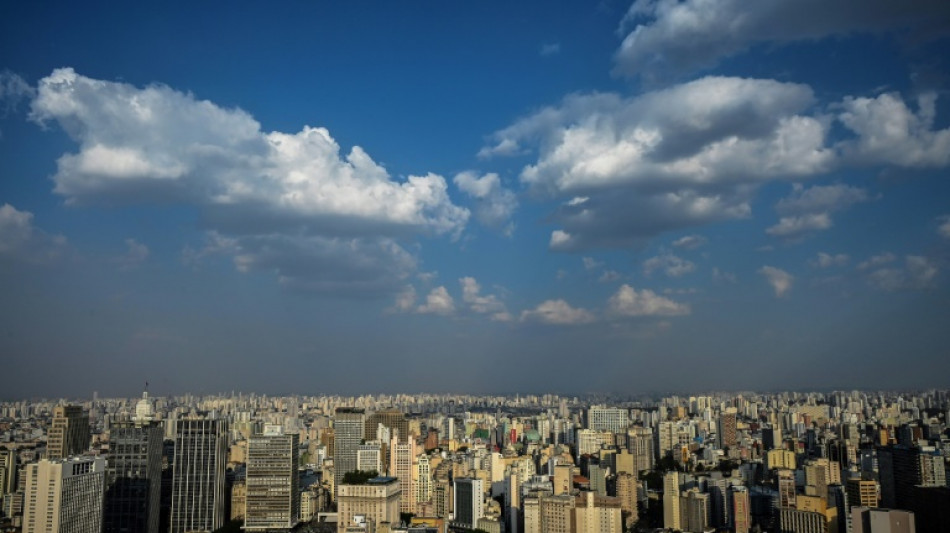
Brazil experiencing winter heat wave / Photo: © AFP

 Greenland parliament approves security agreement with United States

 Qatar envoy meets incoming UN General Assembly president

 Trump Signals Willingness to Work With Democrats After Midterm Defeat

 Galloway accuser could not foresee publishing-sector fallout, lawyer argues

 New York City Center revives In the Heights as a timely community story

 Godzilla Minus Zero shifts focus toward postwar human drama

 Mehbooba Mufti urges dialogue and renewed Central Asia links for Kashmir

 Seacliff Healthcare Seeks Specialist GP in Thirroul

 US stocks fall before midterm Election Day as technology shares weaken

 BLS Polymers makes strong market debut at ₹248 per share

 Petrol and diesel prices remain broadly steady across major Indian cities

 Reliance shares remain in focus after near-12% surge

 2026 Arizona Midterms: Key Races, Ballot Measures, and Voter Deadlines

 Coal India prepares possible $1 billion Mahanadi Coalfields listing

Brazil is enduring a heat wave in the middle of the southern hemisphere's winter, with the metropolis of Sao Paulo close to breaking records for August and for the year 2023.
The inhabitants of the largest city in Latin America, with 11.5 million people, have been surprised by temperatures almost 10 degrees above the average for the month, of 24.5 degree Celsius (76.1 degrees Fahrenheit), according to the National Institute of Meteorology (Inmet).
And thermometers hit a high of 32.3 Celsius on Wednesday, close to the 32.5 Celsius reported on January 16, in summer.
And they were also very close to the highest temperatures ever officially logged for August: 33.1 Celsius on August 31, in 1952 and 1955.
Inmet, which has measured the weather since 1943, warned that the historical records for August and 2023 could be broken on Thursday.
"Then it will get colder... But in the future the winters will probably get hotter," Fabio Luiz Teixeira, a professor at the Department of Atmospheric Sciences at the University of Sao Paulo, told AFP.
The unusual weather this month is the result of a large mass of hot and dry air hovering over Brazil, experts said.
That mass, which raises the temperature, is formed by a combination of the El Nino weather phenomenon and global warming due to human activity.
- "We're used to the heat" -
"Today we have temperatures five degrees above average in some areas or cities in Brazil," said Cleber Souza, an Inmet meteorologist.
Souza also warned of high temperatures in Mato Grosso, in the center-west of Brazil, of around 41 degrees, with the north and northeast of the country getting close to 40 degrees.
The authorities of the state of Sao Paulo, which in July had temperatures above average and rainfall below average, have identified several areas at elevated risk for forest fires.
And they have asked citizens to keep themselves hydrated, avoid exercising outdoors and even, in some areas, to use serum to refresh their noses and eyes due to the dry climate and low humidity.
In the streets of Sao Paulo, people dressed as though for a typical summer day.
"It's hot but it's windy. We're used to the heat," said Jose Carlos Antonio, a 40-year-old construction worker.
Countries of the Southern Cone have registered heat records in the middle of the southern winter. But waves of high temperatures could become a permanent phenomenon in the world due to climate change, warned a UN specialist.
"People are far too relaxed about the signs," John Nairn, an extreme heat expert at the World Meteorological Organization WMO, told AFP.
"The science has been saying this is coming your way. And this is not where it stops."
"It will only get more intense and more frequent," he warned
R.Adler--BTB