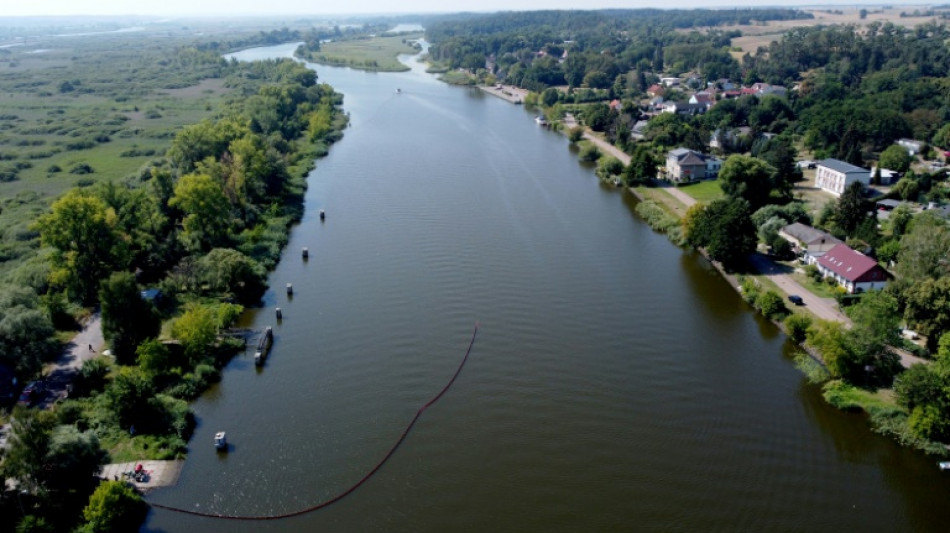
Greenpeace slams Poland's new river protection law / Photo: © AFP/File

 Ed Sheeran returns to stage after Palestinian controversy

 Asian Games to open in Japan after troubled build-up

 Drone owners rush to offload devices ahead of Beijing ban

 Trump's beef policies irk Texas ranchers, testing their loyalty

 Nvidia, OpenAI CEOs to attend Xi dinner at White House

 Anthropic picks Accenture for in-house AI safety evaluation

 Balogun returns as Monaco beat Lens to continue strong Ligue 1 start

 'Pause' on overt repression in Venezuela, but reforms still needed: HRW

 Global stocks mixed as yen falls despite Bank of Japan rate hike

 Cuba hit with seventh major blackout of the year

 Murray out with concussion so Wentz will start for Vikings

 UN chief 'deeply regrets' US visa refusal to Abbas for annual meeting

 England quick Carse to face no charges over alleged nightclub assault

 Mancini brings nine newcomers into the first squad of his Italy comeback

 Czechs level Davis Cup tie against USA as South Korea eye Finals

 New France boss Zidane confirms Mbappe as captain after naming first squad

 California governor signs order to explore AI 'kill switch'

 Head leads run spree as Australia win Zimbabwe ODI series

 In-form Raphinha wants to finish career at Barcelona

 Warren Buffett steps down as Berkshire Hathaway chairman

 Carrick confident Man Utd can 'work through' tough time

 Mbappe ends Nike partnership to join Swiss brand On

 Liverpool boss Iraola puts Bournemouth love affair on hold

 'A disaster' if Man City do not win says Maresca after flawless start

 Kerry James Marshall: American 'blackness' painter celebrated in Europe

Environmentalists on Friday slammed the passing of a controversial law in Poland on the revitalisation of the Oder river, which was hit by toxic algae growth last year that caused mass fish deaths.
A toxic algae bloom hit the river on the Polish border with Germany last summer, with at least 300 tonnes of dead fish pulled from the water as tensions spiked between the two countries.
In response to the environmental disaster, Warsaw passed a new law Thursday evening which includes provision for new water treatment plants, and is intended to put more stringent requirements on industrial sites.
But Greenpeace said the government had "ignored the voice of the public and scientists" in passing the law, in a statement on the social media site X, formerly known as Twitter.
They criticised what they said was a lack of consultation and said that the bill will "not protect the Oder" and will continue to be polluted.
The World Wildlife Fund (WWF) had previously criticised the bill for focusing on "further regulation of the Oder (and other rivers), which will further destroy the ecosystem and its ability to clean itself."
The law allows the building of new infrastructure including the modernisation of sewer systems and constructing new water treatment plants, estimated to cost some 9.5 billion zlotys ($2.3 billion).
The new law also forces large industrial sites, such as mines, to invest in systems to reduce saltwater discharges.
The toxic algae growth was sparked by the introduction of high levels of salt into the waters, according to the German environment ministry, which said that there was a "lack of available information" on the cause.
Poland also blamed toxic algae for the mass fish deaths, but said the disaster had most likely been caused by poor water quality as a result of high temperatures and very low water levels.
Polish and German authorities on either side of the river have said they are determined to stop future disasters happening, but have clashed over responsibility and the best way to keep the algae in check.
S.Keller--BTB