Turkey quake survivors' latest menace -- dust / Photo: © AFP

 Drone owners rush to offload devices ahead of Beijing ban

 Trump's beef policies irk Texas ranchers, testing their loyalty
 Nvidia, OpenAI CEOs to attend Xi dinner at White House

 Anthropic picks Accenture for in-house AI safety evaluation
 Balogun returns as Monaco beat Lens to continue strong Ligue 1 start

 'Pause' on overt repression in Venezuela, but reforms still needed: HRW

 Global stocks mixed as yen falls despite Bank of Japan rate hike

 Cuba hit with seventh major blackout of the year
 Murray out with concussion so Wentz will start for Vikings

 UN chief 'deeply regrets' US visa refusal to Abbas for annual meeting
 England quick Carse to face no charges over alleged nightclub assault
 Mancini brings nine newcomers into the first squad of his Italy comeback
 Czechs level Davis Cup tie against USA as South Korea eye Finals
 New France boss Zidane confirms Mbappe as captain after naming first squad
 California governor signs order to explore AI 'kill switch'
 Head leads run spree as Australia win Zimbabwe ODI series

 In-form Raphinha wants to finish career at Barcelona
 Warren Buffett steps down as Berkshire Hathaway chairman
 Carrick confident Man Utd can 'work through' tough time

 Mbappe ends Nike partnership to join Swiss brand On

 Liverpool boss Iraola puts Bournemouth love affair on hold
 'A disaster' if Man City do not win says Maresca after flawless start
 Kerry James Marshall: American 'blackness' painter celebrated in Europe

 Spain coach De la Fuente offers 'full support' to people of Ceuta

 Russia seizes assets of Nestle, French firms over West's Ukraine support
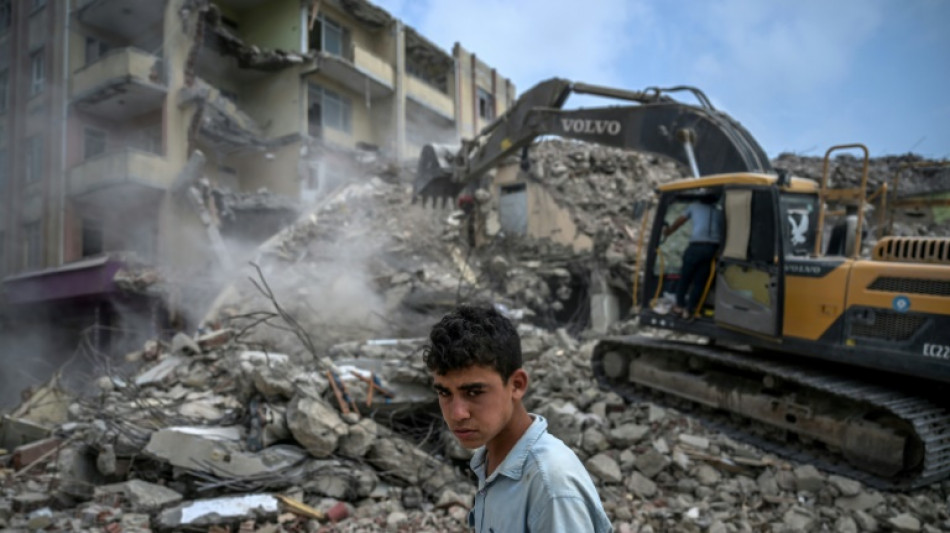
The excavator tore into the remnants of the damaged building in southeast Turkey, bringing it crashing down into a cloud of dust -- the latest menace facing survivors of the deadly February quake that ravaged the region.
Extending to the horizon, a cocoon of fine grey dust envelops the city of Samandag in the south of Hatay province, devastated by the February 6 earthquake that killed more than 55,000 people and laid waste to parts of Turkey and Syria.
"We survived the earthquake but this dust will kill us," Michel Atik, founder and president of the Samandag Environmental Protection Association, said with a sigh.
"We are going to die of respiratory diseases and lung cancer with all these hazardous materials."
Five months after the quake, the scale of cleanup and reconstruction is enormous, with the government estimating that nearly 2.6 million buildings have been destroyed.
According to the UN Environment Programme, some 210 million tonnes of rubble must be disposed of.
By comparison, some 1.8 million tonnes of rubble had to be hauled away after the September 11, 2001 attacks in New York City that brought down the World Trade Center skyscrapers.
Environmental activists and local residents worry that in the rush to clean up and rebuild, crucial safety measures are being ignored, with potentially adverse effects on the health of local residents, the environment and the economy.
- Landfills -
The landfill near Samandag is one of several that have been set up in this province bordering Syria. It lies next to the Mediterranean and the Milleyha natural bird reserve, which is natural bird reserve, which is a nesting site for endangered green sea turtles.
Another landfill, in the Antakya region, lies near a valley of olive trees at the foot of the Nur Mountains. With olive oil the primary source of income in the province, there are fears that the dump could harm the trees.
"They don't even hose it down," said Cagdas Can, 33, an environmental activist with the Reconstruct group, as he watched trucks filled with debris leave Samandag toward the huge open-air landfill that lies next to one of Turkey's longest beaches.
"There were other possible sites... But the companies that won the tenders (for clearing) chose here to save fuel," said Can.
"All they care about it recovering the iron and the metal," he said.
"Nobody wears a mask. The demolition sites are not covered or hosed down and neither are the holds of the trucks, as required by law," he said.
Can said that his environmental organisation had tried to stop the trucks by forming human chains, "but the police intervened. Eighteen people were arrested and I had my collarbone broken," he said.
The exhausted local population, faced with a myriad of problems after the quake, has not mobilised, he said, but they are as worried as the conservationists about the impact of the cleanup.
- Hidden hazards -
"The children are the first to be affected, they cough a lot, so do we. As soon as it's windy, everything is covered in dust," said Mithat Hoca, 64, who sells vegetables at a stall in central Samandag.
"We have to cover everything," said Mehmet Yazici, a 61-year-old retiree who passed by on a scooter. "We wipe the table 15 to 20 times a day. You have to do it every half hour".
Ali Kanatli, a doctor in Antakya, some 26 kilometres (16 miles) away from Samandag, has already seen cases of "conjunctivitis, allergies, asthma, bronchitis."
But above all, he worries about the long-term effects, like an increase in cancers, that the hazardous materials in the rubble and dust could cause in the region.
Turkey did not ban asbestos until 2013 and most of the buildings affected by the quake are older, he said.
"In addition to asbestos, we have lead in paint, heavy metals including mercury in electronic equipment such as televisions, household appliances", he said.
K.Thomson--BTB