Mountain forests disappearing at alarming rate: study / Photo: © AFP

 Hushing and hedging: US companies retreat on climate

 Springboks to face Fiji before 2027 Rugby World Cup

 Nigeria miners struggled to breathe in cell before 37 died: survivors

 McIlroy on the charge at PGA Championship as Reed withdraws

 McIlroy on the charge at PGA Championship

 Crisis-wracked Volkswagen warns of 10-bn-euro hit to profits

 Costa Rica's Grynspan tops third informal poll for UN chief: diplomat

 Stock markets retreat after central bank rate hikes

 Russia labels director of Cannes Grand Prix winner a 'foreign agent'

 Macron warns of Russian 'hybrid' threat after meeting presidential hopefuls

 UN holds third informal poll for new chief

 Kulusevski return can spark Spurs: De Zerbi

 Shakira to cap off world tour with Madrid 12-gig run

 Isolated Syrian-Druze city blames Damascus for shortages

 Isolated Syrian-Druze city shortages

 Dutch drop Depay for Germany match in Xavi's first pick

 Ronaldo named in Portugal squad for Nations League

 Stock markets diverge after central bank rate hikes

 Anti-Assad music star makes triumphant return to Syria

 In-form Fernandez included in Spain Nations League squad

 Arteta buries hatchet with Hurzeler ahead of Brighton clash

 Alexander-Arnold and Palmer return to England squad for Nations League

 Russians vote as Ukraine war drags on for fifth year

 Backpackers fret over Australian visa crackdown

 Most Asian stocks track Wall St rally, yen drops after BoJ rate hike

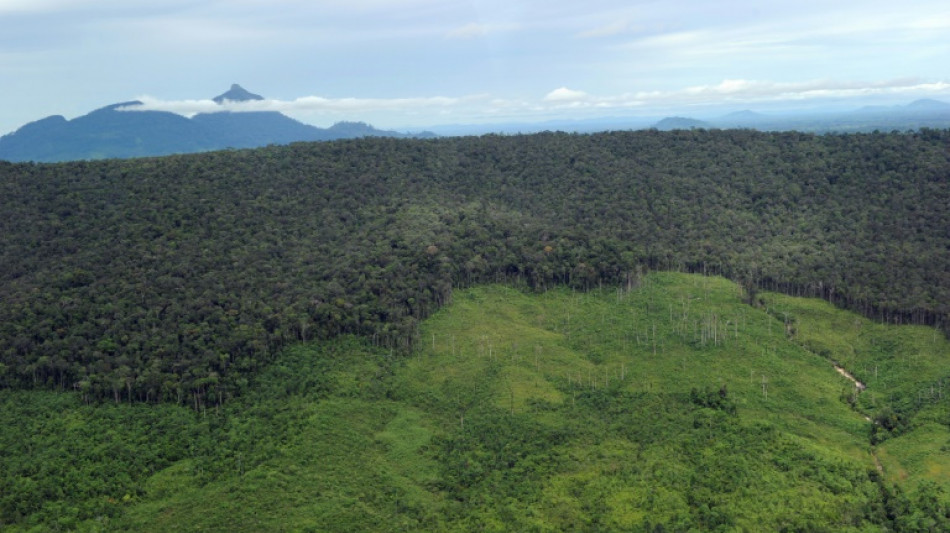
Logging, wildfires and farming are causing mountain forests, habitat to 85 percent of the world's birds, mammals and amphibians, to vanish at an alarming rate, according to a study published on Friday.
Mountain forests covered 1.1 billion hectares (2.71 billion acres) of the planet in 2000, the authors of the study published in the Cell Press journal One Earth said.
But at least 78.1 million hectares -- an area larger than the US state of Texas -- have been lost between 2000 and 2018, with recent losses 2.7-fold greater than at the beginning of the century.
Key drivers of the loss are commercial logging, wildfires, "slash-and-burn" cultivation and commodity agriculture, said the authors from China's Southern University of Science and Technology and the University of Leeds.
Of particular concern, they said, is that heavy forest losses have occurred in mountain areas that are "tropical biodiversity hotspots" -- refuges for rare and endangered species.
High elevations and steep slopes have historically restricted human exploitation of mountain forests, the authors said. But they have increasingly been targeted for timber and used for agriculture since the turn of the century.
Commercial forestry was responsible for 42 percent of mountain forest loss, followed by wildfires (29 percent), shifting cultivation (15 percent), and permanent or semi-permanent commodity agriculture (10 percent), the study said.
Shifting cultivation involves growing a crop on a plot of land for a few years and then abandoning it until it becomes fertile again.
"The drivers are different for different regions," said Zhenzhong Zeng, a co-author of the study, with wildfires the main cause of loss in boreal forests found in high latitudes.
"For boreal areas, it's caused by climate change, because there's an increase in temperature and a decrease in precipitation," Zeng told AFP.
"We have to reduce the use of fossil fuels to slow down global warming."
Commodity agriculture was a main driver of mountain forest loss in Southeast Asia, the authors said.
"People plant more rubber or palm farms to make more product," Zeng said. "People need to have more land to grow corn to feed their chickens."
Shifting cultivation is preeminent in tropical Africa and South America.
- 'Impact is huge' -
The authors said the greatest amount of forest loss observed during the study period using satellite data was in Asia -- 39.8 million hectares -- more than half the global total.
South America, Africa, Europe and Australia also all suffered significant losses.
"The mountain forest loss in the tropical areas is increasing very fast, much higher than other regions," Zeng said. "And the biodiversity is very rich there so the impact is huge."
"For tropical areas, we have to make people live with the forest, not cut the forest," he said.
Xinyue He, another co-author, said that regrowth has been observed in some areas but it does not always involve native species and is not keeping pace with forest loss.
She said there needed to be greater forest management including stricter enforcement of laws and regulations.
"Protecting areas can help to reduce the loss," she said.
F.Pavlenko--BTB