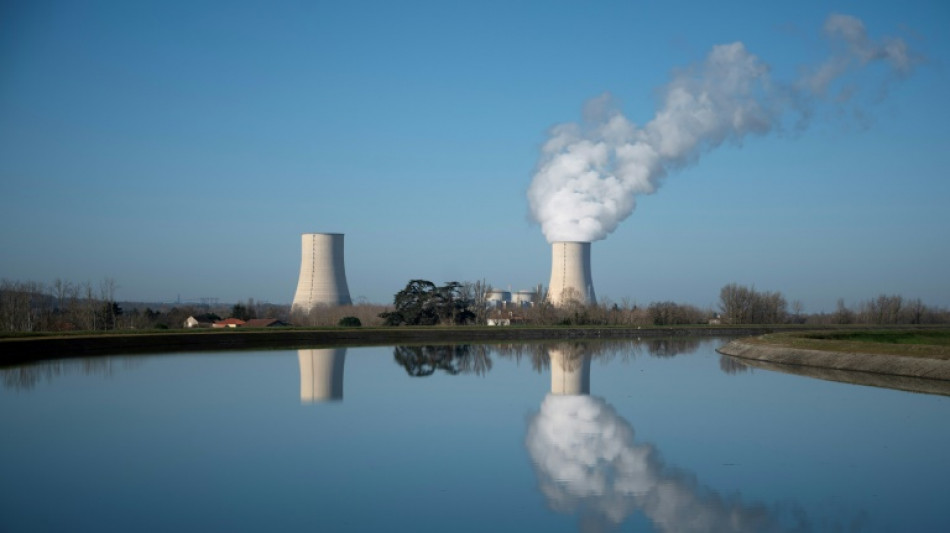
EU to unveil green tech plans to take on US, China / Photo: © AFP/File

 Hushing and hedging: US companies retreat on climate

 Springboks to face Fiji before 2027 Rugby World Cup
 Nigeria miners struggled to breathe in cell before 37 died: survivors

 McIlroy on the charge at PGA Championship as Reed withdraws
 McIlroy on the charge at PGA Championship
 Crisis-wracked Volkswagen warns of 10-bn-euro hit to profits
 Costa Rica's Grynspan tops third informal poll for UN chief: diplomat
 Stock markets retreat after central bank rate hikes

 Russia labels director of Cannes Grand Prix winner a 'foreign agent'

 Macron warns of Russian 'hybrid' threat after meeting presidential hopefuls
 UN holds third informal poll for new chief
 Kulusevski return can spark Spurs: De Zerbi

 Shakira to cap off world tour with Madrid 12-gig run
 Isolated Syrian-Druze city blames Damascus for shortages
 Isolated Syrian-Druze city shortages

 Dutch drop Depay for Germany match in Xavi's first pick

 Ronaldo named in Portugal squad for Nations League
 Stock markets diverge after central bank rate hikes
 Anti-Assad music star makes triumphant return to Syria
 In-form Fernandez included in Spain Nations League squad
 Arteta buries hatchet with Hurzeler ahead of Brighton clash
 Alexander-Arnold and Palmer return to England squad for Nations League
 Russians vote as Ukraine war drags on for fifth year
 Backpackers fret over Australian visa crackdown
 Most Asian stocks track Wall St rally, yen drops after BoJ rate hike
The EU will reveal hotly debated proposals on Thursday to boost spending on clean tech, possibly overcoming internal divisions to include nuclear energy in the mix, to confront growing industrial competition from the United States and China.
Brussels wants to protect European businesses by prioritising green technologies, including solar and wind, for more financing and greater regulatory freedom.
The European Commission, the EU's executive arm, will publish draft plans for a Net Zero Industry Act on Thursday to meet its ambitious target to become a "climate neutral" economy with zero greenhouse gas emissions by 2050.
The proposal was to be made public Tuesday, but a standoff in the commission over whether to include nuclear power, a low-carbon energy, delayed the announcement. Heated discussion was expected until the last minute.
Another landmark draft regulation will also be unveiled on Thursday that aims to secure supplies of critical raw materials needed to make the most of the electrical products consumers use today, including smartphones and electric vehicles.
Green technology production took on greater urgency after the United States unveiled a $370-billion "buy American" subsidy programme for tax credits and clean energy subsidies, known as the Inflation Reduction Act (IRA) last year.
European businesses have warned that lavish subsidies elsewhere alongside lower energy bills could tempt the continent's firms to Asia or North America, and EU officials have complained that the IRA will discriminate against Europe's industry.
- Matching subsidies -
The commission has toiled over a response to the IRA despite divisions in the 27-member bloc, with some countries arguing for looser subsidy rules to allow them to back their own firms with state aid, and others opposed over fears of triggering a subsidies war.
Last week, the commission loosened state aid rules for green technology and allowed members to match subsidies offered in other states.
The clean technology sector is expected to be worth 600 billion euros ($630 billion) worldwide by 2030, more than three times current levels.
Under draft proposals seen by AFP, the commission now wants at least 40 percent of green tech to be produced in the EU by 2030.
This will be achieved, the commission hopes, by ensuring businesses obtain permits faster and says public tenders would be considered based on green criteria that could favour European companies.
If nuclear is included as a green technology, that would be a victory for around a dozen countries including France, although there is stringent opposition from anti-nuclear Germany.
Some have questioned the bloc's "protectionist" objectives.
"The purpose of this law and how the draft was written is not to achieve faster decarbonisation, but it's basically to reshore production and that is a protectionist goal," said Niclas Poitiers, research fellow at the Brussels-based Bruegel think tank.
"This is about making sure that batteries and solar panels are produced in the EU."
Commission President Ursula von der Leyen, however, this week dismissed such claims and insisted the proposal was in fact "a very open act".
- 'Vulnerable' EU -
The EU also wants to meet the rapidly growing need for raw materials, much of which it currently imports from China, to avoid relying on one country for a specific product.
When Moscow invaded Ukraine last year, the EU was brought to its knees by higher energy costs as Brussels raced to find fossil fuels elsewhere instead of Russia.
"The EU's supply of raw materials is highly concentrated on a few countries... This makes us vulnerable to supply disruptions or aggressive actions," the bloc's internal market commissioner Thierry Breton said.
According to the leaked proposals, the EU wants the bloc to meet 10 percent of the demand for mining and extraction of raw materials.
It also says the EU should not rely on one single country for more than 70 percent of imports for any strategic raw material by 2030.
K.Brown--BTB



