
China's population shrinks for first time in over 60 years / Photo: © AFP

 Mancini brings nine newcomers into the first squad of his Italy comeback

 Czechs level Davis Cup tie against USA as South Korea eye Finals

 New France boss Zidane confirms Mbappe as captain after naming first squad

 California governor signs order to explore AI 'kill switch'

 Head leads run spree as Australia win Zimbabwe ODI series

 In-form Raphinha wants to finish career at Barcelona

 Warren Buffett steps down as Berkshire Hathaway chairman

 Carrick confident Man Utd can 'work through' tough time

 Mbappe ends Nike partnership to join Swiss brand On

 Liverpool boss Iraola puts Bournemouth love affair on hold

 'A disaster' if Man City do not win says Maresca after flawless start

 Kerry James Marshall: American 'blackness' painter celebrated in Europe

 Spain coach De la Fuente offers 'full support' to people of Ceuta

 Russia seizes assets of Nestle, French firms over West's Ukraine support

 England can build on World Cup 'spirit', says Tuchel

 UNESCO can be 'moderator' in AI debate: chief to AFP

 Infantino 'must go', says German FA vice-president

 Russia seizes assets of Nestle, French firms

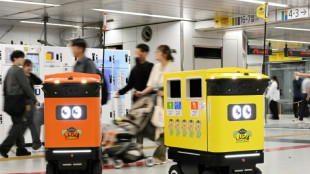 Japan's busiest rail station tests robot bins

 Anthropic says AI systems moving towards building themselves

 Asian stocks boosted by falling oil, yen weakens after BoJ rate hike

 Pakistan court blocks expulsion of Afghan medical college students

 Athletes 'can't take it any more' as Asian Games issues mount

 Allen lights up Bills' new stadium with 41-31 win over Lions

 Afghan medical students in Pakistan hope court stops college expulsions

China's population shrank last year for the first time in more than six decades, official data showed Tuesday, as the world's most populous country faces a looming demographic crisis.
The nation of 1.4 billion has seen birth rates plunge to record lows as its workforce ages, in a rapid decline that analysts warn could stymie economic growth and pile pressure on strained public coffers.
The mainland Chinese population stood at around 1,411,750,000 at the end of 2022, Beijing's National Bureau of Statistics (NBS) reported, a decrease of 850,000 from the end of the previous year.
The number of births was 9.56 million, the NBS said, while the number of deaths stood at 10.41 million.
The last time China's population declined was in the early 1960s, as the country battled the worst famine in its modern history, a result of the disastrous Mao Zedong agricultural policy known as the Great Leap Forward.
China ended its strict one-child policy -- imposed in the 1980s owing to fears of overpopulation -- in 2016 and began allowing couples to have three children in 2021.
But that has failed to reverse the demographic decline for a country that has long relied on its vast workforce as a driver of economic growth.
"The population will likely trend down from here in coming years," Zhiwei Zhang of Pinpoint Asset Management said.
"China cannot rely on the demographic dividend as a structural driver for economic growth," he added.
"Economic growth will have to depend more on productivity growth, which is driven by government policies."
- 'I will not be a mother' -
News of the population decline quickly trended on China's heavily censored internet, with some expressing fears for the country's future.
"Without children, the state and the nation have no future," one comment on the Twitter-like Weibo service read.
"Having children is also a social responsibility," another comment from a well-known "patriotic" influencer read.
But others pointed to the soaring cost of living and the difficulties of raising children in modern China.
"I love my mother, I will not be a mother," said one.
"No one reflects on why we do not want to have (children) and do not want to get married," another said.
Many local authorities have already launched measures to encourage couples to have children.
The southern megacity of Shenzhen, for example, now offers a birth bonus and pays allowances until the child is three years old.
A couple who has their first baby automatically receives 3,000 yuan ($444), an amount that rises to 10,000 yuan for their third.
In the country's east, the city of Jinan has since January 1 paid a monthly stipend of 600 yuan for couples that have a second child.
Chinese people are "getting used to the small family because of the decades-long one-child policy", Xiujian Peng, a researcher at Australia's University of Victoria, told AFP.
"The Chinese government has to find effective policies to encourage birth, otherwise, fertility will slip even lower," she added.
- 'A real concern' -
And analysts argue much more needs to be done.
"A comprehensive policy package that covers childbirth, parenting, and education is needed to reduce the cost of childraising," researcher Peng told AFP.
"Women's job insecurity after giving birth should be addressed particularly."
Independent demographer He Yafu also pointed to "the decline in the number of women of childbearing age, which fell by five million per year between 2016 and 2021" -- a consequence of the ageing of the population.
The Chinese population could decline each year by 1.1 percent on average, according to a study by the Shanghai Academy of Social Sciences updated last year and shared with AFP.
China could have only 587 million inhabitants in 2100, less than half of today, according to the most pessimistic projections of that team of demographers.
And India is set to dethrone China this year as the most populous country in the world, according to the United Nations.
"A declining and ageing population will be a real concern for China," Peng said.
"It will have a profound impact on China's economy from the present through to 2100."
L.Dubois--BTB