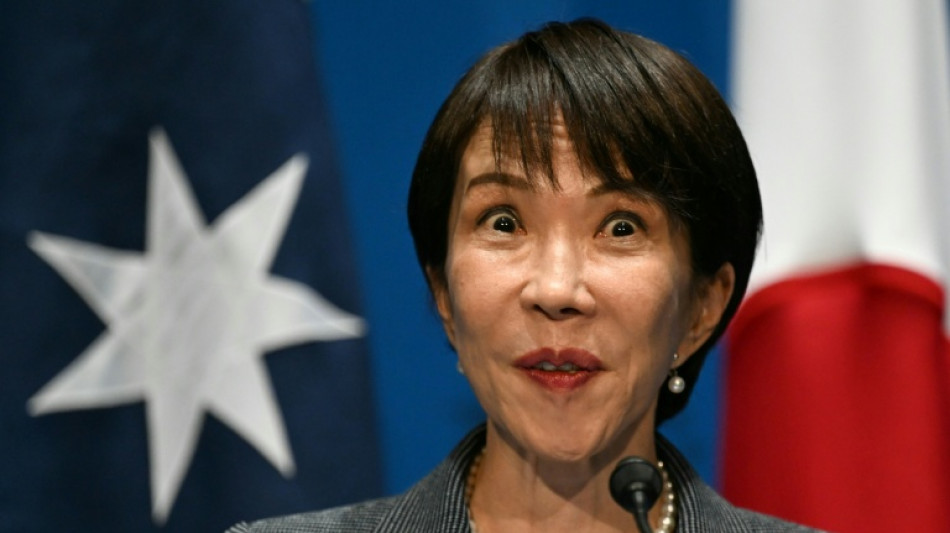
Japan PM says oil crisis has 'enormous impact' in Asia-Pacific / Photo: © AFP

 Losing start in AFCON qualifying for 78-year-old coach Le Roy
 Italy bans burqas in schools, caps numbers of foreign students per class

 Israel policies threaten 'life and existence' of Palestinians, Abbas says

 Paolini steers Italy past China in BJK

 Zidane admits emotion on eve of first game as France coach

 Breetzke and Maharaj sink Australia in first one-day international

 Zelensky broke confidentiality with North Korea POWs disclosure: South's president

 Former Liverpool star Carroll reveals he was sexually assaulted
 Dominican Republic calls for Haiti force to be strengthened

 Dolly Parton's nephew ordered to stay away from estate staff, properties

 Early exit for Philippine darling Eala at Singapore Open

 Hurricane Polo triggers huge waves in coastal Mexican city
 What happens if the US bans diesel exports

 Macklemore hits back with 'Free Palestine Tour' after Sheeran split

 Met Opera to give New Yorkers free tickets in affordability push

 Top ECB official to resign to take up IMF role

 Xi and Trump call for peace in lavish White House state visit

 Five up-and-coming players looking to make mark in Nations League

 CNN, MS NOW, Politico request court hearing after White House access denied
 Eviction of pensioner puts Spain housing crisis in spotlight
 CNN, MS NOW, Politico say reporters still barred from White House
 Udinese sign ex-Real Madrid defender Alaba on free transfer

 Trump welcomes Xi to Washington with lavish praise

 Kane relishing chance to become England's most-capped player

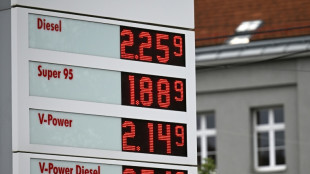 Average EU diesel price hits record 2.23 euros a litre: AFP analysis

A global oil supply squeeze is inflicting an "enormous impact" on the Asia-Pacific region, Japan Prime Minister Sanae Takaichi said Monday.
Speaking in Canberra after talks with Australian Prime Minister Anthony Albanese, she said the two countries would respond urgently to secure stable energy supplies.
Roughly one-fifth of the world's oil normally flows through the Strait of Hormuz, where shipping has been throttled by Iran since it was attacked by the United States and Israel.
Eighty percent of that oil is destined for Asia, according to the International Energy Agency.
"The effective closure of the Strait of Hormuz has been inflicting enormous impact on the Indo-Pacific," the Japanese leader told journalists.
"We affirmed that Japan and Australia will closely communicate with each other in responding with a sense of urgency."
The two countries aim to strengthen autonomy and resilience to secure stable supplies of energy, Takaichi said.
Australia is the biggest supplier of liquefied natural gas to Japan, which in turn is a source for about seven percent of Australia's diesel.
- 'Global shocks' -
The two countries issued a string of statements vowing to work together on energy, the economy, defence, and critical minerals.
"These agreements are to the benefit of both of our people," Albanese said.
"For Australians, it will mean we are less vulnerable to global shocks like we are seeing right now because of conflict in the Middle East."
Japan's government has said it is also keen to ensure a stable supply of critical minerals, essential for semiconductors, electric vehicle batteries and weapons systems.
Australia has touted its abundant critical minerals as a way to loosen China's grip over global supplies of rare earths.
Australia and Japan have strengthened their defence ties, too, striking a Aus$10 billion (US$6 billion) deal last year for Japan to to provide Mogami-class stealth warships to the Australian navy.
In a foreign policy address delivered in Vietnam at the weekend, Takaichi promised to do more to ensure a "free and open Indo-Pacific" -- a strategy that has rankled China.
Japan aimed to build its resilience, she said, notably strengthening its supply chains for energy and critical minerals, and enhancing security cooperation.
First articulated a decade ago by Takaichi's mentor Shinzo Abe, the idea of a "free and open" Indo-Pacific has since been embraced by multiple US partners and allies seeking to curb China's influence in the region.
P.Staeheli--VB