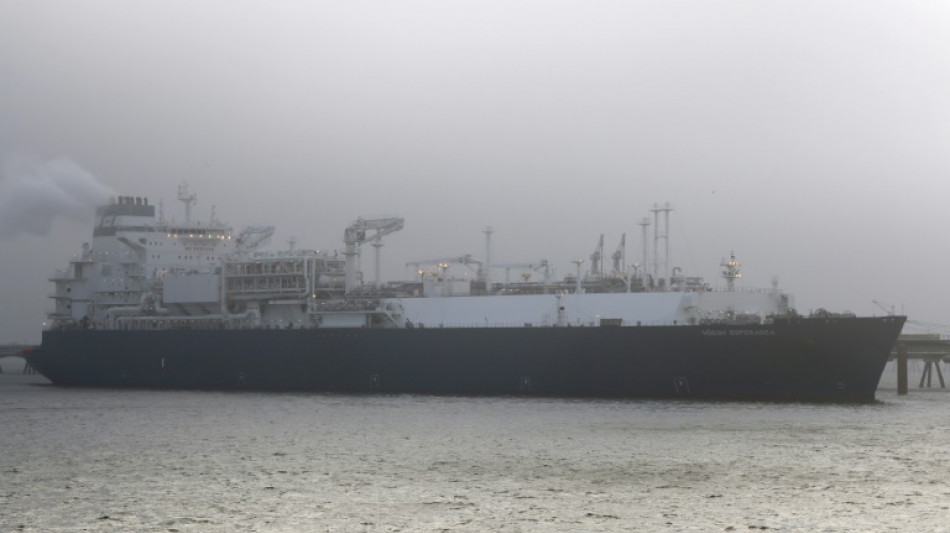
Germany cuts the ribbon on first LNG terminal / Photo: © AFP

 Stock markets retreat after central bank rate hikes

 Russia labels director of Cannes Grand Prix winner a 'foreign agent'

 Macron warns of Russian 'hybrid' threat after meeting presidential hopefuls
 UN holds third informal poll for new chief

 Kulusevski return can spark Spurs: De Zerbi

 Shakira to cap off world tour with Madrid 12-gig run

 Isolated Syrian-Druze city blames Damascus for shortages
 Isolated Syrian-Druze city shortages

 Dutch drop Depay for Germany match in Xavi's first pick

 Ronaldo named in Portugal squad for Nations League
 Stock markets diverge after central bank rate hikes

 Anti-Assad music star makes triumphant return to Syria

 In-form Fernandez included in Spain Nations League squad
 Arteta buries hatchet with Hurzeler ahead of Brighton clash
 Alexander-Arnold and Palmer return to England squad for Nations League
 Russians vote as Ukraine war drags on for fifth year
 Backpackers fret over Australian visa crackdown
 Most Asian stocks track Wall St rally, yen drops after BoJ rate hike
 Russians begin voting in controlled election as war drags on

 Trump 'clearly' wants dialogue with Pyongyang: South Korean President

 Bank of Japan hikes rates to 31-year high to battle inflation
 Thailand's Muslim separatists vow to fight to the end
 Mideast turmoil, AI set to dominate UN gathering of world leaders

 Australia to detain tourists who overstay visa, minister says

 Championship rivals brace for renewal of bitter feuds

Germany on Saturday inaugurated its first liquefied natural gas (LNG) terminal, built in record time, as the country scrambles to adapt to life without Russian energy.
The rig in the North Sea port of Wilhelmshaven was opened by Chancellor Olaf Scholz at a ceremony on board a specialist vessel known as an FSRU, named the Hoegh Esperanza.
"It's a good day for our country and a sign to the whole world that the German economy will be able to remain strong," Scholz said from the boat.
The Hoegh Esperanza sounded its horn as the chancellor, dressed in a high visibility jacket, approached.
The ship has already been stocked with gas from Nigeria that could supply 50,000 homes for a year, and the terminal is set to begin deliveries on December 22.
Germany plans to open four more government-funded LNG terminals over the next few months as well as a private terminal in the port of Lubmin.
Together, the terminals could deliver 30 billion cubic metres of gas a year from next year, or a third of Germany's total gas needs -- if Berlin can find enough LNG to service them.
LNG terminals allow for the import by sea of natural gas which has been chilled and turned into a liquid to make it easier to transport.
The FRSU stocks the LNG, then turns it back into a ready-to-use gas.
Until now, Germany had no LNG terminals and relied on cheap gas delivered through pipelines from Russia for 55 percent of its supply.
- Supply worries -
But since Russia's invasion of Ukraine, gas supplies to Germany have been throttled and Berlin has been forced to rely on LNG processed by Belgian, French and Dutch ports, paying a premium for transport costs.
The government decided to invest in building its own LNG terminals as quickly as possible and has spent billions of euros (dollars) on hiring FSRUs to service them.
However, Germany has not yet signed a single major long-term contract to begin filling the terminals from January.
"The import capacity is there. But what worries me are the deliveries," Johan Lilliestam, a researcher at the University of Potsdam, told AFP.
A contract has been signed with Qatar for LNG to supply the Wilhelmshaven terminal but deliveries are not set to begin until 2026.
Suppliers want long-term contracts, while the German government is not keen to be locked into multi-year gas deals as it wants the country to become climate-neutral by 2045.
"Companies need to know that the purchasing side in Germany will eventually diminish if we want to meet climate protection targets," economy minister Robert Habeck has said.
Environmental campaigners have criticised the LNG project, with the DUH association announcing it will take legal action. A handful of protestors turned out in Wilhelmshaven with placards demanding an "End to gas".
- Cold winter -
Germany could initially be forced to buy LNG from the expensive spot markets, which would lead to higher prices for consumers.
The market could also be squeezed next year by renewed demand in China as it emerges from strict Covid-19 curbs, Andreas Schroeder, an expert at the ICIS energy research institute, told AFP.
"If Europe has been able to receive so much LNG in recent months, it is because Chinese demand was low," Schroeder said.
China recently signed a deal to buy gas from Qatar for 27 years -- the longest such deal in history, according to Doha.
Germany has also had a cold winter so far, meaning the gas tanks have been emptying faster than expected.
"Gas consumption is increasing. This is a risk, especially if the cold spell continues," said Klaus Mueller, the head of the country's Federal Network Agency regulatory body, in a recent interview.
As a result, there is a real risk that Germany could experience temporary supply disruptions next winter, according to Schroeder.
Gas usage is currently down 13 percent compared to last year but the government wants that figure to be closer to 20 percent.
In Europe, the gap between supply and demand could reach 27 billion cubic metres (950 billion cubic feet) in 2023, according to an IEA report -- equivalent to 6.5 percent of the European Union's annual consumption.
M.Odermatt--BTB