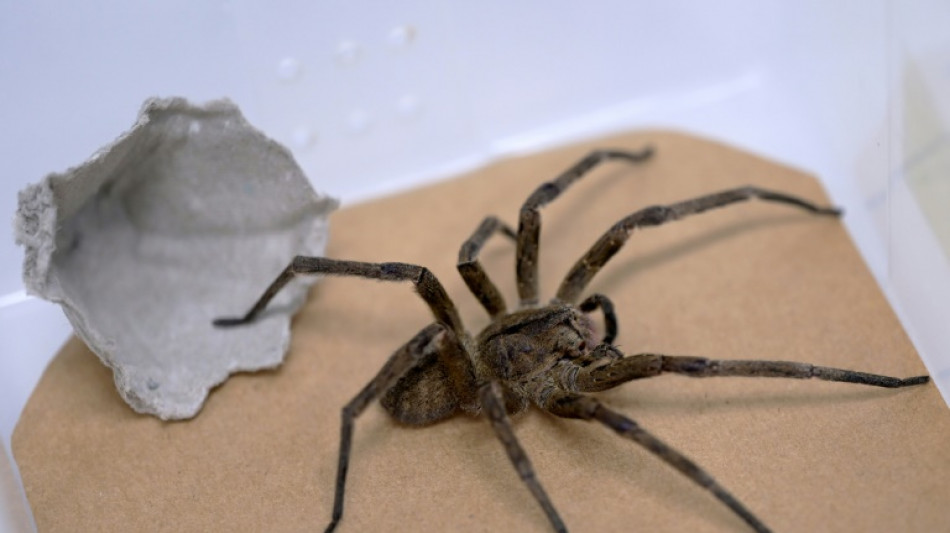
Brazil's banana spider aids erectile dysfunction treatment / Photo: © AFP

 Trump renames AI "super intelligence," rejects international oversight

 Trump rejects international regulation of AI

 How is the EU approaching record fuel prices?

 Sri Lanka's Colombage strikes on debut as England dismissed for 265 in first ODI

 Hurricane Polo strengthens to top category 5 off Mexico

 11 hurt as teen opens fire outside school in western Turkey

 UN chief says 'Big Oil' treats atmosphere as open sewer

 Tunisia says 2026 summer hottest on record

 England's Rashid out of Sri Lanka ODIs with hand injury

 Houthis accuse Saudi Arabia of deadly strikes as thousands flee

 Stocks climb as oil slides, AI buzz returns

 India cricketers win in style as Afghan savours 'special' Games silver

 La Liga president hits out at Real Madrid refereeing 'conspiracy' claims

 MEXC Launches “Real Stocks, Real Friends” with Rewards for Bringing Friends to Wall Street

 Mbappe continues media push for Ballon d'Or recognition

 Stocks rise on AI buzz, oil prices cool

 India narrowly survive huge scare against minnows Japan

 Missing F-35 fighter parts 'not sensitive', says Australia minister

 Cambodia showcases scams crackdown with global conference

 Afghan cyclist who disguised herself as man wins Asian Games silver

 Typhoon Dujuan leaves four dead in Japan, 45,000 houses without power

 G7 leaders condemn Houthi strikes on Saudi Arabia

 Google data centre sparks protests in Austria

 Shin Ohashi: Junk food-loving teen and Japan's next big swimming hope

 Stocks rise on AI buzz, drop in oil prices

Three decades ago, Brazilian researchers began studying a curious side effect from banana spider bites: the toxin left victims with priapism, a painful and persistent erection.
The scientists were inspired to develop a synthetic molecule using some properties of the spider's poison to create a gel to treat erectile dysfunction, which is now undergoing promising clinical trials.
Covered in thick brown hair, and with a maximum size of up to 15 centimeters (six inches), the arachnid is one of the most poisonous in the world.
It is found in several South American countries, and was nicknamed for its common presence in banana plantations, but it is also called the "wandering spider" or "armed spider."
In the southeastern Brazilian state of Minas Gerais, it is found in rural areas as well as urban centers.
At the Ezequiel Dias Foundation (FUNED), a medical research center in the state's capital Belo Horizonte, a biologist delicately grabs one of the spiders with a pair of tweezers and stimulates its fangs to get a few drops of venom.
FUNED then sends the venom to the Federal University of Minas Gerais (UFMG) which has been researching which component could be replicated to treat erectile dysfunction, which affects tens of millions of men around the world.
"The venom is only used to learn the properties of the molecule" which causes the priapism in bite victims, said Maria Elena de Lima, a UFMG researcher.
Brazilian biotech company Biozeus has bought the patent for the molecule.
The company wants to sell it in an ointment, which would be rubbed on the penis when required, resulting in an erection in a few minutes, said de Lima.
The molecule triggers the release of nitric oxide, which is essential for an erection as it increases blood circulation and allows blood vessels to widen.
De Lima said the research could be especially useful in the fight against cancer, as men suffering prostate cancer often refuse a procedure to remove the prostate because it can damage nerves and lead to erectile dysfunction.
After the first phase of clinical trials was approved by Brazil's Anvisa regulatory agency, the medication has now moved into the second of three phases prior to being approved for sale.
De Lima said the discovery of a potential erectile dysfunction treatment was a message "not to destroy animals, even poisonous ones, because there is a real library of molecules that are still unknown."
S.Spengler--VB