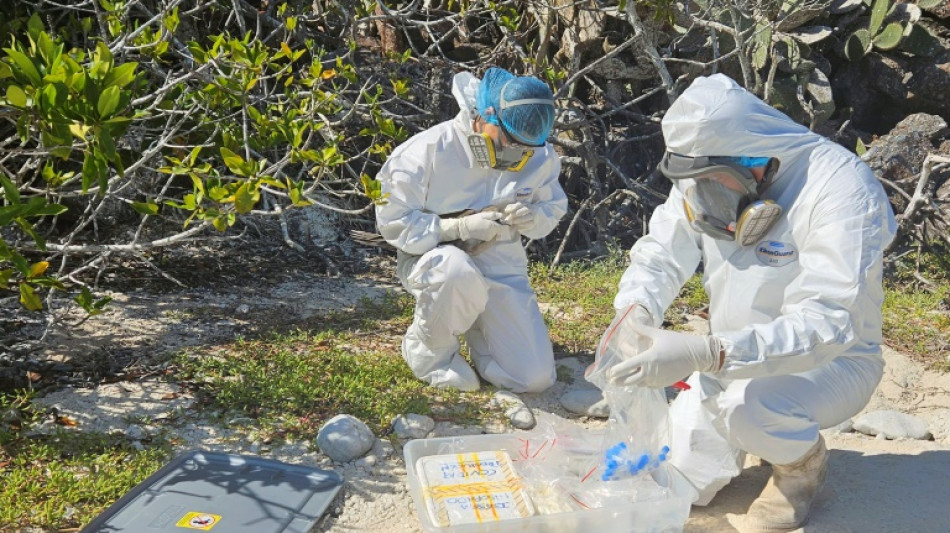
Avian flu hits bird paradise of Galapagos Islands / Photo: © PARQUE NACIONAL GALAPAGOS/AFP

 Carney Welcomes U.S. Trade Reversal After Democratic Midterm Victory

 Armenian FM Discusses EU Accountability for Palestinian Rights in Madrid

 Trump and Vance Pursue Secret Diplomacy with Iran Amid Military Pressure

 Classic Car Values Surge: De Tomaso Vallelunga Leads 190% Gain

 Microsoft Ends Oracle AI Computing Rental Deal Amid Cloud Strategy Shift

The Galapagos National Park said Tuesday that it had detected its first cases of avian flu on the remote islands, home to unique bird species that helped inspire the theory of evolution.
Three positive cases of the H5N1 virus were detected after reports of visibly sick birds on the islands, the park said in a statement.
The Galapagos archipelago is a bird-watchers paradise with scores of unique and colorful species, such as the blue-footed booby with its quirky mating rituals, and endemic penguins, cormorants and albatrosses.
English naturalist Charles Darwin developed his theory of evolution after studying finches and mockingbirds on the Galapagos islands in 1835.
The islands, 1,000 kilometers (621 miles) from Ecuador's coast, are home to "78 species of native and endemic birds," according to the environment ministry.
Ecuadoran authorities said in December they had put in place a monitoring system on the Galapagos as a global bird flu outbreak reached South America.
The H5N1 bird flu has typically been confined to seasonal outbreaks, but since 2021 cases have emerged year-round, and across the globe, leading to what experts say is the largest outbreak ever seen.
There is no treatment for bird flu, which spreads naturally between wild birds and can also infect domestic poultry.
Avian influenza viruses do not typically infect humans, although there have been rare cases, including that of a nine-year-old girl infected in Ecuador in January.
The outbreak has infected several mammal species, such as farmed minks, cats, and sea lions, and the World Health Organization warned in July this could help it adapt to infect humans more easily.
A.Ruegg--VB