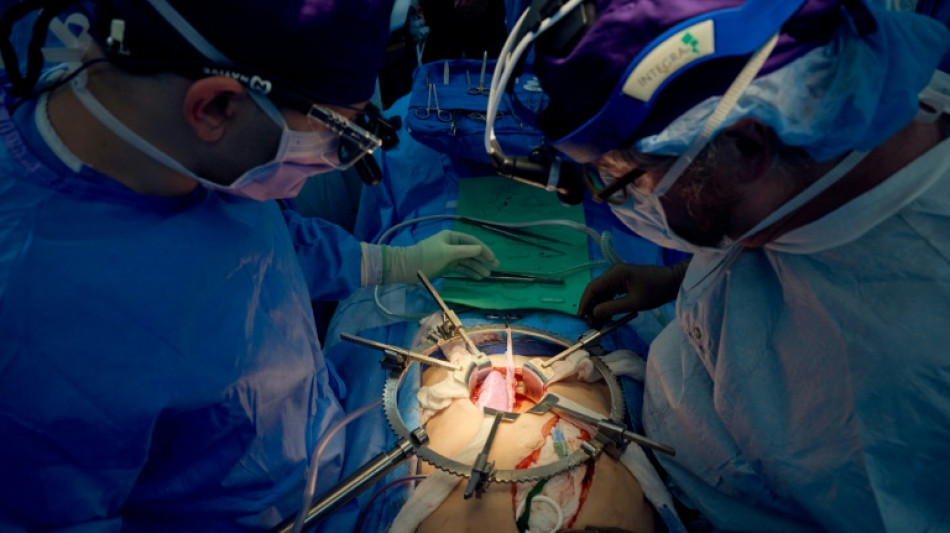
US surgeons report longest successful pig-to-human kidney transplant / Photo: © NYU Langone Health/AFP

 Trump renames AI "super intelligence," rejects international oversight

 Trump rejects international regulation of AI

 How is the EU approaching record fuel prices?

 Sri Lanka's Colombage strikes on debut as England dismissed for 265 in first ODI

 Hurricane Polo strengthens to top category 5 off Mexico

 11 hurt as teen opens fire outside school in western Turkey

 UN chief says 'Big Oil' treats atmosphere as open sewer

 Tunisia says 2026 summer hottest on record

 England's Rashid out of Sri Lanka ODIs with hand injury

 Houthis accuse Saudi Arabia of deadly strikes as thousands flee

 Stocks climb as oil slides, AI buzz returns

 India cricketers win in style as Afghan savours 'special' Games silver

 La Liga president hits out at Real Madrid refereeing 'conspiracy' claims

 MEXC Launches “Real Stocks, Real Friends” with Rewards for Bringing Friends to Wall Street

 Mbappe continues media push for Ballon d'Or recognition

 Stocks rise on AI buzz, oil prices cool

 India narrowly survive huge scare against minnows Japan

 Missing F-35 fighter parts 'not sensitive', says Australia minister

 Cambodia showcases scams crackdown with global conference

 Afghan cyclist who disguised herself as man wins Asian Games silver

 Typhoon Dujuan leaves four dead in Japan, 45,000 houses without power

 G7 leaders condemn Houthi strikes on Saudi Arabia

 Google data centre sparks protests in Austria

 Shin Ohashi: Junk food-loving teen and Japan's next big swimming hope

 Stocks rise on AI buzz, drop in oil prices

US surgeons who transplanted a genetically modified pig kidney into a brain-dead patient announced Thursday they had ended their experiment after a record-breaking 61 days.
The latest experimental procedure is part of a growing field of research aimed at advancing cross-species transplants, mainly testing the technique on bodies that have been donated for science.
There are more than 103,000 people waiting for organ transplants in the United States, 88,000 of whom need kidneys.
"We have learned a great deal throughout these past two months of close observation and analysis, and there is great reason to be hopeful for the future," said Robert Montgomery, director of the New York University Langone Transplant Institute, who led the surgery in July.
It was the the fifth so-called xenotransplant performed by Montgomery, who also carried out the world's first genetically modified pig kidney transplant in September 2021.
Tissue collected during the study indicated a mild rejection process had begun, requiring intensification of immunosuppression medication.
By "knocking out" the gene responsible for a biomolecule called alpha-gal -- a prime target for roving human antibodies -- the NYU Langone team were able to stop immediate rejection.
The donor pig in this experiment came from a herd cultivated by Virginia-based biotech company Revivicor.
The herd has also been approved by the Food and Drug Administration as a source of meat for people with hypersensitivity to the alpha-gal molecule, an allergy caused by some tick bites.
These pigs are bred, not cloned, meaning the process can be more easily scaled.
Early xenotransplantation research focused on harvesting organs from primates -- for example, a baboon heart was transplanted into a newborn known as "Baby Fae" in 1984, but she survived only 20 days.
Current efforts focus on pigs, which are thought to be ideal donors for humans because of their organ size, their rapid growth and large litters, and the fact they are already raised as a food source.
In January 2022, surgeons at the University of Maryland Medical School carried out the world's first pig-to-human transplant on a living patient -- this time involving a heart.
He died two months after the milestone, with the presence of porcine cytomegalovirus in the organ later blamed.
Last week, Chinese scientists published a paper showing they had succeeded in hybrid pig-human kidneys in pig embryos, an alternative approach that also has the potential to one day help address organ donation shortages.
But the development raised ethical issues -- especially since some human cells were also found in the pigs' brains, experts said.
A.Ruegg--VB