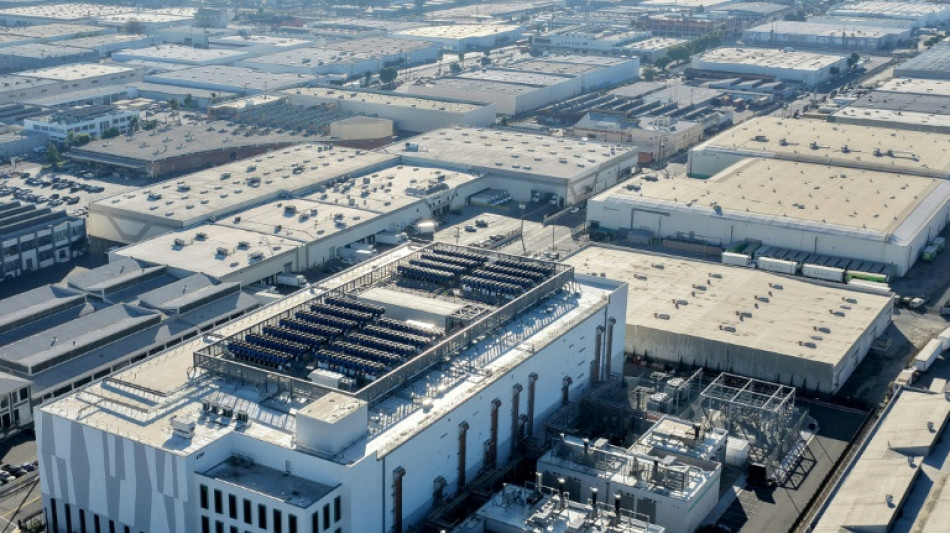
Eyes turn to space to feed power-hungry data centers / Photo: © GETTY IMAGES NORTH AMERICA/AFP/File

 Swiss vote on what it means to be neutral

 Pope to meet with victims of clerical sex abuse during France trip

 Iran stands firm on Hormuz plan after US rejection

 Madrid protest camp grows after eviction outrage

 Italy winemakers hail bumper harvest but cut output

 Kyiv shoppers feel the pinch from Russian strikes
 Japanese anime actor fights TikTok over AI voice cloning

 Curtain falls on the romance of India's single-screen cinemas

 Smells like teen spirit as US thrash Peru 4-1

 Cavy chaos: Hundreds attend New Zealand's biggest guinea pig show

 Venezuela releases more political prisoners after opposition talks

 England's best 'for a long time' despite Spain defeat, says Kane

 Powerful storm pummels northeast US with rain, high winds

 Filmmaker Mike Leigh wins top prize at Spain festival with 'last film'

 Spain beat England in Nations League to extend unbeaten run

 Ireland squad vote to play Israel tie despite Gaza unease

 Gutsy Vollering wins cycling road race world title

 Vollering wins cycling road race world title

 Man City's meteoric rise clouded by dark shadow

 Mbappe out for two weeks or more with knee injury say Real

 Lyon collapse away to Stade and suffer first Top 14 loss

 Russia accuses Europe of seeking to thwart Ukraine talks

 Man City chairman defiant over reported Premier League charges

 Germany ready to 'walk through fire' for Klopp, says Tah

 At least 16 killed in Russian and Ukrainian strikes

Tech firms are floating the idea of building data centers in space and tapping into the sun's energy to meet out-of-this-world power demands in a fierce artificial intelligence race.
US startup Starcloud this week sent a refrigerator-sized satellite containing an Nvidia graphics processing unit (GPU) into orbit in what the AI chip maker touted as a "cosmic debut" for the mini-data center.
"The idea is that it will soon make much more sense to build data centers in space than it does to build them on Earth," Starcloud chief executive Philip Johnston said at a recent tech conference in Riyadh.
Along with a constant supply of solar energy, data centers are easier to cool in space, advocates note.
Announcements have come thick and fast, the latest being Google this week unveiling plans to launch test satellites by early 2027 as part of its Suncatcher project.
That news came just days after tech billionaire Elon Musk claimed his SpaceX startup should be capable of deploying data centers in orbit next year thanks to its Starlink satellite program.
Starcloud's satellite was taken into space by a SpaceX rocket on Sunday.
- Junk and radiation -
Current projects to put data centers into orbit envision relying on clusters of low Earth orbit satellites positioned close enough together to ensure reliable wireless connectivity.
Lasers will connect space computers to terrestrial systems.
"From a proof concept, it's already there," University of Arizona engineering professor Krishna Muralidharan, who is involved with such work, said of the technology.
Muralidharan believes space data centers could be commercially viable in about a decade.
Amazon founder Jeff Bezos, the tech titan behind private space exploration company Blue Origin, has estimated it might take up to twice that long.
Critical technical aspects of such operations need to be resolved, particularly harm done to GPUs by high levels of radiation and extreme temperatures as well as the danger of being hit by space junk.
"Engineering work will be necessary," said University of Michigan assistant professor of engineering Christopher Limbach, contending that it is a matter of cost rather than technical feasibility.
- Sun synched -
The big draw of space for data centers is power supply, with the option of synchronizing satellites to the sun's orbit to ensure constant light on solar panels.
Tech titans building AI data centers have ever-growing need for electricity, and have even taken to investing in nuclear power plants.
Data centers in space also avoid the challenges of acquiring land and meeting local regulations or community resistance to projects.
And advocates argue that data centers operating in space are less harmful overall to the environment, aside from the pollution generated by rocket launches.
Water needed to cool a space data center would be about the same amount used by a space station, relying on exhaust radiators and re-using a relatively small amount of liquid.
"The real question is whether the idea is economically viable," said Limbach.
An obstacle to deploying servers in space has been the cost of getting them into orbit.
But a reusable SpaceX mega-rocket called Starship with massive payload potential promises to slash launch expenses by at least 30 times.
"Historically, high launch costs have been a primary barrier to large-scale space-based systems," Suncatcher project head Travis Beals said in a post.
But project launch pricing data suggests prices may fall by the mid-2030s to the point at which "operating a space-based data center could become comparable" to having it on Earth, Beals added.
"If there ever was a time to chart new economic paths in space -- or re-invent old ones -- it is now," Limbach said.
R.Kloeti--VB