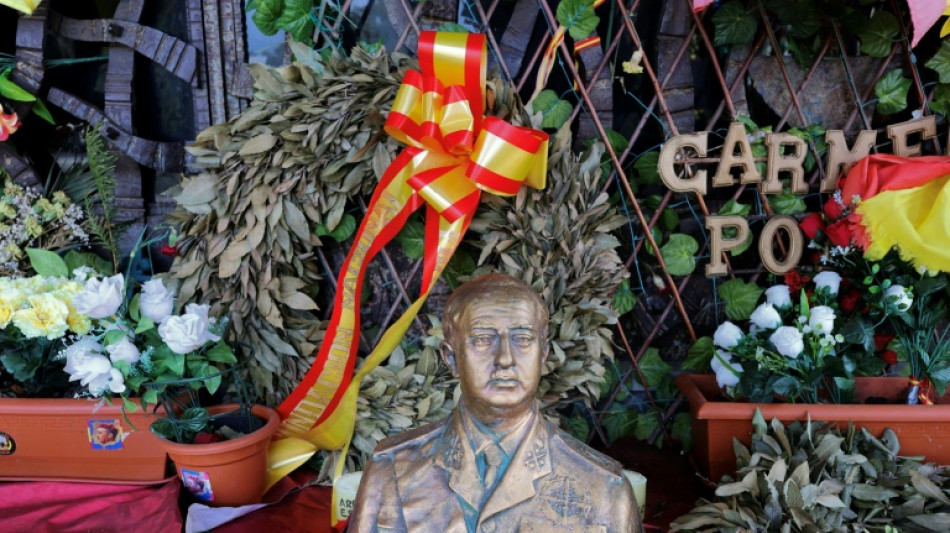
Franco captivates young Spaniards 50 years after death / Photo: © AFP

 Colombian judge bans strikes on guerrillas if minors are present

 Khachanov shocks ailing Auger-Aliassime, Swiatek and Osaka advance at US Open

 Lone juror blocking verdict in US mother's child murder trial: defense

 'Kinda chic' - Williams sisters set to launch US Open doubles bid

 Volkswagen says cutting 100,000 jobs by end of decade

 Russia slaps curfew on charity director over army criticism

 Ailing Auger-Aliassime upset by Khachanov at US Open

 Richarlison omitted from Tottenham's Premier League squad

 How El Nino is choking the Panama Canal

 Hamilton drives his Ferrari dream at Monza

 Senegal has an IMF loan, now what?

 Auger-Aliassime upset by Khachanov at US Open
 Hugging Face, the French start-up that became AI's warehouse

 World Cup winner Llorente retires from Spain team at 31

 Osaka squeezes into US Open third round

 Apple faces £2 bn lawsuit in UK over app privacy feature

 Former champ Swiatek eases into US Open third round

 DR Congo latest to promise moving Israel embassy to Jerusalem

 War criminal Mladic's body returns to Serbia with military honours

 Pierre Cardin museum brings designer's futurist style to Venice

 Slovenian rookie Omrzel triumphs as Mas extends Vuelta lead

 British, French leaders talk migrants, EU relations

 Heading for Ferrari's home race, Leclerc still dreams of world title

 Cafe at centre of Israel culture clash agrees to shut on Sabbath

 Spacecraft bound for Mercury begins 'tricky' arrival

Spanish youth are increasingly seduced by General Francisco Franco 50 years after the dictator's death, often unaware of his harsh rule and influenced by propaganda permeating social media, experts say.
"Life was better under Franco" has become a trope on social media, hooking a frustrated generation that has received little education on the dictatorship and is receptive to anti-system politics.
After overthrowing a democratic republic in a 1936-1939 civil war that killed hundreds of thousands of people, Franco ruled Spain with an iron fist until his death in 1975.
But Cristina Luz Garcia, who teaches history at a Madrid school, said she has seen some of her students repeat "myths" and "phrases that are closely tied to the regime itself and Francoist propaganda".
Those pupils do not have "very deep knowledge of the person" or of "the negative consequences" of 36 years marked by torture and the denial of freedoms, she told AFP.
The pro-Franco narrative is, for some students, "a way to defy the teachers or appear to have a different opinion... which is something very attractive about adolescence itself", she added.
Constructing reservoirs, ensuring economic prosperity and creating social security are some of the feats -- real or exaggerated -- attributed to Franco as a way to weave an alternative narrative of his fascist-backed regime.
According to an October survey by national polling institute CIS, more than one-fifth of Spaniards thought the dictatorship was "good" or "very good", with 65.5 percent describing it as "bad" or "very bad".
A separate poll that month by conservative daily El Mundo found that the ruling Socialists had ceased to be the most popular party among the 18-29 age group.
The main conservative opposition Popular Party had overtaken them, while the formation that increased its support most among Spain's youngest voters was the far-right Vox.
Both parties oppose the leftist government's measures to revisit Spain's Francoist past, including an official programme of events this year marking the 50th anniversary of the dictator's death.
- 'Education deficit' -
The young "are incredibly frustrated" by precarious working conditions and unaffordable housing, said Veronica Diaz, coordinator of a master's degree in social problems at the National University of Distance Learning.
"They believe traditional political parties not only fail to solve their problems, but are part of them," Diaz told AFP, explaining the attraction of the far-right's "anti-system" discourse.
"The deficit in history education" at school and the proliferation of "content creators who reinterpret history" are leading young people who lack "enough critical tools" to "confuse those narratives with legitimate versions of history", said Diaz.
In the southern town of Iznalloz, fellow history teacher Jose Maria Garcia is trying to fill the knowledge gaps.
In 2020, he started to develop activities aimed at teaching his pupils "what Francoism really was", highlighting its "method of repression".
The project seeks to provide students with "material so that they are able to defend a discourse" different from what they encounter on social media.
- Raising awareness -
His students Hugo Guindos, 15, and Erika Hurtado, 16, say they see "more and more" praise for Franco among their peers.
TikTok influencers "speak without arguments, and the people who do not have arguments either and listen to them, believe it", Hurtado told AFP.
Both pupils were previously unaware of the repression in their own region, where "there are a huge number of mass graves," said Guindos, surprised by the regime's frequent use of torture.
He believes the project is important "to raise awareness among the current generation" about the past, "now that Francoism is gaining strength".
Hurtado agreed that Franco had been misrepresented: "It was not as good a period as they say."
G.Frei--VB