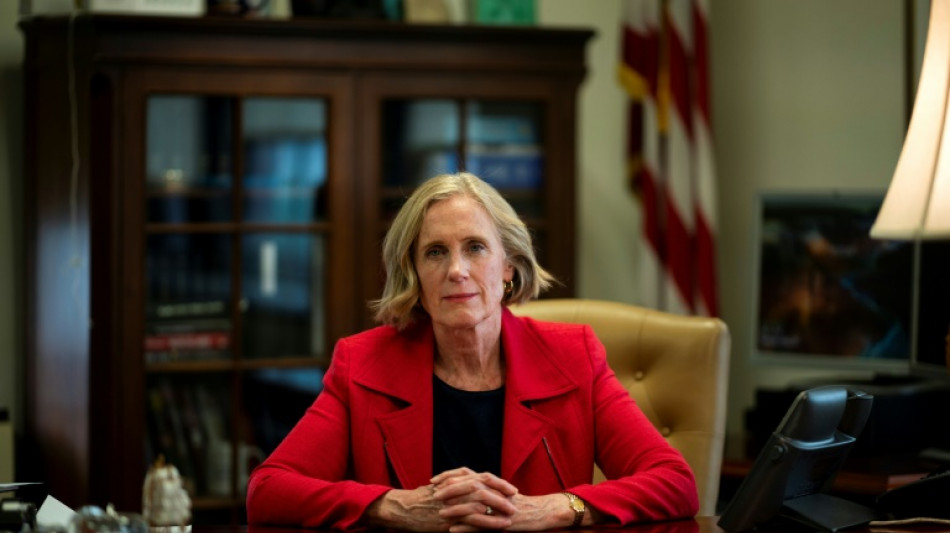
Fentanyl pill surge worries New York drug prosecutor / Photo: © AFP

 Trump renames AI "super intelligence," rejects international oversight

 Trump rejects international regulation of AI

 How is the EU approaching record fuel prices?

 Sri Lanka's Colombage strikes on debut as England dismissed for 265 in first ODI

 Hurricane Polo strengthens to top category 5 off Mexico

 11 hurt as teen opens fire outside school in western Turkey

 UN chief says 'Big Oil' treats atmosphere as open sewer

 Tunisia says 2026 summer hottest on record

 England's Rashid out of Sri Lanka ODIs with hand injury

 Houthis accuse Saudi Arabia of deadly strikes as thousands flee

 Stocks climb as oil slides, AI buzz returns

 India cricketers win in style as Afghan savours 'special' Games silver

 La Liga president hits out at Real Madrid refereeing 'conspiracy' claims

 MEXC Launches “Real Stocks, Real Friends” with Rewards for Bringing Friends to Wall Street

 Mbappe continues media push for Ballon d'Or recognition

 Stocks rise on AI buzz, oil prices cool

 India narrowly survive huge scare against minnows Japan

 Missing F-35 fighter parts 'not sensitive', says Australia minister

 Cambodia showcases scams crackdown with global conference

 Afghan cyclist who disguised herself as man wins Asian Games silver

 Typhoon Dujuan leaves four dead in Japan, 45,000 houses without power

 G7 leaders condemn Houthi strikes on Saudi Arabia

 Google data centre sparks protests in Austria

 Shin Ohashi: Junk food-loving teen and Japan's next big swimming hope

 Stocks rise on AI buzz, drop in oil prices

As America's illegal drug market continues to expand, from heroin and fentanyl to the "zombie drug" known as tranq, AFP spoke with New York's special narcotics prosecutor Bridget Brennan.
Here are her responses:
- Q: What developments are you seeing in fentanyl trafficking? -
"Fentanyl itself has had different variations called analogs. What we've seen most recently is some deadly combinations. Xylazine is now being mixed with fentanyl. And xylazine is not an opioid, it's a sedative. It's an animal tranquilizer. And it works on the body differently. And that combination of xylazine and fentanyl is proving to be not only deadly, but it is very destructive.
"Now what we're seeing is fentanyl pressed into pills, often in Mexico, and sometimes in the US. What we have seen is a real explosion in the number of pills that we've seized. Last year, here in New York City, my office alone seized almost a million fentanyl pills (up 425 percent from 2021). And it continues to expand."
- Q: How are the pills dispersed? -
"The pills are distributed through social media, through websites. They may have the markings of a Xanax prescription, oxycodone prescription, (Attention Deficit Disorder drug) Adderall -- another prescription which incidentally has been in short supply in the US.
"That's one way the criminal organizations look to expand their market. That concerns me quite a bit, because those people who might be buying through social media, through the websites may be far more naive than the people who are buying on the street. And they also may have no tolerance for fentanyl."
"They actually may think that they're buying Adderall but they're really getting fentanyl. And if they have no tolerance whatsoever, it certainly could be fatal."
- Q: What is being done to combat the threat?
"The best thing we can do is take as much supply off the market as possible. The other very important thing is to try to shut down the supply of money that's going back to Mexico, and now going back to China.
"There are many ways to attack the problem, but the most important thing is the one thing we can control somewhat in the US. And that is to decrease the demand for the drugs, decrease the number of people who want to use the drugs, and treat those people who are suffering from addictions to the drugs.
"The other thing that I would like to see is an effective prevention program. Messaging, honest messaging that explains what these drugs are, explains the consequences of using them in simple words, and not trying to terrify people but trying to educate people and especially children.
"Often, abuse of drugs starts when people are quite young. And if you can educate them as we've done with cigarettes, if we can use those same kinds of tools and educate them, then ultimately we'll see the demand diminish."
- Q: Is there anything hampering the fight? -
"The trend that worries me the most is that we seem to be unable to work effectively with Mexico to control the production and distribution of the drugs. We need a more effective strategy to work with the Mexican government.
"The other problem is the more we buy drugs the more we empower the cartels, which corrupt the government there, and really harm the lives of the Mexican people. And so it's just a circular problem.
"The other thing is how to break our cycle here. We'd like to lay all the blame on Mexico but we're the ones using the drugs. And we need to break that cycle.
"The US has decreased the number of treatment programs. You don't see many very straightforward, clear, well done prevention campaigns in the US either anymore. So we're not focusing on all the aspects of this problem."
K.Brown--BTB