'Not based on science': US confronts abortion 'reversal' myths / Photo: © AFP

 Hurricane Polo strengthens to top category 5 off Mexico

 11 hurt as teen opens fire outside school in western Turkey

 UN chief says 'Big Oil' treats atmosphere as open sewer

 Tunisia says 2026 summer hottest on record

 England's Rashid out of Sri Lanka ODIs with hand injury

 Houthis accuse Saudi Arabia of deadly strikes as thousands flee

 Stocks climb as oil slides, AI buzz returns

 India cricketers win in style as Afghan savours 'special' Games silver

 La Liga president hits out at Real Madrid refereeing 'conspiracy' claims

 MEXC Launches “Real Stocks, Real Friends” with Rewards for Bringing Friends to Wall Street

 Mbappe continues media push for Ballon d'Or recognition

 Stocks rise on AI buzz, oil prices cool

 India narrowly survive huge scare against minnows Japan

 Missing F-35 fighter parts 'not sensitive', says Australia minister
 Cambodia showcases scams crackdown with global conference

 Afghan cyclist who disguised herself as man wins Asian Games silver

 Typhoon Dujuan leaves four dead in Japan, 45,000 houses without power

 G7 leaders condemn Houthi strikes on Saudi Arabia

 Google data centre sparks protests in Austria

 Shin Ohashi: Junk food-loving teen and Japan's next big swimming hope

 Stocks rise on AI buzz, drop in oil prices

 China's robot dancers limber up for America's Got Talent final

 Despite military might, Saudi struggles to crush the Houthis

 Trump to tout deals, defend Iran war in UN speech

 Sri Lanka to issue verdict in landmark Easter attack trial

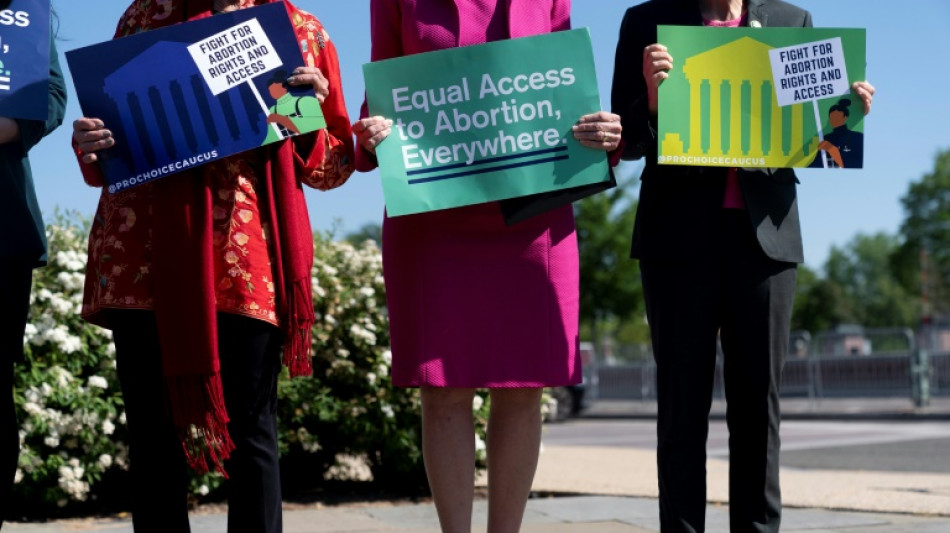
Wracked by guilt after taking an abortion pill, a sobbing woman calls a US hotline. It recommends a "reversal" treatment to save the fetus -- despite medical warnings that it is potentially life-threatening.
Misinformation about medical termination appears to have skyrocketed since last June, when the Supreme Court overturned the landmark 1973 Roe v. Wade decision that guaranteed a constitutional right to abortion.
That includes false "pro-life" posts on social media claiming abortion pills cause cancer and infertility -- as well as "pro-choice" content promoting dubious herbal treatments to terminate a pregnancy.
More striking, researchers say, is a wave of misleading content that promotes an unscientific treatment that promises to undo the effects of the first pill, mifepristone, in the two-drug regimen for medical abortion.
Anti-abortion advocates in the United States have heralded the so-called "reversal" treatment -- which involves taking the hormone progesterone -- for women who change their minds after taking mifepristone.
"Abortion pill reversal can help turn back the clock," reads the website for the Abortion Pill Rescue Network (APRN), a pro-life outfit that supports the treatment.
"When destructive voices would only say 'it is done,' abortion pill reversal says 'here is a second chance at life, just in time.'"
APRN's website lists anecdotal "success stories" -- emotional testimonies from women who opted for the treatment. Some, including a single mother identified as Shashana, broke down after taking the first pill, consumed with regret.
She reached out to APRN's hotline that got her started on the "reversal" procedure that her written testimony says saved her fetus.
What is not mentioned is the warning from the American College of Obstetrics and Gynecologists (ACOG), an association of reproductive health specialists, that calls the treatment "unproven," "unethical" and "not based on science."
Also omitted is a 2019 medical trial by researchers from the University of California, Davis, to test the effectiveness of the "reversal" treatment. The trial had to be stopped prematurely after some participants experienced severe internal bleeding.
- 'Potential to harm' -
"The anecdotal 'success stories' often fail to acknowledge that there is no reputable medical evidence that taking progesterone to reverse the effects of mifepristone increases the likelihood of a pregnancy continuing," Anicka Slachta, a senior analyst at the watchdog NewsGuard, told AFP.
"Ultimately, omitting that context and presenting abortion pill 'reversal' as definitively safe and effective has the potential to cause harm."
When AFP requested APRN provide supporting data and interviews with the women cited under the "success stories," a publicist for Heartbeat International, an anti-abortion group that backs the network, replied.
She inquired what AFP's article intended to highlight but stopped responding thereafter.
When a US health misinformation researcher reached APRN's hotline posing as a pregnant woman, she was told the network had successfully saved 4,000 babies through the "reversal" treatment.
The hotline operator did not reveal the number of unsuccessful cases but mentioned a success rate of 64-68 percent, a statistic also cited on the network's website.
When the researcher -- who shared the audio recording with AFP -- pointed out that ACOG did not consider the treatment as safe, the operator dismissed the organization as "very pro-abortion," a stance that makes them "biased."
The operator said a prayer that she "make the right decision" -– that is, not carry out the abortion.
- 'Bodily autonomy' -
"What was clear in the call is that this group cares more about the life of the baby than the mother, point blank," the researcher told AFP, requesting anonymity for fear of online harassment.
"That was evident in the way they referred to the fetus but also through the omission of any real data about the risks."
In a report last week, the Center for Countering Digital Hate (CCDH) said thousands of "fake clinics" across the United States -- which seek to prevent "abortion-determined" people from accessing care -- collectively spent $10.2 million on Google search ads over the past two years.
Many of them, it said, promoted the "potentially dangerous" reversal procedure.
Research by the technology nonprofit Meedan Digital Health Lab shows that in the months after Roe v. Wade was overturned, online conversations about pill "reversals" were among three topics associated with abortion misinformation that saw a dramatic surge.
"It's not the idea of someone changing their mind on their own about having an abortion that's dangerous," Jenna Sherman, a program manager at the nonprofit, told AFP.
"It's pushing an unverified and potentially life-threatening intervention in an effort to be anti-abortion first and foremost over everything, rather than support people's bodily autonomy."
K.Brown--BTB