Rubbing vaginal fluid on C-section babies boosts development: study / Photo: © AFP/File

 Hurricane Polo strengthens to top category 5 off Mexico

 11 hurt as teen opens fire outside school in western Turkey

 UN chief says 'Big Oil' treats atmosphere as open sewer

 Tunisia says 2026 summer hottest on record

 England's Rashid out of Sri Lanka ODIs with hand injury

 Houthis accuse Saudi Arabia of deadly strikes as thousands flee

 Stocks climb as oil slides, AI buzz returns

 India cricketers win in style as Afghan savours 'special' Games silver

 La Liga president hits out at Real Madrid refereeing 'conspiracy' claims

 MEXC Launches “Real Stocks, Real Friends” with Rewards for Bringing Friends to Wall Street

 Mbappe continues media push for Ballon d'Or recognition

 Stocks rise on AI buzz, oil prices cool

 India narrowly survive huge scare against minnows Japan

 Missing F-35 fighter parts 'not sensitive', says Australia minister
 Cambodia showcases scams crackdown with global conference

 Afghan cyclist who disguised herself as man wins Asian Games silver

 Typhoon Dujuan leaves four dead in Japan, 45,000 houses without power

 G7 leaders condemn Houthi strikes on Saudi Arabia

 Google data centre sparks protests in Austria

 Shin Ohashi: Junk food-loving teen and Japan's next big swimming hope

 Stocks rise on AI buzz, drop in oil prices

 China's robot dancers limber up for America's Got Talent final

 Despite military might, Saudi struggles to crush the Houthis

 Trump to tout deals, defend Iran war in UN speech

 Sri Lanka to issue verdict in landmark Easter attack trial

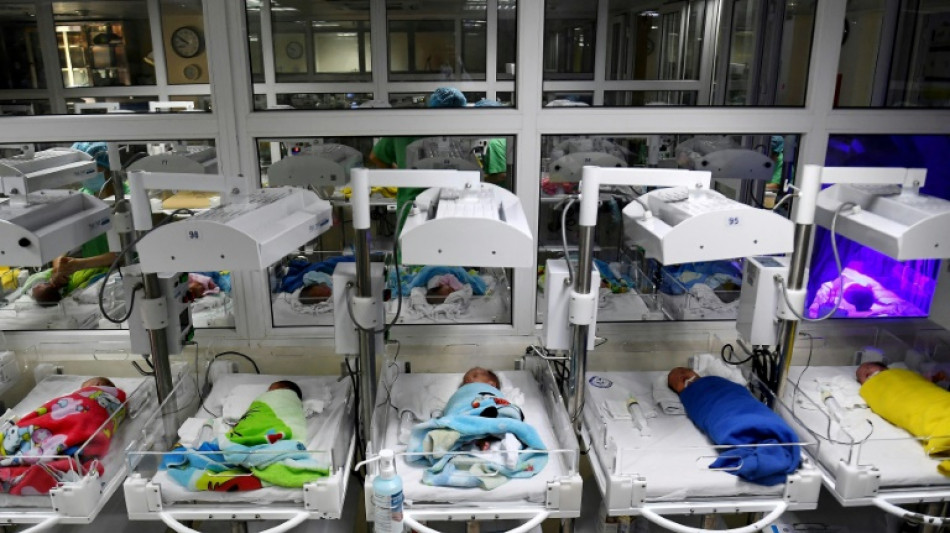
Babies born by cesarean section don't acquire the same healthy bacteria as those delivered vaginally, a setback to the development of their immune system thought to increase their risk of certain diseases later in life.
But a new study, published Thursday in the journal Cell Host & Microbe, finds that exposing C-section babies to their mother's vaginal fluids after birth successfully restores this microbial balance, and has neurodevelopment benefits, too.
The study used rigorous methods but was small, involving just 68 infants.
Coauthor Jose Clemente of the Icahn School of Medicine at Mount Sinai told AFP that if the findings are confirmed in bigger clinical trials, the technique could be used as a low-cost way to ensure C-section newborns start life on the same footing as vaginally delivered infants.
"If the results can be generalizable to a larger population, then ideally we would like to see that this becomes a part of standard of care," he said.
It comes as C-section rates are on the rise globally, now accounting for around one in every three births in the United States, though the World Health Organization estimates only 10-15 percent are medically necessary.
Past research has shown infants born by C-section have vastly different gut bacteria composition compared to those born vaginally.
The latter receive their early gut bacteria from their mother's birth canal, while C-section babies receive theirs mainly from their mothers' skin, breast milk and the environment.
These differences tend to disappear by around the age of one, but even so, they can have certain lasting impacts, raising the risk for asthma, allergies and diabetes.
- 'Vaginal seeding' -
In the new study, Clemente, an expert on the role of the microbiome in human health, collaborated with colleagues at the Southern Medical University in Guangzhou, China to test out a technique known as "vaginal seeding," or smearing newborns with vaginal fluid.
Chinese colleagues, led by researcher Yan He, rubbed 32 newborns delivered by C-section with a gauze soaked with their mother's vaginal fluids, and another 36 newborns with a gauze soaked with saline as a control.
The gauze was placed inside the mothers' vaginas about an hour before C-section. Applying it to babies took about 30 seconds, starting with the mouth and face and moving to the rest of the body.
Mothers were tested in advance to make sure they did not have sexually transmitted diseases or group B streptococcus. No infants experienced severe adverse events as a result of the experiment.
At six-weeks-old, the group exposed to vaginal fluid had gut bacteria that was more "mature" and more characteristic of vaginally delivered babies than the group given the saline placebo.
The team also looked at the babies' neurodevelopment at three months and six months using a standard questionnaire to ask their mothers about milestones, such as whether the babies were able to make simple sounds or had begun rolling or getting in the crawl position.
The infants who received the vaginal seeding scored significantly higher at both three and six months.
"We think this is partially because of how microbes are producing certain chemical compounds that might impact brain function," said Clemente, an expanding field of study that is backed by animal research.
Crucially, he stressed, the experiment was "triple blinded," meaning nobody involved (mothers, healthcare providers or researchers) knew beforehand which babies belonged to which group, in order to eliminate any temptation to make the results match expectations.
Dorothy Bishop, a developmental neuropsychology expert at the University of Oxford, who was not involved in the study, praised the "clever design," and said the team had laid the groundwork for bigger trials by establishing the safety and feasibility of the technique.
However, she stressed that they had not yet proven developmental benefit and that the test scores from the placebo group "seem pretty average" rather than suggesting impairment.
Next, Clemente is looking to expand the study with his Chinese collaborators to move the procedure closer to clinical practice, while he has another ongoing study assessing whether it reduces the risk of food allergies.
In the meantime, he says, families should not try to replicate the procedure outside of clinical research settings.
M.Furrer--BTB