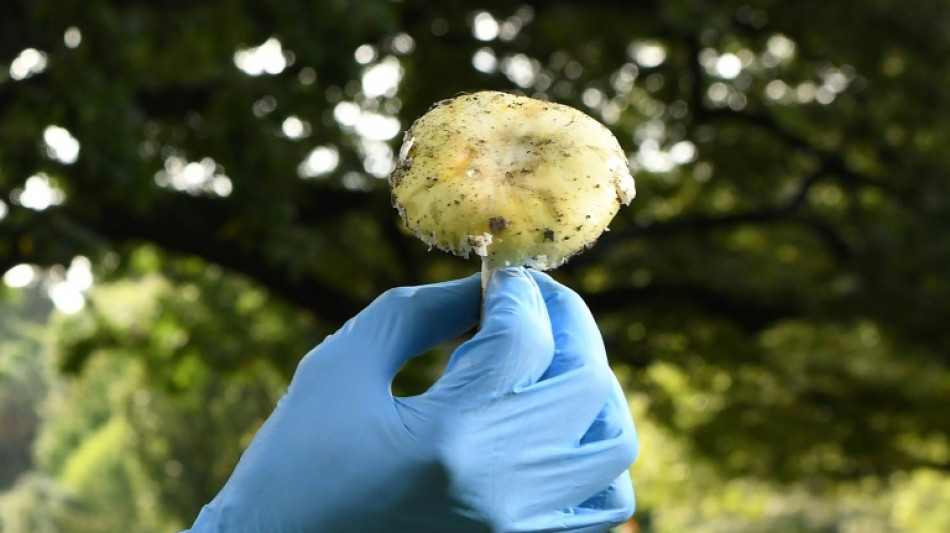
Possible antidote discovered for deadliest mushroom: study / Photo: © AFP/File

 Hurricane Polo strengthens to top category 5 off Mexico

 11 hurt as teen opens fire outside school in western Turkey

 UN chief says 'Big Oil' treats atmosphere as open sewer

 Tunisia says 2026 summer hottest on record

 England's Rashid out of Sri Lanka ODIs with hand injury

 Houthis accuse Saudi Arabia of deadly strikes as thousands flee

 Stocks climb as oil slides, AI buzz returns

 India cricketers win in style as Afghan savours 'special' Games silver

 La Liga president hits out at Real Madrid refereeing 'conspiracy' claims

 MEXC Launches “Real Stocks, Real Friends” with Rewards for Bringing Friends to Wall Street

 Mbappe continues media push for Ballon d'Or recognition

 Stocks rise on AI buzz, oil prices cool

 India narrowly survive huge scare against minnows Japan

 Missing F-35 fighter parts 'not sensitive', says Australia minister

 Cambodia showcases scams crackdown with global conference

 Afghan cyclist who disguised herself as man wins Asian Games silver

 Typhoon Dujuan leaves four dead in Japan, 45,000 houses without power

 G7 leaders condemn Houthi strikes on Saudi Arabia

 Google data centre sparks protests in Austria

 Shin Ohashi: Junk food-loving teen and Japan's next big swimming hope

 Stocks rise on AI buzz, drop in oil prices

 China's robot dancers limber up for America's Got Talent final

 Despite military might, Saudi struggles to crush the Houthis

 Trump to tout deals, defend Iran war in UN speech

 Sri Lanka to issue verdict in landmark Easter attack trial

Researchers said on Tuesday that an already widely used medical dye reduces the poisonous effects of death cap mushrooms in mice, raising hopes of the first targeted antidote for the world's deadliest mushroom.
The China-led team said the dye, which has yet to be tested as an antidote on humans but has already been approved by the US Food and Drug Administration (US FDA) for other uses, has the potential to "save many lives".
Amanita phalloides, commonly known as death caps, are estimated to cause more than 90 percent of all deaths from mushroom poisoning worldwide.
They often resemble other species of mushrooms that people like to pick in the wild -- but eating just half of one can cause deadly failure of the liver or kidneys.
While originally native to Europe, death caps have spread across the world, causing more than 38,000 illnesses and nearly 800 deaths in China alone between 2010 and 2020.
For a new study published in the journal Nature Communications, the researchers sought to target alpha-amanitin, the main toxin produced by the mushrooms.
They used genome-wide CRISPR screening, a relatively new technique that has helped researchers understand the role specific genes play in infections and poisonings.
The team had previously used the technology to find a potential antidote for the box jellyfish, one of the world's most venomous animals.
The CRISPR screening identified that the protein STT3B was a key culprit in the toxic effects of death cap poisoning.
The team searched through a database of drugs already approved by the US FDA and found one that could potentially block the protein.
- 'Unexpected connection' -
It is a fluorescent dye called indocyanine green, which is administered intravenously. It has been widely used for decades in the US, Europe and elsewhere for diagnostic imaging, allowing doctors to measure liver and heart function.
Qiaoping Wang, a researcher at China's Sun Yat-sen University and senior author of the study, told AFP that "upon discovering this unexpected connection, the research team was understandably taken aback".
The team tested the antidote first on liver cells in a petri dish, then on mice.
In both cases, it "demonstrated significant potential in mitigating the toxic impact" of mushroom poisoning, Wang said.
"This molecule holds immense potential for treating cases of human mushroom poisoning and could mark the first-ever specific antidote with a targeted protein," he said.
"It could save many lives if it is as effective in humans as in mice."
The team now intends to conduct trials on humans using the dye as a death cap antidote.
An extract from milk thistle seeds called silibinin has previously been used to treat death cap poisoning, but exactly how it works has remained unclear.
K.Brown--BTB