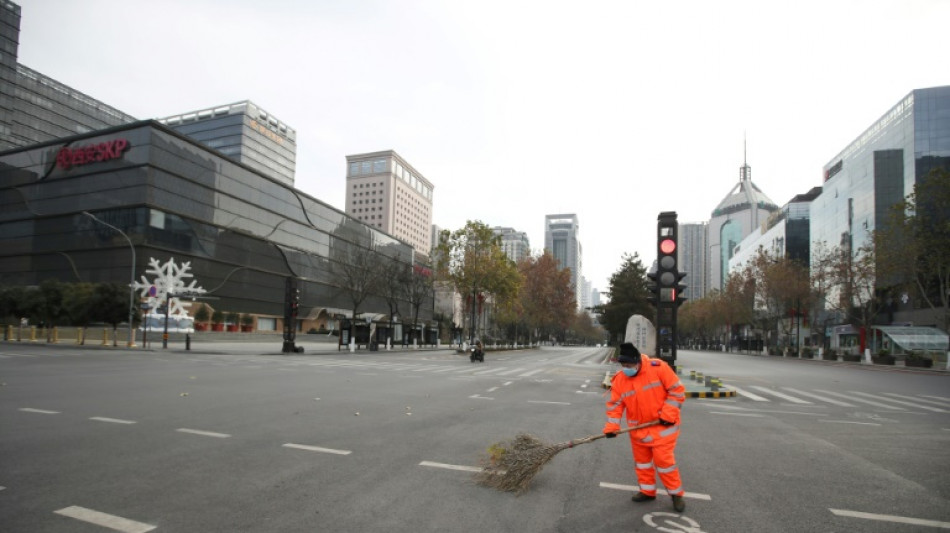
China should eventually 'co-exist' with Covid: top scientist / Photo: ©

 Mbappe says having Zidane as France coach 'like a film'

 Palmer, Rice out of England Nations League squad
 German auto workers stage mass protests in bid to save jobs

 Embattled Merz vows to keep ruling for 'democratic future' of Germany

 Merz vows to keep ruling coalition together for 'democratic future' of Germany

 Spain coach De la Fuente gets new deal after World Cup success

 Pressure grows on Germany's Merz after election defeats

 China's Zhang beats Japan rivals to Asian Games gymnastics gold

 Samlingen Haupt: Vad pengar avslöjar om oss människor

 Tens of thousands of German auto workers protest to save jobs

 हॉप्त् कलेक्शन: पैसा हमारे बारे में एक इंसान के रूप में क्या प्रकट करता है

 Συλλογή Haupt: Τι αποκαλύπτει το χρήμα για εμάς τους ανθρώπους

 TradersYard Shifts Focus to Futures Trading

 ハウプト・コレクション:お金が人間について明かすこと

 하우프트 컬렉션: 돈이 우리 인간에 대해 드러내는 것

 Indonesia doing 'everything' but struggling to curb fires

 Sbírka Haupt: Co o nás lidech prozrazují peníze
 North and South Korea fight out draw in niggly Asian Games clash
 Officials say man shot, wounded by ICE agent in Texas

 豪普特收藏:金錢如何揭露人類的本質

 Kolekcja Haupta: Co pieniądze mówią o nas, ludziach

 The Haupt Collection: What Money Reveals About Us as Human Beings

 Barcelona enter new era aiming to retain Women's Champions League crown

 US has deported 25,000 to third countries under secretive deals: report
 Three South Korean soldiers injured in DMZ blast: military

China should aim to co-exist with the virus and could move away from its zero-Covid strategy "in the near future," a top Chinese scientist said in a possible sign that the country's leadership is rethinking its strict approach.
The country where the coronavirus was first detected in 2019 is now one of the last places still clinging to a zero-tolerance approach, responding to small outbreaks with snap lockdowns and cutting off most international travel.
But fatigue over disruptions to everyday life as well as semi-autonomous Hong Kong's struggle to contain a mass Omicron outbreak have raised questions about the sustainability of Beijing's approach.
China's strategy against Covid-19 cannot "remain unchanged forever" and "it is the long-term goal of humanity to co-exist with the virus" at tolerable death and illness rates, Zeng Guang wrote on social media platform Weibo on Monday.
Zeng is the former chief scientist of China's Center for Disease Control and Prevention and one of the experts behind the country's initial Covid response.
Zeng said that while China's approach had prevented the early chaos of widespread infection experienced by many Western countries, its low infection rate was now a "soft spot" as far fewer people had built up natural immunity.
He said Western countries were now showing "commendable courage" in exploring how to live with the virus and that China should "observe and learn" even though there was still "no need to open the country's doors at the peak of the global pandemic".
"In the near future, at the right time, the roadmap for Chinese-style co-existence with the virus should be presented," Zeng said.
His comments are unusual for an official in China's government, which has touted its low infection rates to the Chinese public as a sign of the superiority of its approach.
Experts who previously questioned "zero Covid" have faced a backlash, including prominent scientist Zhang Wenhong who was attacked by online trolls and probed for plagiarism after a similar Weibo post in July.
Zeng's post did not appear to make as much of a splash online, attracting only a few thousand responses on a platform where trending topics normally engage millions of users.
His comments come after authorities said in February that they would crack down on "excessive" Covid-19 measures by local governments, including arbitrary quarantines and business shutdowns.
The problems associated with a zero-Covid approach have been laid bare in Hong Kong, which is in the midst of its worst outbreak yet and has seen panic buying following mixed messaging from the government over whether it would impose strict mainland-style measures.
Authorities plan to test all 7.4 million residents this month and isolate all infections either at home or in a series of camps that are still being constructed with mainland help.
But experts from the University of Hong Kong published new modelling data on Tuesday which estimated the current number of infections at 1.7 million and suggested delaying mass testing to avoid overwhelming the financial hub's ability to isolate and care for those infected.
T.Bondarenko--BTB