G7 to launch 'alliance' countering China's critical mineral dominance / Photo: © Lynas Rare Earths Limited/AFP

 Carrick confident Man Utd can 'work through' tough time

 Mbappe ends Nike partnership to join Swiss brand On

 Liverpool boss Iraola puts Bournemouth love affair on hold

 'A disaster' if Man City do not win says Maresca after flawless start

 Kerry James Marshall: American 'blackness' painter celebrated in Europe

 Spain coach De la Fuente offers 'full support' to people of Ceuta

 Russia seizes assets of Nestle, French firms over West's Ukraine support

 England can build on World Cup 'spirit', says Tuchel

 UNESCO can be 'moderator' in AI debate: chief to AFP

 Infantino 'must go', says German FA vice-president

 Russia seizes assets of Nestle, French firms

 Japan's busiest rail station tests robot bins

 Anthropic says AI systems moving towards building themselves

 Asian stocks boosted by falling oil, yen weakens after BoJ rate hike

 Pakistan court blocks expulsion of Afghan medical college students

 Athletes 'can't take it any more' as Asian Games issues mount
 Allen lights up Bills' new stadium with 41-31 win over Lions

 Afghan medical students in Pakistan hope court stops college expulsions
 AI doomsday warnings unlikely to slow IPOs but questions linger
 ICC eyes China in bid to expand cricket

 Nkunku craving freedom and fun on RB Leipzig return

 Bhutan's traditional archers lose ground to development

 Asian stocks track Wall St rally as oil prices drop

 South Korea makes Asian Games complaint over Japan warlord ceremony

 US aid cuts are killing Kenyan sex workers

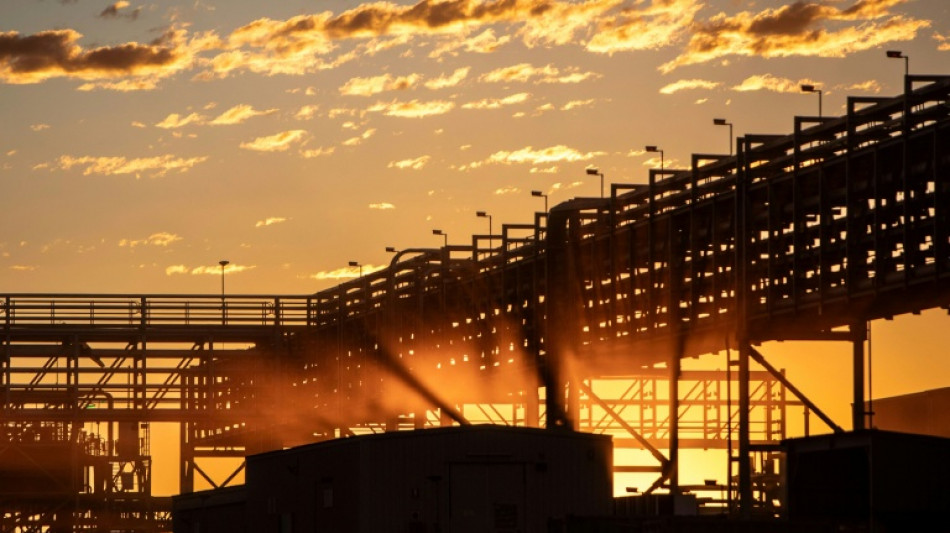
G7 energy ministers meeting in Canada on Thursday planned to launch a new alliance to counter China's critical mineral dominance, in a push for more reliable access to the resources that power advanced technologies.
The two-day Group of Seven meeting in Toronto opened hours after US President Donald Trump and Chinese counterpart Xi Jinping signed an extendable one-year deal on China's supply of rare earths.
Germany's Minister for Economic Affairs and Energy, Katherina Reiche, told reporters the Trump-Xi deal marked "a good sign," noting German reliance on Chinese critical mineral exports.
But she stressed the agreement "can't prevent us" from moving forward on broadening supply chains for the materials used in everything from solar panels and mobile phones to precision missiles.
"We need diversification of our import routes on raw materials," Reiche said.
- Production alliance -
With concern growing about China's overwhelming dominance in rare earth refining and processing, G7 leaders announced a "Critical Minerals Action Plan" at a summit in western Canada in June.
Canada's Energy Minister Tim Hodgson said the Toronto meeting will aim to formally launch a new initiative designed to curb China's market influence.
The Critical Minerals Production Alliance will "secure transparent, democratic, and sustainable critical mineral supply chains across the G7," he said.
Under the alliance, the governments of Britain, Canada, France, Germany, Italy, Japan, and the United States would mobilize private investment to expand critical mineral production that bypasses China.
The head of the critical minerals division at the International Energy Agency, Tae-Yoon Kim, told AFP the Toronto meeting offers "a major opportunity... to start shifting market power."
"The high concentration of critical minerals refining in a single country creates economic and national security risks," Kim said in an email ahead of the G7 talks.
- Distorted markets -
A central complaint about China's conduct is that it does not adhere to market principles.
Since a high proportion of material moves through Chinese-controlled businesses, Beijing can build stockpiles and control global supply.
"For decades, we've been facing a competitor who has very consistently distorted free markets, used industrial subsidies, created overcapacity, and undermined fair trade," said Abigail Hunter, executive director of the Washington-based Center for Critical Minerals Strategy.
Hunter noted that within the G7 there are contrasting energy policy priorities.
The Trump administration, in particular, is seen as less concerned about the transition to clean energy.
G7 unity on critical minerals may also be undermined by Trump's protectionist trade policies, which have caused global economic upheaval.
But given G7 alignment on "security of supply," Hunter said she saw space for cooperation.
"I'm an optimist. I have to be, because this sector is very painful at times."
For her, progress at the Toronto meeting would include concrete action on the issue of traceability -- tracking raw materials from mining to refinement and ensuring suppliers follow global market rules.
Hunter said that "opaque" Chinese-controlled companies exist across the supply chain, which the G7 should strive to "box out of the market" with new policies on traceability and transparency.
"I'm really interested to see what they do on that," she said, adding that processing still includes a "spider web of entities" where Chinese officials maintain outsized control.
"We have a short window of opportunity to fix this. The window is still open -- it's just very, very small," Hunter said.
M.Vogt--VB