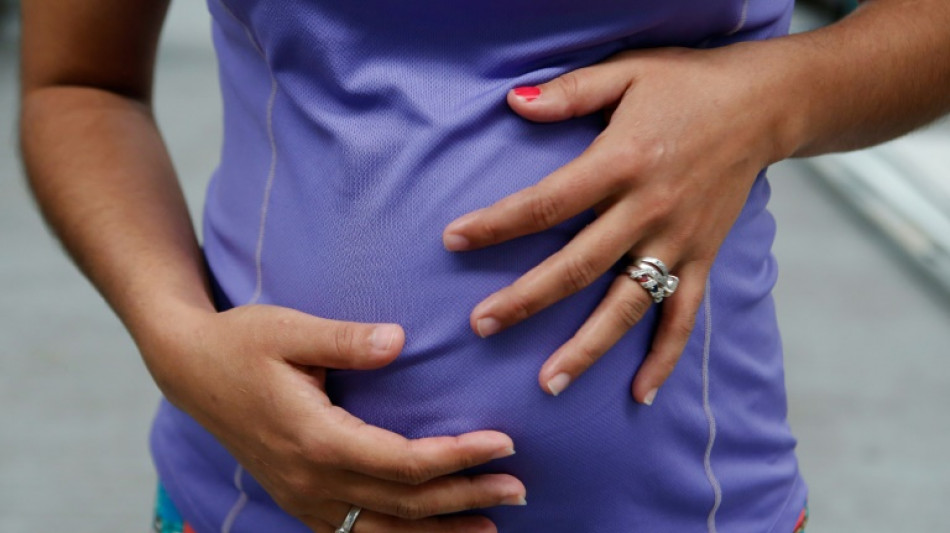
US maternal mortality soars amid widening racial disparities / Photo: ©

 Mbappe says having Zidane as France coach 'like a film'

 Palmer, Rice out of England Nations League squad

 German auto workers stage mass protests in bid to save jobs

 Embattled Merz vows to keep ruling for 'democratic future' of Germany

 Merz vows to keep ruling coalition together for 'democratic future' of Germany

 Spain coach De la Fuente gets new deal after World Cup success

 Pressure grows on Germany's Merz after election defeats

 China's Zhang beats Japan rivals to Asian Games gymnastics gold

 Samlingen Haupt: Vad pengar avslöjar om oss människor

 Tens of thousands of German auto workers protest to save jobs

 हॉप्त् कलेक्शन: पैसा हमारे बारे में एक इंसान के रूप में क्या प्रकट करता है

 Συλλογή Haupt: Τι αποκαλύπτει το χρήμα για εμάς τους ανθρώπους

 TradersYard Shifts Focus to Futures Trading

 ハウプト・コレクション:お金が人間について明かすこと

 하우프트 컬렉션: 돈이 우리 인간에 대해 드러내는 것

 Indonesia doing 'everything' but struggling to curb fires

 Sbírka Haupt: Co o nás lidech prozrazují peníze

 North and South Korea fight out draw in niggly Asian Games clash

 Officials say man shot, wounded by ICE agent in Texas

 豪普特收藏:金錢如何揭露人類的本質

 Kolekcja Haupta: Co pieniądze mówią o nas, ludziach
 The Haupt Collection: What Money Reveals About Us as Human Beings

 Barcelona enter new era aiming to retain Women's Champions League crown

 US has deported 25,000 to third countries under secretive deals: report

 Three South Korean soldiers injured in DMZ blast: military

The US maternal mortality rate -- already the worst in the industrialized world -- rose in 2020 to its highest level in half a century, with Black women three times more likely to die than white women, data showed Wednesday.
A National Center for Health Statistics report showed the rate was 23.8 deaths per 100,000 live births, far higher than comparable countries, such as Canada where it was 7.5 per 100,000, according to OECD statistics for the same year.
Overall, 861 women were identified as having died of maternal causes, which the World Health Organization defines as a death while pregnant or within 42 days of the end of pregnancy, from any cause related to or aggravated by pregnancy or its management.
In 2019, the number of deaths per 100,000 live US births was 20.1, while in 2018 it was 17.4.
"We observed increases across a broad number of categories, and Covid-19 likely contributed," Donna Hoyert, who authored the report, told AFP.
But, she added, the disease was not mentioned in 88 percent of cases, and was thus only a part of the overall picture.
Despite spending more than twice per person on health than the average of high-income nations, the United States has historically remained an outlier on maternal mortality compared to its peers.
Across the world, maternal mortality dropped throughout the 20th century thanks to advances in medical care such as antibiotics and basic hygiene. But the United States has seen backsliding since the year 2000, unlike most other countries.
In fact, the last time the US rate was officially this high was 1968, though a new reporting methodology was introduced in 2018.
"Most of the peer countries have some form of universal health care," Boston University professor Eugene Declercq, who studies the field, told AFP.
"What we do in the United States is we focus on care so intently on the time of birth -- and that's nice -- but the fact of the matter is, women enter their pregnancies in a less healthy state because they're not covered."
Certain conservative-led states, such as Texas and Alabama, have increased hurdles to eligibility to Medicaid, the publicly funded health insurance program, said Declercq.
Upper income limits to enroll in Medicaid are lower for women who are pregnant, but there is a greater chance that by the time they become pregnant, they have untreated chronic conditions.
Limiting access to abortion -- as conservative-led states have increasingly done in recent years -- is also linked to worse maternal health outcomes a 2021 study in the American Journal of Public Health found.
- Racial disparities -
The racial breakdown of the 2020 figures reveal widening disparities.
The number of maternal deaths per 100,000 live births was 55.3 among Black women, compared to 19.1 among white women, which would by itself still be higher than peer countries.
Here too, there are thought to be many factors, and experts say it's not as simple as race being a surrogate for socioeconomic conditions such as access to care and environmental stressors, though these undoubtedly play a role.
In fact, a 2016 study by the Centers for Disease Control and Prevention (CDC) showed for a Black woman with a college education, the likelihood of maternal death is still 60 percent greater than for a white woman with less than a high school education.
"Black women are time and time again shown to not receive the same level of treatment or medications," Ebony Hilton, an anesthesiologist at the University of Virginia - Charlottesville, and an expert in disparities in health care, told AFP.
C.Kovalenko--BTB