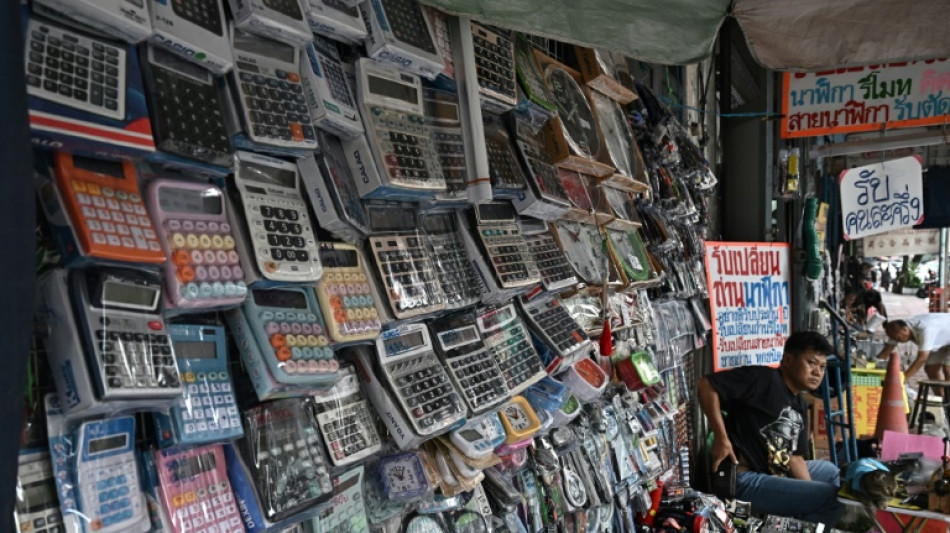
Number's up: Calculators hold out against AI / Photo: © AFP

 Louise Trotter expands her palette at Bottega Veneta

 Pope prays at Lourdes after huge Paris mass

 USA trims International lead after Presidents Cup four-balls

 Russia accuses Europe of blocking Ukraine talks, as strikes drag on

 'He said hello': Families pray with pope on Paris avenue

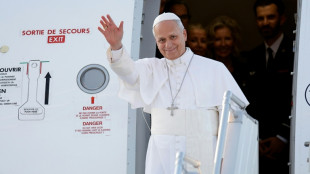 Pope celebrates giant Paris mass, flies to Lourdes

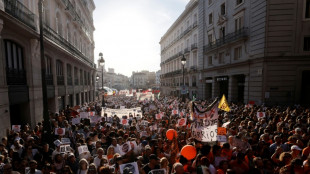 Thousands march in Madrid over eviction of 87-year-old woman
 England women back to winning ways with last-gasp defeat of New Zealand

 Trump rejects Iran proposal for deal to reopen Hormuz

 England's Cox says injured Buttler leaves 'big shoes to fill'
 Ruthless Perpignan upset sloppy Bordeaux-Begles

 Deadly abbey attack feeds anti-Ukrainian sentiment in Poland

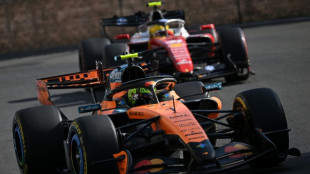
 Antonelli says he drove 'safety-first' on his worst weekend of season
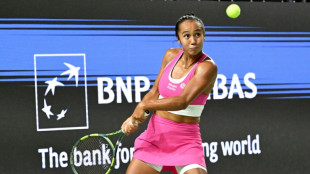 Fernandez fights back to reach Singapore Open final

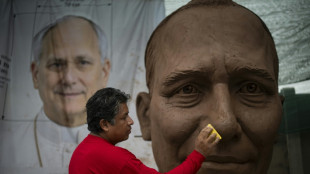 Giant statue of Pope Leo XIV takes shape in Peru workshop

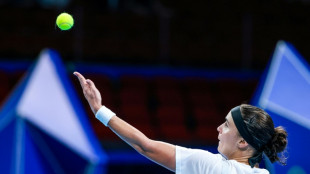 Ukraine crush holders Italy to reach first BJK Cup final
 Pope celebrates giant Paris mass in landmark visit
 Germany selects Munich for Olympics host bid
 Sagnol sacked as Georgia boss after Nations League upset
 Man City could face 'drastic' sanctions after reported guilty verdict: ex-chairman

 Furious Fury says row between rival promoters could scupper Joshua bout

 'Invincible' 223cm teen basketball player stars as China win bronze

 Tenth woman found dead in South Africa's string of killings

 Japan schoolboy, 11, wins gold while empty seats blight Asian Games
 Japan organisers 'not satisfied' as empty seats blight Asian Games
The humble pocket calculator may not be able to keep up with the mathematical capabilities of new technology, but it will never hallucinate.
The device's enduring reliability equates to millions of sales each year for Japan's Casio, which is even eyeing expansion in certain regions.
Despite lightning-speed advances in artificial intelligence, chatbots still sometimes stumble on basic addition.
In contrast, "calculators always give the correct answer," Casio executive Tomoaki Sato told AFP.
But he conceded that calculators could one day go the way of the abacus.
"It's undeniable that the market for personal calculators used in business is on a downward trend," Sato said in Tokyo.
Smartphones and web browsers can handle everyday sums, while AI models achieved gold-level scores for the first time this year at a prestigious global maths contest.
But calculators are more affordable than phones, and run on batteries and solar power -- a plus for schools in developing countries, a potential growth area for Casio, Sato said.
And people who do buy calculators prefer the way they feel, he argued.
Thitinan Suntisubpool, co-owner of a shop selling red bags and beckoning cats in Bangkok's Chinatown, said she loves how durable her big calculator is, having dropped it several times.
"It's more convenient in many ways," the 58-year-old told AFP.
"We can use it to press the numbers and show the customer," avoiding language-barrier misunderstandings.
But at a nearby street stall selling clocks, torches and calculators, the vendor, who gave her name as Da, said calculator sales were "quiet".
- 'Optimised tools' -
At a Casio factory in Thailand, assembly line workers slotted green circuit boards into place and popped cuboid buttons labelled "DEL" from a plastic tub onto pastel-blue calculator frames.
"Calculators are still in demand," said Ryohei Saito, a general manager for Casio in Thailand.
"Not everywhere in the world has smartphone connectivity, and calculators are optimised tools focused on necessary functions," he said.
In the year to March 2025, Casio sold 39 million calculators, general and scientific, in around 100 countries.
That compares to 45 million in 2019-20, but is still up from the 31 million that sold the following year after the Covid-19 pandemic hit.
The company has come a long way from the 1957 invention of the desk-sized "14-A", which it says was the first compact all-electric calculator.
Calculator history even made headlines recently when Christie's suspended the Paris sale of an early calculating machine, "La Pascaline", after a court said it could not be taken abroad.
The auction house called the ebony-decorated 1642 device "the first attempt in history to substitute the human mind with a machine".
Those attempts have accelerated with AI.
- Scoring gold -
In July, AI models made by Google, OpenAI and DeepSeek reached gold-level scores at the annual International Mathematical Olympiad (IMO).
But neither attained full marks at the annual contest for under-20s, unlike five human participants who achieved perfect scores.
IMO president Gregor Dolinar called the progress of artificial intelligence in the field "fascinating".
"When we talk about scientific calculators, in the past you needed them, but nowadays it's easier to just ask AI," he told AFP.
"If you pose the question in the right way," artificial intelligence can crunch abstract, logical questions and show how it reached its conclusion, Dolinar said.
Dolinar, a professor in engineering at the University of Ljubljana, thinks physical calculators are likely to "slowly disappear".
Something that has already happened for his students.
"They can calculate everything on a phone," he said.
T.Zimmermann--VB