-
 Venezuela releases more political prisoners after opposition talks
-
Spain success driven by hunger to improve, says De La Fuente
-
 England's best 'for a long time' despite Spain defeat, says Kane
-
Lyon collapse at Stade Francais to suffer first Top 14 loss
-
 Powerful storm pummels northeast US with rain, high winds
-
Oyarzabal and Spain sink England again as Modric shines for Croatia
-
 Filmmaker Mike Leigh wins top prize at Spain festival with 'last film'
-
Housing protesters camp in central Madrid after mass demonstration
-
 Spain beat England in Nations League to extend unbeaten run
-
Louise Trotter expands her palette at Bottega Veneta

-
 Ireland squad vote to play Israel tie despite Gaza unease
-
Pope prays at Lourdes after huge Paris mass
-
 Gutsy Vollering wins cycling road race world title
-
USA trims International lead after Presidents Cup four-balls
-
 Vollering wins cycling road race world title
-
Russia accuses Europe of blocking Ukraine talks, as strikes drag on
-
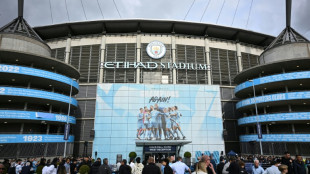
 Man City's meteoric rise clouded by dark shadow
-
'He said hello': Families pray with pope on Paris avenue
-
 Mbappe out for two weeks or more with knee injury say Real
-
Pope celebrates giant Paris mass, flies to Lourdes
-
 Lyon collapse away to Stade and suffer first Top 14 loss
-
Thousands march in Madrid over eviction of 87-year-old woman
-
 Russia accuses Europe of seeking to thwart Ukraine talks
-
England women back to winning ways with last-gasp defeat of New Zealand

-
 Man City chairman defiant over reported Premier League charges
-
Trump rejects Iran proposal for deal to reopen Hormuz
-
 Germany ready to 'walk through fire' for Klopp, says Tah
-
England's Cox says injured Buttler leaves 'big shoes to fill'
-
 At least 16 killed in Russian and Ukrainian strikes
-
Ruthless Perpignan upset sloppy Bordeaux-Begles
-
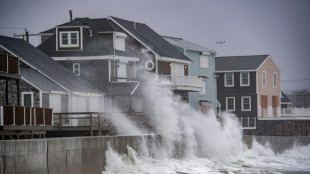 Powerful storm pummels US Northeast
-
Deadly abbey attack feeds anti-Ukrainian sentiment in Poland
-
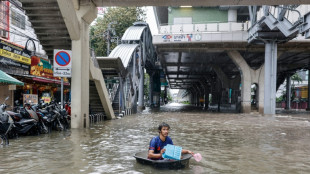 Bangkok declares disaster after homes flooded, roads submerged by heavy rain
-
Antonelli says he drove 'safety-first' on his worst weekend of season
-
 Norris calls for errant Colapinto to be banned for causing Baku crash
-
Fernandez fights back to reach Singapore Open final
-
 Russell finds himself again and prepares to heap pressure on Antonelli
-
Giant statue of Pope Leo XIV takes shape in Peru workshop
-
 South Korea hold nerve to win Asian Games basketball gold
-
Ukraine crush holders Italy to reach first BJK Cup final
-
 Russell holds off Verstappen to claim imperious victory in Baku
-
Pope celebrates giant Paris mass in landmark visit
-
 Russell holds off Verstappen to win Azerbaijan Grand Prix
-
Germany selects Munich for Olympics host bid
-
 India's Kohli says 2027 ODI World Cup will be his last
-
Sagnol sacked as Georgia boss after Nations League upset
-
 Huge crowds cheer Pope Leo along Champs-Elysees ahead of Paris mass
-
Man City could face 'drastic' sanctions after reported guilty verdict: ex-chairman
-
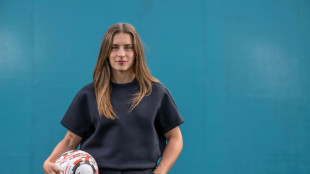 Putellas wants to bring 'winning culture and mentality' to London City
-
Furious Fury says row between rival promoters could scupper Joshua bout
Europe secures record space budget to boost independence
The European Space Agency announced Thursday it had secured a record budget of 22.1 billion euros to fund its programmes for the next three years, as the continent seeks greater independence in space.
The ESA also approved a plan to bolster defence cooperation and laid out plans for scientific space missions at a ministerial council meeting in the German city of Bremen.
The agency's 23 member states committed five billion euros more than 2022's budget, with the total representing almost all of the 22.2-billion-euro ($25.7 billion) funding sought by the agency.
"This has never happened before," ESA director general Josef Aschbacher told the meeting.
The amount of funding "speaks volumes -- it's a sign of confidence in the agency, Aschbacher AFP in an interview.
At the heart of the discussions in Bremen was the European Resilience from Space programme, which includes Earth observation, navigation and telecommunications.
The programme, with an estimated 1.35-billion-euro budget, has both civilian and military applications.
"Defence is always a matter of national sovereignty," said Aschbacher. "But pooling and sharing assets also has a European dimension."
One example was increasing "the number of observations and satellite images for intelligence and surveillance purposes", he said.
If the United States and China continue building huge constellations of satellites and Europe does nothing, Aschbacher feared "the same thing will happen as with Starlink: there will be a dominant US company threatening our European companies and our position".
Germany was the biggest contributor to the total budget with more than five billion euros, followed by France with 3.7 billion.
- Rockets and telescopes -
The industry has changed significantly in recent years as billionaire Elon Musk's SpaceX has risen to dominate the space launches.
Europe lost an independent way to launch its missions into space after Russia pulled its rockets following Moscow's invasion of Ukraine in 2022.
After repeated delays, Europe's new heavy lift Ariane 6 rocket finally blasted off last year. However the rocket is not reusable, unlike SpaceX's Falcon 9 workhorse.
So the ESA is planning to contract out the job of developing the continent's first reusable rocket, having named a shortlist of potential companies.
In Bremen, the European Launcher Challenge received more than 900 million euros in contributions -- twice what had been proposed, Aschbacher said.
The funding boost for ESA comes as US space agency NASA faces stiff budget cuts under President Donald Trump.
However, the ESA said this week that NASA had confirmed it would contribute to Europe's Martian rover Rosalind Franklin.
The mission is scheduled to launch in 2028 aiming to drill into the surface of Mars looking for signs of extraterrestrial life.
Among the scientific projects the ESA has proposed for the future -- but have not yet been approved -- is the first space-based laser observatory aiming to study gravitational waves, which are ripples in spacetime first predicted by Albert Einstein.
Another is the X-ray telescope NewAthena, which would study extreme events in the universe such as supermassive black holes.
There is also a plan to send a spacecraft to Saturn's moon Enceladus, which scientists suspect could have a liquid ocean under its icy shell that might be able to host life.
The ESA also has a joint proposal with Japan to send a spacecraft called Ramses to study the asteroid Apophis as it zings past Earth in 2029, hoping to learn more about how to fend off dangerous space rocks in the future.
- European astronauts to the Moon? -
Also on Thursday, the ESA announced that the first European astronauts to participate in NASA's Artemis programme -- which aims to return humans to the Moon -- will be from Germany, France and Italy.
"I can announce today that the first flight will be allocated to a German astronaut," Aschbacher said on the sidelines of the ministerial meeting.
The programme's first crewed mission to the Moon -- which will not set foot on its surface -- is planned to launch in the first half of next year.
French astronaut Thomas Pesquet, one of his country's leading candidates, said in Bremen that "it has never really been officially confirmed, so this is a positive."
"It means that Europe has its place in this adventure," he added.
M.Vogt--VB