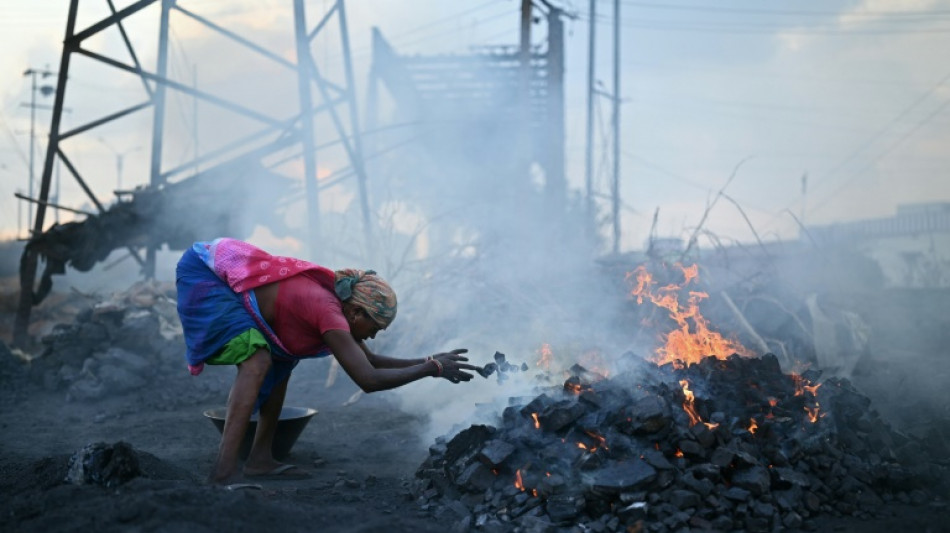
India coal expansion risks massive methane growth: report / Photo: © AFP/File

 Trent Perry’s Late Heroics Lift No. 7 UCLA Past Cal State Fullerton

 2027 Hyundai Elantra Review: Brutalist Design and Expanded Dimensions

 Malta Maritime Forum Study Reveals €1 Billion Economic Contribution Amid Growth Concerns

 China Condemns Chile-Belgium Joint Bid for High Seas Treaty Headquarters

 Dún Laoghaire-Rathdown €335m Budget Faces Mixed Reaction Over Housing and Cost of Living

 Dubai Police Expand Luxury Patrol Fleet with 525-hp Defender

 Iran Strikes US Sites in Kuwait Following US Airstrikes on Qeshm Island
India's plans to expand coal mining could double emissions of the potent greenhouse gas methane from its domestic coal sector by 2029, threatening its climate goals, a report warned Thursday.
Methane is the second-most abundant greenhouse gas produced by human activity, after carbon dioxide. It breaks down faster but has a more powerful effect in the short term.
Coal mining is a key source of methane, which leaks from vents, open pits and cracks in the ground.
India is already one of the world's leading sources of coal-mine methane emissions, as well as the second-biggest producer, importer and consumer of the fossil fuel.
To meet rapidly growing energy demand, it plans to boost domestic coal production from 982 million tonnes to more than 1.5 billion tonnes by 2030, according to the coal ministry.
The planned expansions could more than double coal mine-related methane emissions by 2029 from a decade earlier, the report by independent energy think tank Ember said.
That projection is based on the methodology India uses to calculate its existing coal mine-linked methane emissions.
India has committed to achieve net-zero emissions by 2070.
But the planned coal expansion "poses a considerable risk for the country's domestic emissions reduction plans and will have a profound short-term warming impact", Ember warned.
India, the world's most populous country, faces a conundrum as it seeks to honour its climate commitments while meeting skyrocketing demand for energy and supporting its fast-growing economy.
Ember acknowledged that the "unprecedented increases" in demand for electricity in India are outstripping renewables capacity.
It proposed that India should invest in mitigation technology that could capture methane and even allow it to be used in place of imported gas, potentially saving money.
The European Union and the United States launched a "Global Methane Pledge" in 2021 under which countries commit to slashing emissions of the greenhouse gas 30 percent from 2020 levels by the end of this decade.
More than 150 countries have signed up -- but not China, India or Russia.
Researchers found this month concentrations of methane are rising at an accelerating pace and quicker than those of any other major greenhouse gas.
While methane is also produced by agriculture and landfills, much of the increase is linked to coal extraction and oil and gas production.
A report last week also sounded the alarm on methane emissions from planned Chinese coal mine expansions.
Global Energy Monitor, an NGO, said China has an additional 1.2 billion tonnes of coal capacity in development, more than half the global pipeline.
A.Kunz--VB
