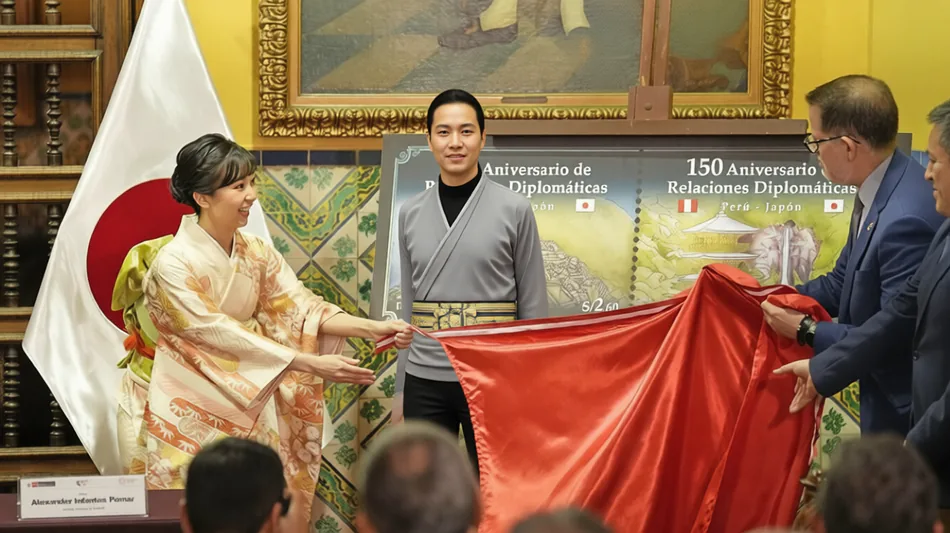
Japan and Peru Mark 150 Years of Diplomatic Ties Amidst Trade and Investment Talks

 Trent Perry’s Late Heroics Lift No. 7 UCLA Past Cal State Fullerton

 2027 Hyundai Elantra Review: Brutalist Design and Expanded Dimensions

 Malta Maritime Forum Study Reveals €1 Billion Economic Contribution Amid Growth Concerns

 China Condemns Chile-Belgium Joint Bid for High Seas Treaty Headquarters

 Dún Laoghaire-Rathdown €335m Budget Faces Mixed Reaction Over Housing and Cost of Living

 Dubai Police Expand Luxury Patrol Fleet with 525-hp Defender

 Iran Strikes US Sites in Kuwait Following US Airstrikes on Qeshm Island
Japan and Peru are commemorating more than 150 years of diplomatic relations as Peruvian President Keiko Fujimori visits Tokyo to strengthen economic ties. The visit highlights a deep historical connection rooted in late-19th-century migration and sustained by modern trade in critical minerals and strategic partnerships.
Peru and Japan are marking more than 150 years of diplomatic engagement as Peruvian President Keiko Fujimori visits Tokyo to discuss bilateral trade, investment, and critical mineral supply chains with Japanese Prime Minister Sanae Takaichi. The visit underscores a relationship that began in 1873 when Japan established its first diplomatic ties in Latin America.
The foundation of modern relations was laid between 1899 and 1923, when approximately 790 Japanese immigrants arrived in Peru aboard the Sakuramaru as contract laborers. These early migrants worked primarily on sugar and cotton plantations. Despite facing significant hardships, including the severance of diplomatic ties during World War II, a community of over 200,000 Japanese Peruvians remains deeply integrated into Peruvian society today.
The political landscape has been significantly shaped by this heritage. Alberto Fujimori, a second-generation Japanese Peruvian born to parents who emigrated from Kumamoto, served as Peru’s president from 1990 to 2000. His daughter, Keiko Fujimori, a third-generation Japanese Peruvian, was inaugurated as president in July of this year.
The cultural impact of Japanese migration is visible across the country. Nouchi Yokichi, a 1917 emigrant from Fukushima, became the first mayor of Machu Picchu Pueblo. Originally arriving as a laborer, he developed an irrigation system that boosted agricultural yields and used hydropower to bring electricity to the village, earning the trust of local residents before dedicating himself to recovery efforts following a devastating landslide.
In the arts, second-generation Japanese Peruvian Tilsa Tsuchiya is regarded as one of the most influential figures in twentieth-century Peruvian art. Her unique style incorporates European elements into indigenous Peruvian mythology. Since December 2023, her image has appeared on Peru’s highest-denomination banknote, the 200-sol bill.
Economically, Japan has run a trade deficit with Peru since the early 2000s. In 2025, Japanese imports from Peru totaled ¥529.6 billion, while exports reached ¥121.8 billion. Imports consist mainly of mineral and energy resources, including copper, petroleum, liquefied natural gas (LNG), zinc, and iron ore. Japan’s exports center on automobiles, other transport equipment, and machinery.
The diplomatic timeline reflects periods of both cooperation and conflict:
- 1873: Diplomatic relations established. - 1941–42: Following Japan’s attack on Pearl Harbor, Peru severed diplomatic relations with Japan in January 1942. Some ethnic Japanese were sent to U.S. internment camps. - 1952: Diplomatic relations restored. - 1996–97: The Japanese ambassador’s residence in Peru was seized by armed guerrillas, a crisis resolved after four months in a military raid. - 2000: President Fujimori announced his resignation while in Japan and remained in exile. - 2011: The Japan–Peru Economic Partnership Agreement was signed. - 2016: Both nations recognized each other as strategic partners. - 2023: The 150th anniversary of diplomatic relations was celebrated. - 2024: At the APEC Economic Leaders’ Meeting in Lima, Japan and Peru issued a joint statement on strengthening their strategic partnership and agreed on a 2024–2033 roadmap.
The current focus on critical mineral supply chains aligns with the 2024 agreement to deepen strategic cooperation through 2033. As global demand for resources intensifies, the historical ties between the two nations provide a framework for ongoing economic and political collaboration.
C.Kreuzer--VB