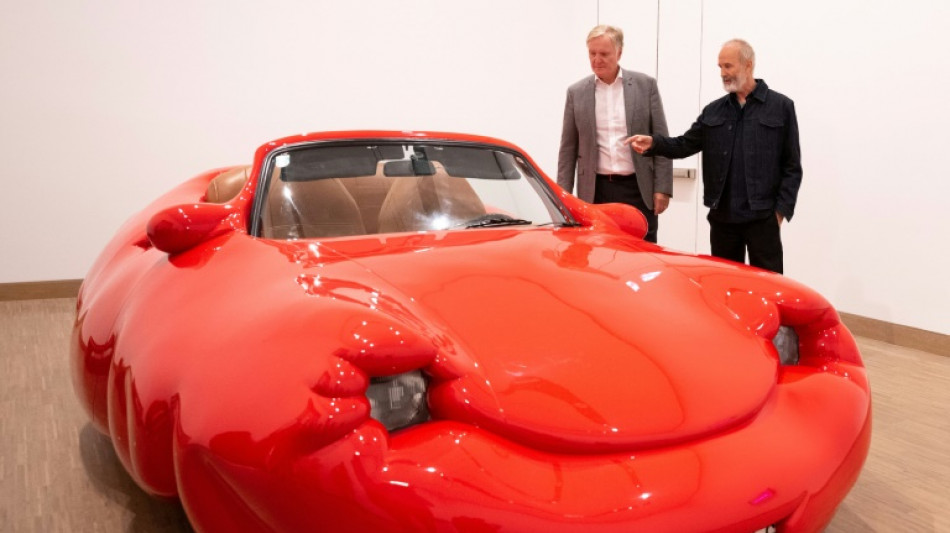
The absurd helps us 'see more' says Austrian artist Wurm / Photo: © AFP

 Trent Perry’s Late Heroics Lift No. 7 UCLA Past Cal State Fullerton

 2027 Hyundai Elantra Review: Brutalist Design and Expanded Dimensions

 Malta Maritime Forum Study Reveals €1 Billion Economic Contribution Amid Growth Concerns

 China Condemns Chile-Belgium Joint Bid for High Seas Treaty Headquarters

 Dún Laoghaire-Rathdown €335m Budget Faces Mixed Reaction Over Housing and Cost of Living

 Dubai Police Expand Luxury Patrol Fleet with 525-hp Defender

 Iran Strikes US Sites in Kuwait Following US Airstrikes on Qeshm Island
A fat Ferrari, pickles on pedestals and two sausages in an intimate embrace -- welcome to the weird world of Erwin Wurm, one of Austria's most famous contemporary artists, who wants us to embrace the absurd.
If we look at "our world from another perspective, from the perspective of the absurd, we might see more", Wurm told AFP as a retrospective of his work opened in Vienna's Albertina Museum to mark his 70th birthday.
"Everything seems normal to us," he said, but if we took another look "we might see different things, and that might be interesting for us to understand things differently".
The show is a reflection on social norms, consumerist society and the diktats of appearance and even identity, with his quirky take on quintessentially Austrian staples such as sausages and pickled cucumbers alongside luxury bags on giant legs, miniature houses and stacks of clothing.
"He likes to take everyday things... and present them as abstract elements, to make artworks out of them," said curator Antonia Hoerschelmann.
- Playful -
Born in the central city of Bruck an der Mur, Wurm wanted to become a painter, but after a university entrance exam found himself in a sculpture class instead.
"It was a big shock... I was frustrated and sad, but then after some time I thought that maybe it's a challenge. And from then on I started to think about the notion of sculpture," Wurm recalled.
His walk-in rural school allows visitors to squeeze inside through a small entrance, recalling Wurm's 2010 work "Narrow House" based on his parental home.
Wurm said he was trying to recreate the "claustrophobic" and "quite rigid" post-World War II Austria where he grew up.
But he also offers more playful approaches.
In his famous "One Minute Sculptures", the public is invited to lie down for a minute on tennis balls or slip into sweaters to "connect them much more to a piece".
There is a darker undercurrent to some of his most recent creations, such as a sculpture of what seems like someone wearing a shirt and pants but with no head.
"Instead of the people I have the clothes. It's like a shadow of something... We still can recognise something, a human being, but not a person. So the personality is cut out," he said, evoking a "dystopian future".
"I'm not happy with our world. How it's progressing and how we treat each other. It's just unbelievable, terrible," he said.
The idea of having a retrospective of his works did not appeal to him right away.
"I'm not interested in looking back but in looking forward," he said. "I like to work, it's the centre of my life and I would like to go on and develop new ideas and develop the old ones."
D.Bachmann--VB
