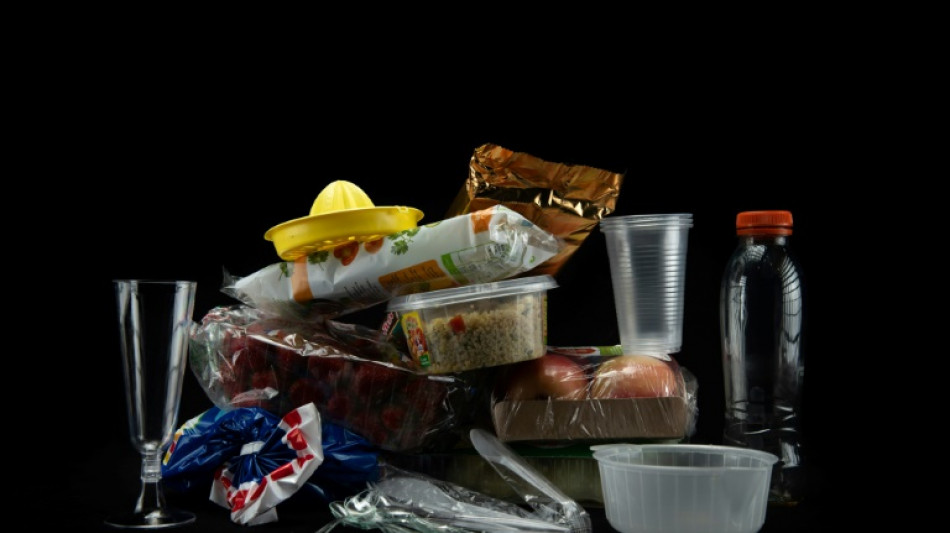
More than 3,600 food packaging chemicals found in human bodies / Photo: © AFP/File

 Google data centre sparks protests in Austria

 Shin Ohashi: Junk food-loving teen and Japan's next big swimming hope

 Stocks rise on AI buzz, drop in oil prices

 China's robot dancers limber up for America's Got Talent final

 Despite military might, Saudi struggles to crush the Houthis

 Trump to tout deals, defend Iran war in UN speech

 Sri Lanka to issue verdict in landmark Easter attack trial

 Macron says talks with Trump on Red Sea, Ukraine 'constructive'

 Green policies just good politics, says UK minister

 Bardot auction in Paris fetches nearly one million euros

 No timeline on Daniels injury return, says Commanders coach

 British Columbia sues OpenAI in US court over Canada school shooting

 French star Batum retires after 18-year NBA career

 Zidane leads first France training session

 Man shot by ICE agent in Texas detained with bullet inside him: lawyer

 California declares state of emergency ahead of El Nino

 South Africa arrests three more suspects, after nine women murdered

 Carse needs time away from England, says captain Brook

 NOWPayments Releases Cross-Chain Payout Data Revealing Key Performance Benchmarks Across TRON, BNB Chain, and Solana

 British Museum bans photos of Bayeux Tapestry as crowds linger

 COP31 host says AI climate footprint to be a summit priority

 Berlin's far-left vote winners reject anti-semitism charges

 Mancini eager for 'new adventure' on Italy return

 Mbappe says having Zidane as France coach 'like a film'

 Palmer, Rice out of England Nations League squad

More than 3,600 chemicals used in food packaging or preparation have been detected in human bodies, some of which are hazardous to health, while little is known about others, a study published on Tuesday said.
Around 100 of these chemicals are considered to be of "high concern" to human health, said lead study author Birgit Geueke from the Food Packaging Forum Foundation, a Zurich-based NGO.
Some of these chemicals are relatively well-studied and have already been found in human bodies, such as PFAS and bisphenol A -- both of which are the target of bans.
But little is known about the health effects of others, Geueke told AFP, calling for more research into how chemicals used in packaging end up being swallowed along with food.
The researchers had previously catalogued around 14,000 food contact chemicals (FCCs), which are capable of "migrating" into food from packaging made of plastic, paper, glass, metal or other materials.
They can also come from other parts of the food-making process, such as from conveyer belts or kitchen utensils.
The researchers then searched for these chemicals in existing biomonitoring databases, which track chemicals in human samples.
The team was expecting to find a few hundred FCCs, Geueke said. Instead, they were surprised to find 3,601 -- a quarter of all the known FCCs.
Geueke emphasised that this study could not show that all these chemicals necessarily ended up in bodies from food packaging, as "other exposure sources are possible".
Among the "high concern" chemicals were numerous PFAS, also known as forever chemicals, which have been detected in many parts of the human body in recent years and linked to a range of health problems.
Also detected was bisphenol A, a hormone-disrupting chemical used to make plastics that has already been banned from baby bottles in many countries.
Another hormone-disrupting chemical was phthalates, which has been linked to infertility.
Less is known about oligomers, which are also byproducts of plastic production.
"There is almost no evidence on the health effects of these chemicals," Geueke said.
- Reduce contact with packaging -
When it comes to toxicology, an old saying is that "the dose makes the poison".
A limitation of the study was that it could not say whether there were particularly high concentrations of any of the chemicals, Geueke acknowledged.
But she warned that these chemicals can interact with each other, pointing to a single sample that had up to 30 different PFAS.
Geueke recommended that people reduce their contact time with packaging -- and to avoid heating up food in the packaging it came in.
Duane Mellor, an expert in evidence-based medicine at the UK's Aston University and not involved in the research, praised the "very thorough piece of work".
"However, it does not cover how much of these chemicals we are exposed to and hints at other sources of these chemicals in our environment," he told AFP.
Rather than being "unduly alarmed", Mellor suggested that people "demand better data and minimise unnecessary exposure to chemicals which may ultimately impact our health".
Some of the chemicals are also already facing bans.
The European Union is in the final stages of banning the use of PFAS in food packaging. The EU has also proposed a similar ban for bisphenol A from the end of this year.
The study was published in the Journal of Exposure Science and Environmental Epidemiology.
E.Gasser--VB