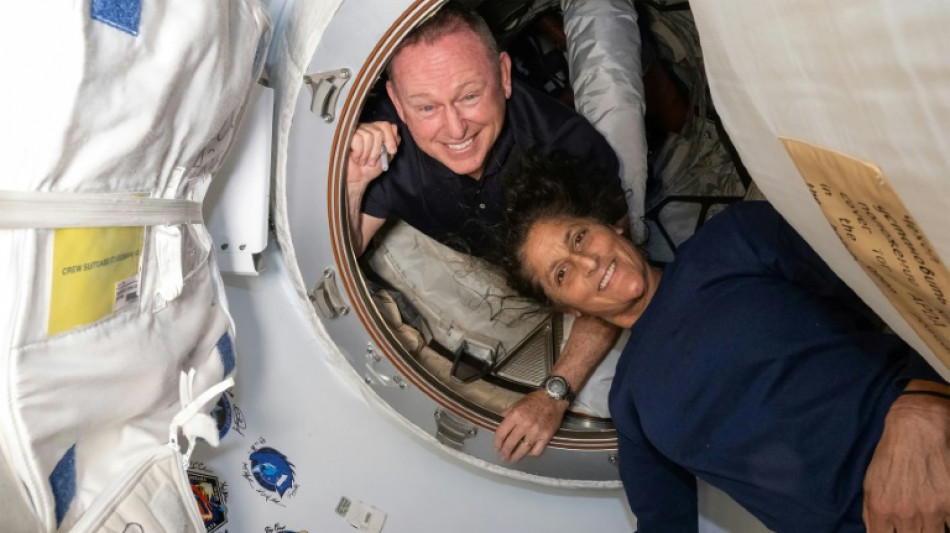
Boeing 'ran out of time' on Starliner: astronaut stuck on ISS / Photo: © NASA/AFP/File

 Arizona Superintendent Tom Horne to Leave Office, Plans Law Practice and Charter School

 Japan and Peru Mark 150 Years of Diplomatic Ties Amidst Trade and Investment Talks

 Ian Jackson Scores Game-High 22 Points After Rick Pitino's Prank Suspension

 Khan Welcomes Milburn’s Youth Employment Reforms Amid High NEET Rates

 Shinde Clarifies Torn Photo Controversy Amid Sonia Gandhi Book Protest

 BMW i3 vs Mercedes C-Class Electric vs Hyundai Ioniq 6: The Ultimate Premium EV Showdown

 BING X: 22,624.66 SNC have disappeared at BingX – how safe are tokens on BingX? Will BingX’s MiCAR licence be suspended?

 Urban Company Raises Rs 2,500 Crore via QIP to Expand InstaHelp
A US astronaut stuck on the International Space Station said Friday he believed Boeing's Starliner could have carried him home, if more time had been available to work through the beleaguered spacecraft's issues.
Last week, Barry "Butch" Wilmore and Sunita "Suni" Williams watched the Boeing Starliner they rode to the ISS three months prior head back to Earth without them.
"We could have gotten to the point, I believe, where we could have returned on Starliner, but we just simply ran out of time," Wilmore said Friday in a video press conference.
On June 5, Wilmore and Williams took off aboard the Starliner as part of the vessel's first crewed mission, in what was originally meant to be eight days in orbit.
After the Starliner ran into several technical issues, their stay is now expected to last for eight months.
Last month, NASA decided Williams and Wilmore will return in February with the Crew-9 flight of Boeing's aerospace rival SpaceX.
Though Wilmore said he was "absolutely not" let down by the decision to stay in space, he indicated there were "disagreements" about how to handle the return.
"In this case, we found some things that we just could not get comfortable with putting us back in the Starliner when we had other options," Wilmore said.
Williams said she was "so happy" Starliner landed on Earth without issues, even if they were not on it.
"We wanted to take Starliner to the completion and land back on land at home, but you know, you have to turn the page and look at the next opportunity," she said.
Both astronauts said the support they have received has helped them transition to the new return timeline.
"I can sum it up in one word, and that's resiliency," Wilmore said. "We are tasked -- and we learn, and we train -- to handle all types of situations."
A.Ammann--VB
