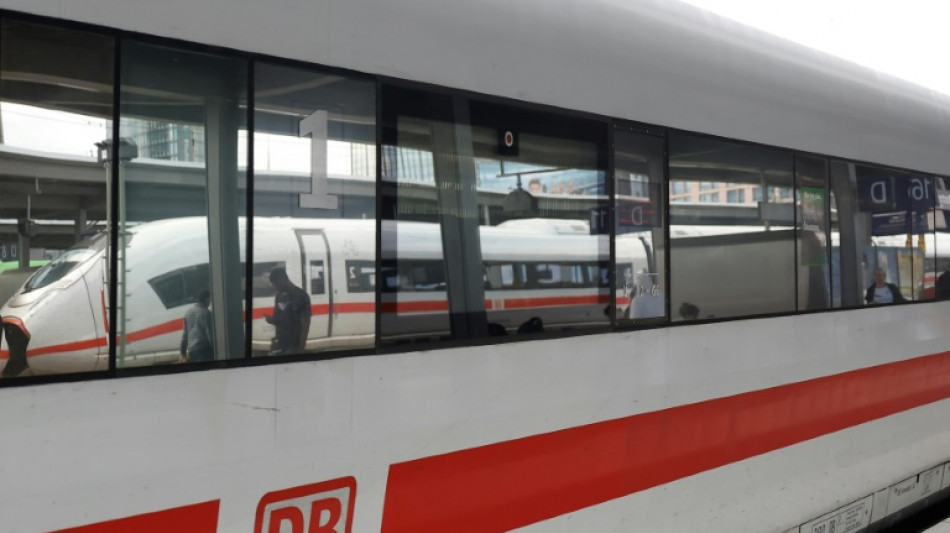
Troubled Deutsche Bahn sells logistics unit to Danish group / Photo: © AFP

 Arizona Superintendent Tom Horne to Leave Office, Plans Law Practice and Charter School

 Japan and Peru Mark 150 Years of Diplomatic Ties Amidst Trade and Investment Talks

 Ian Jackson Scores Game-High 22 Points After Rick Pitino's Prank Suspension

 Khan Welcomes Milburn’s Youth Employment Reforms Amid High NEET Rates

 Shinde Clarifies Torn Photo Controversy Amid Sonia Gandhi Book Protest

 BMW i3 vs Mercedes C-Class Electric vs Hyundai Ioniq 6: The Ultimate Premium EV Showdown

 BING X: 22,624.66 SNC have disappeared at BingX – how safe are tokens on BingX? Will BingX’s MiCAR licence be suspended?

 Urban Company Raises Rs 2,500 Crore via QIP to Expand InstaHelp
Troubled German rail operator Deutsche Bahn announced Friday the sale of its logistics unit Schenker to Danish group DSV for 14.3 billion euros ($15.8 billion) to create a freight-forwarding giant.
The state-owned German group, which has faced mounting criticism due to creaking infrastructure and poor punctuality, said the deal would provide fresh investments into Europe's biggest economy and help pay down its monster debts.
"With the acquisition we bring together two strong companies, creating a world-leading transport and logistics powerhouse that will benefit our employees, customers and shareholders," DSV chief executive Jens Lund said in a statement.
The new entity will aim to compete with other heavyweights in the sector, like DHL, UPS and Fedex.
DSV, founded in 1976, said the deal was its biggest transaction to date.
The combined companies will have 147,000 employees in more than 90 countries and generate revenue of 39.3 billion euros. The transaction is expected to close in 2025.
Despite fears about job cuts following the sale, DSV insisted Germany will remain a "key market" for the company and it will retain Schenker's offices in Essen, western Germany.
- Huge debts -
Deutsche Bahn launched the sale of Schenker, its most profitable subsidiary, at the end of 2023, seeking funds to pay down a 30-billion-euro debt and plough desperately needed investments into Germany's creaking rail infrastructure.
Deutsche Bahn CEO Richard Lutz said that the sale was the largest transaction in the operator's history and "provides our logistics subsidiary with clear growth prospects".
The Danish group plans to invest one billion euros in Germany over the next three to five years, Deutsche Bahn said.
The German rail group said the sale will enable it to focus on its top priority -- improving rail infrastructure and operations, which are also seen as key to helping Germany reach climate goals.
Deutsche Bahn, once a symbol of German efficiency, has been blighted by problems in recent years, with critics blaming chronic underinvestment.
Breakdowns and delayed arrivals are now commonplace on the German railways. Last year 36 percent of long-distance trains arrived six minutes or more past their scheduled arrival time, well above the European average.
The problems on the network were on display when Germany hosted the Euro 2024 football tournament in June and July, with fans complaining frequently about problems on the network.
Its net losses soared 16-fold year-on-year in the first half of 2024, with the operator blaming extreme weather, strikes and upgrades to its network.
By reducing its vast debts, the sale of Schenker "will make a substantial contribution to the group's financial sustainability," Deutsche Bahn chief Lutz said.
The sale of Schenker has left its employees in Germany fearing for their jobs, with staff protesting against the move outside the subsidiary's office this week.
DSV has promised to maintain, and even increase, staffing numbers in Germany in the long-term but there concerns are about an initial phase of cuts.
The Handelsblatt financial daily reported that DSV initially wants to cut about 1,600 to 1,900 jobs at Schenker in Essen and Frankfurt, up to 15 percent of the unit's staff in Germany.
R.Fischer--VB
