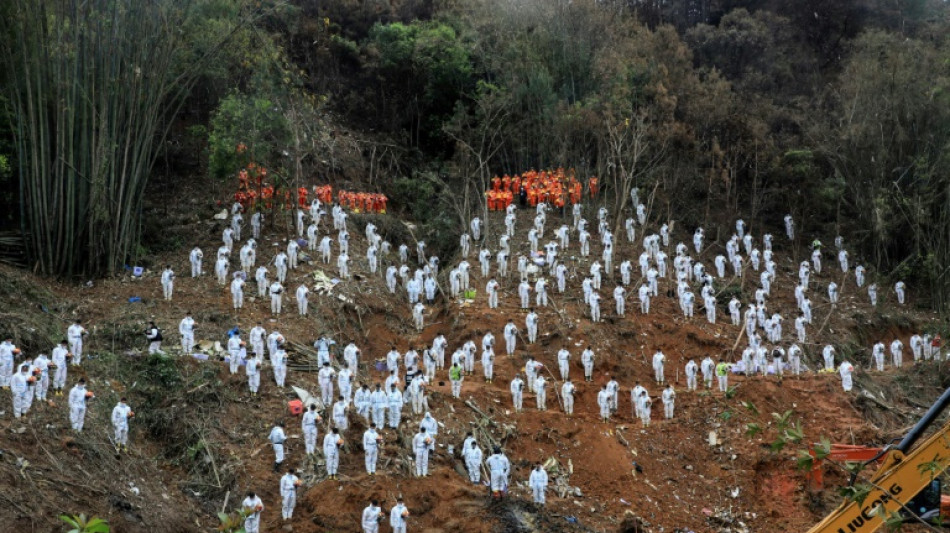
China reinforces tight control over plane crash mystery / Photo: © CNS/AFP

 Trent Perry’s Late Heroics Lift No. 7 UCLA Past Cal State Fullerton

 2027 Hyundai Elantra Review: Brutalist Design and Expanded Dimensions

 Malta Maritime Forum Study Reveals €1 Billion Economic Contribution Amid Growth Concerns

 China Condemns Chile-Belgium Joint Bid for High Seas Treaty Headquarters

 Dún Laoghaire-Rathdown €335m Budget Faces Mixed Reaction Over Housing and Cost of Living

 Dubai Police Expand Luxury Patrol Fleet with 525-hp Defender

 Iran Strikes US Sites in Kuwait Following US Airstrikes on Qeshm Island
The cause of China's deadliest air crash in decades remains a mystery, with authorities giving few details in a preliminary report on Wednesday while enforcing strict censorship one month after the disaster.
In the immediate aftermath of the crash, China's ruling Communist Party moved quickly to control information, revving up its censorship machine as media outlets and local residents raced to the crash site.
It has maintained its tight grip over the narrative, with the preliminary probe leaving key questions unanswered.
China Eastern flight MU5375 was travelling from Kunming to Guangzhou last month when it inexplicably plunged from an altitude of 29,000 feet into a mountainside, killing all 132 people on board.
Beijing was required to submit a preliminary report to the International Civil Aviation Organisation within 30 days.
According to that report, investigators found no evidence of "anything abnormal", the country's Civil Aviation Administration (CAAC) said on Wednesday.
The regulator has indicated, however, that it will not make the preliminary report available to the public and a full investigation may take years.
In a statement, the CAAC said staff had met safety requirements before takeoff, the plane was not carrying dangerous goods and did not appear to have run into inclement weather.
No reasoning was given as to why the plane abruptly dropped out of the sky, nor were details shared about the two flight trackers or "black boxes" that were recovered.
The devices -- a cockpit voice recorder and a flight data tracker -- are being analysed at an American lab with the help of US government investigators.
The crash was China's deadliest in around 30 years and dented the country's otherwise enviable flight safety record.
- Information chokehold -
After the fatal descent near the southern city of Wuzhou, authorities swiftly cordoned off a huge area, with officials -- some wearing military fatigues -- initially denying access to AFP journalists.
Attempts to reach the victims' relatives were rebuffed, as officials housed the bereaved in heavily guarded hotels and blocked reporters who tried to approach them.
Relatives did not respond to AFP interview requests for this story.
State media played up the rescue and recovery effort, even as the few outlets that published details of the deceased found themselves ensnared in online controversy for appearing to capitalise on grief.
Meanwhile, China's internet regulator announced it had scrubbed vast amounts of "illegal information" on the crash from China's tightly controlled web, as a social media hashtag bearing the plane's flight number appeared to be censored.
The information chokehold was a far cry from past disasters, when buccaneering Chinese reporters unearthed damning evidence of government shortcomings -- notably the shoddy construction of thousands of government-built schools that collapsed during the 2008 Sichuan earthquake.
Beijing's strategy in reporting on the MU5375 tragedy has been to stress official action and "de-emphasise emotion", said David Bandurski, director of the University of Hong Kong's China Media Project.
"They don't want human personalities," he told AFP. "It creates sympathy and emotion that can be directed towards agendas that aren't the leadership's."
- No surprises -
The enhanced public scrutiny around the crash helps to explain Beijing's kneejerk attempts to direct the narrative, said Margaret E. Roberts, an associate professor specialising in Chinese censorship at the University of California San Diego.
Disasters, she told AFP, "can easily turn political".
"Many people pay attention to them at once. As a result, one misstep by the government in their response to the crisis can be very damaging."
In the month after the crash, state media pivoted towards the message that it was time for the public to put the incident behind them -- allowing other events to drown out coverage of the disaster, Bandurski said.
Such diversion tactics mean "we can expect the same type of sensitivity" around reports on the causes of the crash, he added, warning of heightened secrecy in a potentially turbulent year that will likely see President Xi Jinping bid for a precedent-smashing third term in office.
"The last thing they want is another story to come out of left field and surprise them."
E.Schubert--BTB
