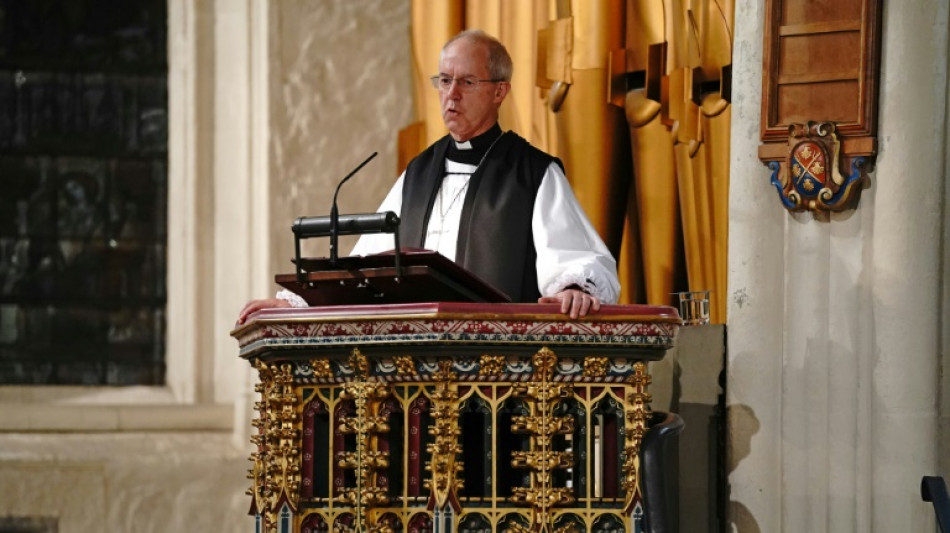
UK archbishop raises 'ethical questions' on Rwanda migrants plan / Photo: © POOL/AFP/File

 Arizona Superintendent Tom Horne to Leave Office, Plans Law Practice and Charter School

 Japan and Peru Mark 150 Years of Diplomatic Ties Amidst Trade and Investment Talks

 Ian Jackson Scores Game-High 22 Points After Rick Pitino's Prank Suspension

 Khan Welcomes Milburn’s Youth Employment Reforms Amid High NEET Rates

 Shinde Clarifies Torn Photo Controversy Amid Sonia Gandhi Book Protest

 BMW i3 vs Mercedes C-Class Electric vs Hyundai Ioniq 6: The Ultimate Premium EV Showdown

 BING X: 22,624.66 SNC have disappeared at BingX – how safe are tokens on BingX? Will BingX’s MiCAR licence be suspended?

 Urban Company Raises Rs 2,500 Crore via QIP to Expand InstaHelp
The Church of England's most senior cleric, Justin Welby, on Sunday criticised the British government's plans to send asylum-seekers to Rwanda to process their claims.
The scheme has sparked outrage and widespread criticism from human rights organisations and even the UN.
And Welby, who as the Archbishop of Canterbury is the Church of England's highest-ranking cleric, added his voice to the dissent in his Easter Day address.
While "the details are for politics and politicians", Welby suggested that sending asylum-seekers overseas posed "serious ethical questions".
"The principle must stand the judgement of God and it cannot," Welby said.
A country like Britain informed by Christian values cannot "sub-contract out our responsibilities, even to a country that seeks to do well like Rwanda," the church leader continued.
It "is the opposite of the nature of God".
When unveiling the policy last week, Prime Minister Boris Johnson had already suggested there could be legal challenges to the plans.
But the interior ministry, or Home Office, which is in charge of implementing the policy, argued that Britain's current system was "broken" and pointed to unprecedented global migratory pressures.
- 'Whatever it takes' -
Johnson has pledged to do "whatever it takes" to ensure the plans work -- but the UN refugee agency UNHCR condemned the scheme as an "egregious breach of international law".
According to an exchange of letters published by the Home Office, the ministry's top civil servant, Matthew Rycroft, stressed on the eve of the announcement his doubts about both the expected "deterrent effect" of the scheme and its cost.
But Home Secretary Priti Patel said it would be "imprudent" to delay a measure that "we believe will reduce illegal migration, save lives, and ultimately break the business model of the smuggling gangs".
According to Rwanda, the British government will fund the deal by up to 120 million pounds ($157 million, 144 million euros) and migrants would be "integrated into communities across the country".
"I recognise your assessment on the immediate value for money aspect of this proposal. However, I note that without action, costs will continue to rise, lives will continue to be lost," Patel added in the letter.
British media from the left-leaning Guardian to the conservative Daily Telegraph on Saturday warned the policy could spark a "mutiny" among civil servants tasked with making the scheme operational.
For Tahsin Tarek, a 25-year-old glazier from Arbil, the capital of Iraq's Kurdistan region, who is saving up to finance a new trip to Europe, the British announcement is a game changer.
"(I) will think about another country," he told AFP on Saturday.
"To live here and endure the difficulties here is better than living in Rwanda.
"I don't think anyone will accept this decision and go live there. If they give the refugees a choice between being expelled to Rwanda or their country, they will choose their own country."
C.Meier--BTB
