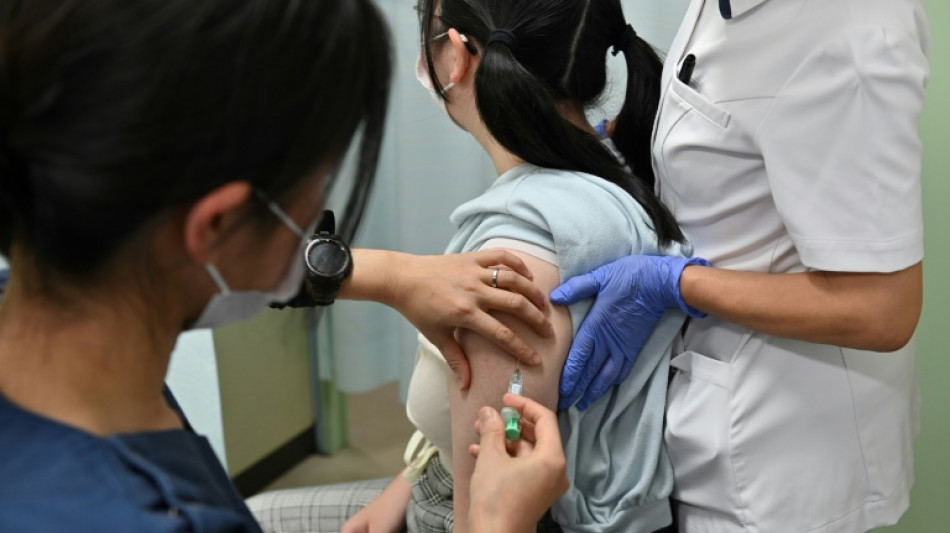
Single HPV shot enough for young women: WHO experts / Photo: © AFP

 Arizona Superintendent Tom Horne to Leave Office, Plans Law Practice and Charter School

 Japan and Peru Mark 150 Years of Diplomatic Ties Amidst Trade and Investment Talks

 Ian Jackson Scores Game-High 22 Points After Rick Pitino's Prank Suspension

 Khan Welcomes Milburn’s Youth Employment Reforms Amid High NEET Rates

 Shinde Clarifies Torn Photo Controversy Amid Sonia Gandhi Book Protest

 BMW i3 vs Mercedes C-Class Electric vs Hyundai Ioniq 6: The Ultimate Premium EV Showdown

A single vaccine shot against Human Papillomavirus (HPV), which causes cervical cancer, delivers comparable protection for girls and women under 21 as two doses, the WHO's immunisation experts said.
"This could be a game-changer for the prevention of the disease, seeing more doses of the life-saving jab reach more girls," the World Health Organization said.
More than 95 percent of cervical cancer is caused by sexually-transmitted HPV, which is the fourth most common type of cancer in women globally.
Almost entirely preventable, the disease is often referred to as the "silent killer".
The WHO's Strategic Advisory Group of Experts on Immunisation (SAGE) evaluated new evidence that single-dose schedules provide comparable efficacy to two- or three-dose regimens.
They concluded that one shot delivers solid protection against HPV.
"SAGE urges all countries to introduce HPV vaccines," the group's chair Alejandro Cravioto said Monday.
"These recommendations will enable more girls and women to be vaccinated and thus preventing them from having cervical cancer and all its consequences over the course of their lifetimes."
SAGE recommended a one or two-dose schedule for girls aged nine to 14; the same for young women aged 15 to 20; and two doses with a six-month interval for women over 21.
Immunocompromised individuals should receive three doses if feasible.
The new recommendations replace the old guidelines of two doses among girls aged nine to 14, and three shots for girls and women aged 15 and over.
More than 340,000 women died from cervical cancer in 2020.
"I firmly believe the elimination of cervical cancer is possible," said WHO assistant director-general Nono Simelela.
"This single-dose recommendation has the potential to take us faster to our goal of having 90 percent of girls vaccinated by the age of 15 by 2030."
Global uptake of the vaccine has been slow, and far short of the 2030 target, due to supply challenges, the cost of delivering two doses and with older girls falling outside of routine childhood immunisation programmes.
SAGE said the vaccine supply situation was improving in the short and medium term.
Girls aged nine to 14 should be the primary target for vaccination, then older girls and women who have missed out on the jabs, the group said.
The vaccination of boys and men -- with a one- or two-dose regimen -- should be managed carefully until there is an unconstrained vaccine supply, said SAGE.
O.Krause--BTB


