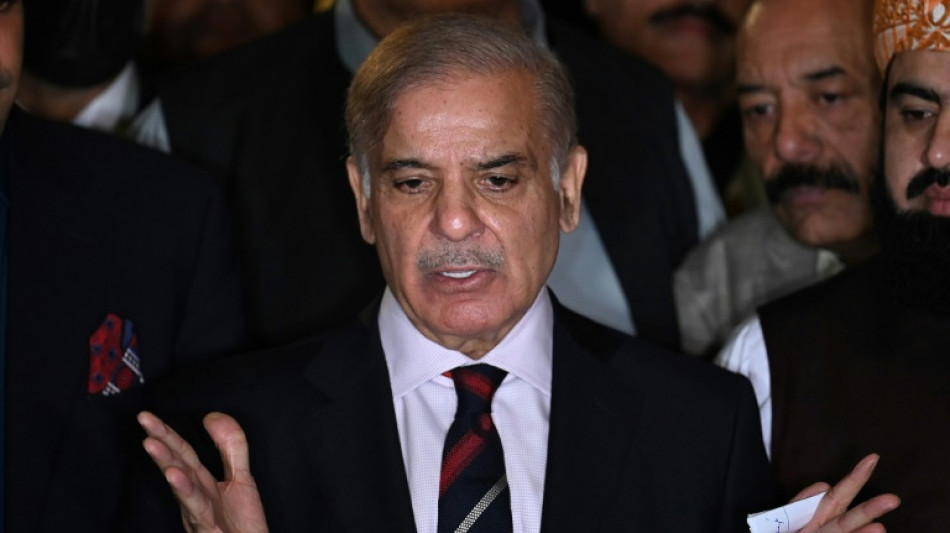
Sharif elected new Pakistan PM after Khan ouster / Photo: ©

 Arizona Superintendent Tom Horne to Leave Office, Plans Law Practice and Charter School

 Japan and Peru Mark 150 Years of Diplomatic Ties Amidst Trade and Investment Talks

 Ian Jackson Scores Game-High 22 Points After Rick Pitino's Prank Suspension

 Khan Welcomes Milburn’s Youth Employment Reforms Amid High NEET Rates

 Shinde Clarifies Torn Photo Controversy Amid Sonia Gandhi Book Protest

 BMW i3 vs Mercedes C-Class Electric vs Hyundai Ioniq 6: The Ultimate Premium EV Showdown

Pakistan lawmakers on Monday elected Shehbaz Sharif as the country's new prime minister following the weekend ouster of Imran Khan, who resigned his national assembly seat -- along with most of his party members -- ahead of the vote.
Khan was dismissed Sunday after losing a no-confidence vote, paving the way for an unlikely alliance that faces the same issues which bedevilled the cricket star-turned-politician.
Sharif immediately announced a raft of populist measures, including a new minimum wage of 25,000 rupees (around $135), pay rises for civil servants, and development projects in rural areas.
Sharif, leader of the centrist Pakistan Muslim League-N (PML-N), was the only candidate after Khan loyalist Shah Mahmood Qureshi, the former foreign minister, withdrew his candidacy and resigned his seat.
"It's a victory of righteousness, and evil has been defeated," Sharif said in his maiden speech as premier, to cheers from the remaining lawmakers.
Khan's Pakistan Tehreek-e-Insaf (PTI) party had 155 members of the 342-seat chamber before the mass resignations, and Sharif was elected with 174 votes.
Once sworn in, Sharif's first task will be to form a cabinet that will also draw heavily from the centre-left Pakistan Peoples Party (PPP), as well as find space for the smaller conservative Jamiat-ulema-e-Islam-F (JUI-F) group.
- Bitter rivals -
The PPP and PML-N are dynastic parties that have dominated Pakistani politics for decades -- usually as bitter rivals -- but their relations are sure to fray in the lead-up to the next election, which must be held by October 2023.
"History knows there is no ideological convergence among them," Qureshi said before storming out.
They need to tackle soaring inflation, a feeble rupee and crippling debt, while militancy is also on the rise -- with Pakistan's Taliban emboldened by the return to power last year of the hardline Islamist group in neighbouring Afghanistan.
"The situation is very bad, but I am sure that we will change it with the blessing of Allah and with hard work," said Sharif.
Sharif may also rethink Pakistan's global alignment, which drifted away from Washington under Khan and closer to Russia and China -- a vital economic partner.
"On the foreign policy front we have to face a lot of debacles. Our strategic partners left us," he said.
Sharif is the younger brother of disgraced three-time prime minister Nawaz Sharif, and Pakistan media are already speculating the latter may soon return from exile in Britain.
The elder Sharif was dismissed in 2017 and later jailed for 10 years by an accountability court on graft charges after revelations from the Panama Papers, but was released to seek medical treatment abroad.
The younger Sharif is also mired in graft proceedings. In 2019, the National Accountability Bureau seized nearly two dozen properties belonging to him and his son Hamza, accusing them of money laundering.
He was arrested and detained in September 2020, but released six months later on bail for a trial which is still pending.
A seasoned politician in his own right, Sharif, 70, jointly inherited the family's steel business as a young man and was first elected to provincial office in 1988.
He is known as a tough administrator, feared for his frequent "surprise visits" to government institutions, and has a penchant for quoting revolutionary poetry.
- Defeat not taken well -
No prime minister has ever served a full term in Pakistan, but Khan is the first to lose office via a vote of no-confidence -- a defeat he has not taken well.
He tried everything to stay in power after losing his majority in parliament -- including dissolving the assembly and calling a fresh election.
But the Supreme Court deemed all his actions illegal and ordered them to reconvene and vote.
Khan insists he has been the victim of a "regime change" conspiracy involving Washington and his opponents, and has vowed to take his fight to the streets in the hope of forcing an early election.
Sharif promised an investigation into Khan's allegations.
"If an iota of evidence is provided against us, I will immediately resign," he told parliament.
C.Kovalenko--BTB


