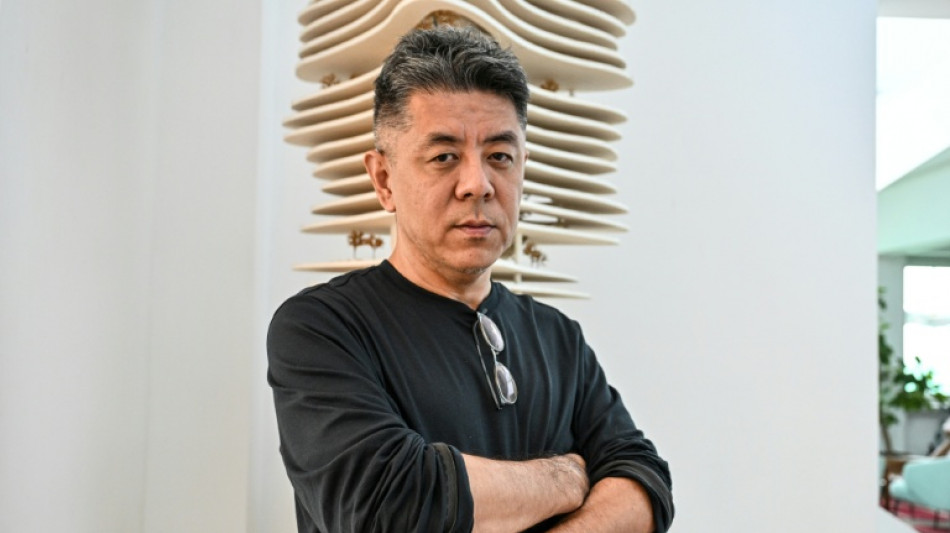
Chinese architect Ma Yansong melds nature with 'futuristic feel' / Photo: © AFP

 Television's A-listers glitter on Emmys red carpet

 US Supreme Court blocks Trump mail-in ballot restrictions

 Dodgers clinch playoff berth in bid for third straight World Series
 Doomers and boosters: who's who in the AI wars
 GAC presents autonomous trucks and MONTX concepts at Hannover show

 EU extends Russia sanction deadline
 Thai wildlife investigators track traffickers through social media

 Trump rejects AI slowdown concerns as UN urges coordinated controls

 US judge postpones new visa rules for foreign students, journalists

 Higher wages draw migrant workers to Kashmir despite attacks

 Oil supply concerns and AI warnings weigh on global markets
 'I am the hoax buster': Trump rejects AI danger warnings
 Macklemore dropped from Ed Sheeran tour after 'free Palestine' speech
 Trump's son confirms Russian businessman paid for post-wedding festivities

 Betis beat winless Villarreal to go third

 Etihad capacity rises as war disruption weighs on annual earnings

 At G20 summit, US unravels power plant climate rules

 Russian disinformation campaign sets sights on US midterms
 England No 8 Pollock could move abroad or switch sports amid contract stand-off
 Canada makes pitch as safe place to invest in 'uncertain world'

 In-form Malen fires Roma to Serie A summit
 IOC visits Lyon amid leadership turmoil for 2030 Winter Olympics
 New York seizes 12 celeb deep-fake porn sites

 Jesse Eisenberg channels emotional intensity into 'The Debut'
 Alarm over AI grows as divided US Congress struggles to act
From a distance, it looks as though a giant spaceship has just landed in the palm tree-dotted streets near downtown Los Angeles.
It could also be a wide-canopied tree or a low passing cloud -- but for its Chinese architect Ma Yansong, as long as the building "sparks curiosity", he's achieved his purpose.
Over the past two decades, Ma has created dozens of visually striking projects in his home country and abroad, integrating nature with sleek, modern designs.
In some ways, his seemingly sci-fi-inspired style is a perfect match for his newest project opening on September 22, the Lucas Museum of Narrative Art in Los Angeles, founded by "Star Wars" creator George Lucas and his wife, Mellody Hobson.
"The building takes on a futuristic feel that generates excitement," Ma told AFP at the Beijing office of MAD Architects, the firm he established in 2004.
"When people visit the Lucas Museum, they will each bring their own unique perspectives," said the 50-year-old, who last year was included on Time magazine's list of the 100 most influential people.
"They might catch a beam of light, see it cutting through the building, glimpse the clouds, the sky, or even the cosmos.
"This sparks curiosity and new ideas -- and those diverse thoughts are incredibly valuable."
- Mountains and water -
A Beijing native, he grew up in a courtyard house typical of the "hutong" alleyways that crisscross the historic centre of China's capital city.
"There was a very close connection to nature," he said, recalling the trees and small pockets of open space interspersed in hutong neighbourhoods.
Later, he went overseas to train as an architect, graduating from the Yale School of Architecture and working briefly at the studio of acclaimed Iraqi-British designer Zaha Hadid.
Ma and his firm have conceptualised landmark works all over China, including the Harbin Opera House, a vast, swooping structure perched dramatically on the banks of the frigid Songhua River.
Abroad, his notable projects include a pair of twisting residential buildings called the "Absolute Towers" near Toronto, Canada, and a migration-themed museum that opened last year in Rotterdam, the Netherlands.
Ma's architectural vision draws inspiration from traditional Chinese paintings known as "shanshui", or "mountains and water", usually depicting natural scenery.
The Lucas Museum is closely interwoven with its external environment by lawns, trees, running water and a roof covered in vegetation and solar panels.
"If you look at a Chinese garden, it is a completely natural environment, even though it is artificially designed," Ma told AFP.
"There is a global conversation (now) about ecology and how to bring people closer to nature, yet I find that traditional Eastern architecture mastered this long ago," he said.
- People-centred architecture -
Ma told AFP that he embraces what he calls a "major shift" in architecture towards placing people, rather than the buildings themselves, at the centre of the design concept.
"We aren't using architecture to flaunt wealth or power," he said.
Although many of MAD's clients wield significant financial resources, Ma said his focus is not merely to impress, but also to create "uniquely valuable space for people to enjoy".
MAD's Beijing office is located in the heart of a hutong neighbourhood near where Ma attended school in his youth.
"I like these small streets, with their trees, the people walking by and that certain atmosphere of everyday urban life," he said.
Ma said when he designs a building he wants to make sure it gives "freedom of movement" to residents -- a concept which drove his design of the Baiziwan Social Housing project in Beijing, a subsidised residential compound for low-income communities.
"Many low-income individuals feel they cannot integrate into the city," said Ma.
"Often, such housing is walled off, isolating residents," he said, adding: "It's a psychological barrier -- they feel the city doesn't accept them."
Unlike the closed, block-like apartments that have sprung up in Chinese cities during decades of rapid urbanisation, Baiziwan features an open layout with an elevated garden level and a design that optimises sunlight.
Ma said he doesn't want his buildings "to be a palace or a temple-like structure that demands reverence".
"I want it to be open, a place where everyone feels they are the masters of the city."
C.Koch--VB