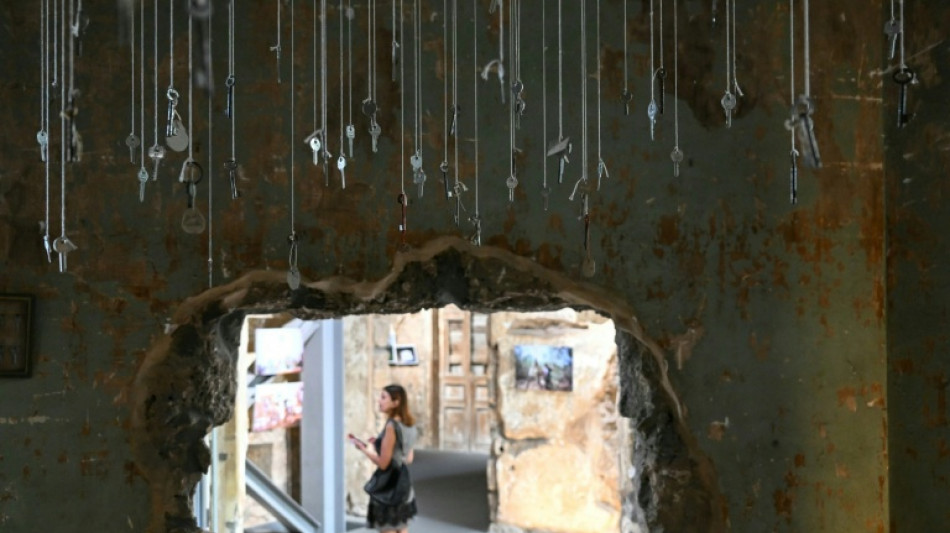
In a Lebanon museum, 'keys without homes' evoke destruction in south / Photo: © AFP

 Macron welcomes Canada's Carney to French Atlantic territory
 Fiorentina frustrate Napoli with Serie A draw, Como upset

 Five-star Man City top Premier League after Sunderland thriller
 Ukrainian drones hit Moscow on last day of Russian elections
 Multi-Asset Trading Venue Monochrome Exchange Announces IEO of Its Native Token, $MCR
 South Korea break Japan hearts to win Asian Games basketball gold
 Acosta takes first victory at Austrian MotoGP
 PSG president Nasser al-Khelaifi under investigation in France for conflict of interest
 China swim sensation, 13, sets Games record after Japan win early

 Drones hit Moscow as Russians go to the polls

 New England boss Fleming says 'wrong' to ask Stokes to end retirement

 Germans vote in elections threatening fresh blow to Merz
 US fears rapid escalation in Mideast after Houthis attack Riyadh
 Japan triathlete Hojo wins first gold of Asian Games
 IOC president impressed by 'beautiful' Asian Games wooden huts

 First Asian Games gold goes to Japan as China's 13-year-old Yu lights up pool
 Data centre command hub keeps AI up and running
 Pope Leo in France: the issues on the table
 Packing for a pope: behind the scenes on foreign trips

 Republicans find transgender issues a powerful political weapon in midterm campaigning

 German state elections threaten new shock waves for Merz

 Chile's Bachelet quits race to be next UN chief

 Raphinha treble fires perfect Barca to win at Sevilla
 Thiam makes winning heptathlon return at Decastar meet
 Czechs beat USA to qualify for Davis Cup finals
Tears streamed down south Lebanon resident Fatima Hajj Ali's face as she stared at a host of keys hanging like windchimes from the ceiling of a Beirut museum -- each one symbolising a home, like her own, destroyed by Israel.
Hajj Ali is among the thousands of southerners who lost their houses in the recent conflicts between Israel and Hezbollah, the first of which broke out in 2023 when the group launched attacks in support of its ally Hamas, and the second in March when it entered the Middle East war on the side of its backer Iran.
"We were supposed to go home and open the door with the key, but there is no door anymore," the 23-year-old said.
Despite a lull in fighting following the signing of a memorandum of understanding between the United States and Iran on June 17, intermittent Israeli strikes continue, as do widespread demolitions in and around occupied villages, making it impossible for many people to return.
The exhibition "Hkeeli ya Jnoub", or "Tell me, O South", features pictures and videos preserving the memory of southern Lebanon at the capital's Beit Beirut museum.
Walking through, Hajj Ali reminisced on her home in Nabatieh al-Fawqa, which she was only able to visit once after an April truce that ultimately failed to stop the fighting.
"Half the house collapsed and half remained," she told AFP.
"I long for sunset and to hear the call to prayer in our garden while I drink my coffee," said the psychologist, adding that Beirut had "beautiful" places, but "they are not home".
One of the projects on display is "Keys Without Homes", which comprises videos of three southerners who kept the keys to their houses, even though they no longer exist.
The artist, 36-year-old Adeeb Farhat, himself from the south, said the idea came to him during the previous war in 2024, when he feared losing his own home.
"I was constantly haunted by the question: What will happen to my house? Will it be bombed? And how will my relationship with my house key change? Will we become the new Palestinians?" he said.
There is a longstanding tradition among Palestinians of keeping the keys of homes they lost during the Nakba -- or "catastrophe" in Arabic -- which saw the flight and expulsion of an estimated 760,000 Palestinian Arabs during the creation of the State of Israel in 1948.
- 'What Remains' -
Within the exhibition halls, a bedroom, living room and kitchen -- complete with a glass jug, coffee pot, and spice containers -- recreate details of daily life in the homes of southern Lebanese residents.
The exhibition also includes an old photograph of the coastal city of Tyre, a black-and-white video of Nabatieh, and notebooks in which visitors wrote down their memories of the south.
In another work called "What Remains", Sama Beydoun, 29 and living in Paris, showed pictures of her grandfather's now-destroyed home in Bint Jbeil, near the border with Israel, which she last saw in 2025.
However, a technical glitch resulted in most of the images appearing blurry, making them look like a "dream", Beydoun said.
"I remember how many people this house brought together, how my family grew up there, how many generations it witnessed, and how life changed, while some things remained constant", like the weekly Sunday gatherings, she said.
"Life was very simple, but it was beautiful."
In a photo essay called "Manufacturing Estrangements", Rawan Mazeh, 29, tells the story of a couple detained in the notorious Khiam Prison, run by the South Lebanon Army, an Israeli proxy militia, during Israel's 22-year occupation of south Lebanon that ended in 2000.
To Mazeh, the exhibition "created a comfortable place where people could come and feel close to their land".
A.Ammann--VB