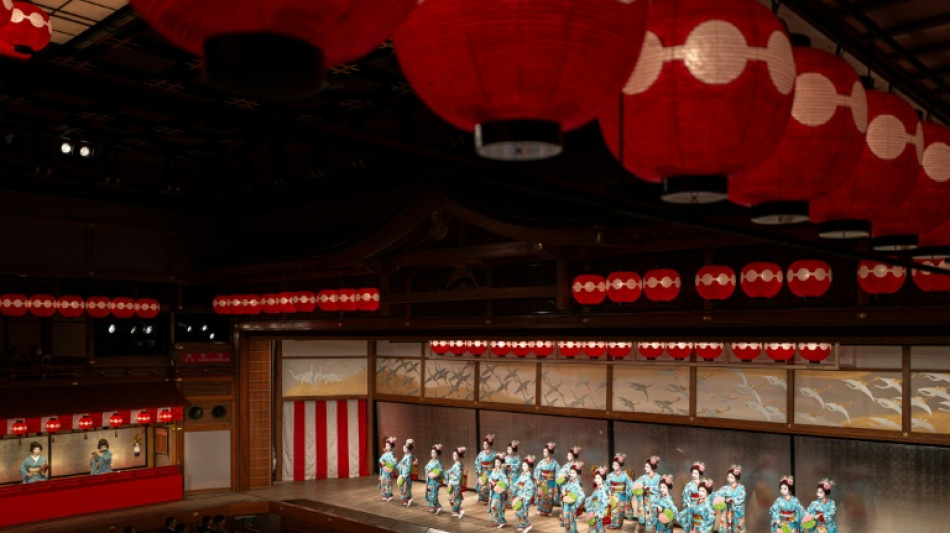
Geisha spectacle in Japan's Kyoto celebrates arrival of spring / Photo: © AFP

 British buyers pay substantial premiums for period-home appearance

 Thomas Markle released to house arrest after child-abuse-image charge

 Dawn of War 4 developers chose Adeptus Mechanicus for tactical variety

 Italy face unbeaten South Africa in Turin Nations Championship match

 ChatGPT interactive interface feature tested across six custom tools

 Freshways milk-price cut deepens pressure on UK dairy farms

 Labour and National remain virtually tied as New Zealand vote count advances

 The Good Daughter adapts Karin Slaughter thriller with Rose Byrne and Meghann Fahy

 Heavy-lift drone evacuates wounded Ukrainian soldier from frontline kill zone

 Morrison says West Brom recovered after pressure from successive derby losses

 Britain considers 2027 state visit for Ukraine’s Zelensky

 Arizona Democrats Secure Historic Trifecta with New Legislative Leadership

 Carney Welcomes U.S. Trade Reversal After Democratic Midterm Victory

 Armenian FM Discusses EU Accountability for Palestinian Rights in Madrid

 Trump and Vance Pursue Secret Diplomacy with Iran Amid Military Pressure

 Classic Car Values Surge: De Tomaso Vallelunga Leads 190% Gain

 Microsoft Ends Oracle AI Computing Rental Deal Amid Cloud Strategy Shift
Against a backdrop of blooming cherry blossoms, a group of geishas elegantly shuffle onto a stage in Japan's Kyoto city to begin a centuries-old performance celebrating the arrival of spring.
Dressed in sky blue kimonos emblazoned with flowers, the dancers twist and twirl in unison in front of hundreds of spectators eager to see the annual "Miyako Odori" in the nation's spectacular ancient capital.
Geishas, known as geikos in Kyoto, and apprentices called maikos have been donning elaborate costumes and fluttering fans since the Miyako Odori -- or "capital city dance" -- first started in 1872.
"Just as cherry blossoms bloom when spring approaches, the Miyako Odori is a spring tradition in Kyoto," Kyoko Sugiura, head of the Yasaka Nyokoba Gakuen, a school for geishas in Kyoto's Gion district, told AFP.
In Japanese, the word geisha means "person of the arts", and can refer to a woman or man trained in traditional Japanese performing arts.
In the popular imagination geishas are often confused with courtesans but their work as trained masters of refined old artforms does not involve selling sex.
Their performances are usually small and private, and take place at high-class establishments which operate a no first-time customer policy.
"That's why it is often thought of as a very exclusive world," Sugiura said.
"But the Miyako Odori is a one-hour show in which geisha and maiko have the opportunity to showcase the arts they practise daily," she said.
"Anyone and everyone with a ticket can enjoy the show."
The Miyako Odori began soon after Kyoto hosted Japan's first national expo -- an effort to revitalise the western city following the relocation of the capital to Tokyo in 1869.
The format of the performance has not changed much, Sugiura explained, although the music and dance moves are sometimes switched up.
Maria Superata, a geisha expert who has worked with them as an interpreter, explained that the show "combines all of the traditional performing arts that you can see in Japan".
"For example, elements from kabuki (classical Japanese theatre), elements from traditional dance. So they have to act, they have to sing, they have to play the instruments, everything all in one," she said.
"That's why it's so special."
But the number of geishas, who once made a living through performing for Japan's wealthy elite, is in decline.
Superata said that fewer young Japanese want a life that demands huge discipline and comes with a strict practise schedule.
"Nowadays, young Japanese people... are not very interested that much in traditional art and in kimono."
P.Keller--VB
