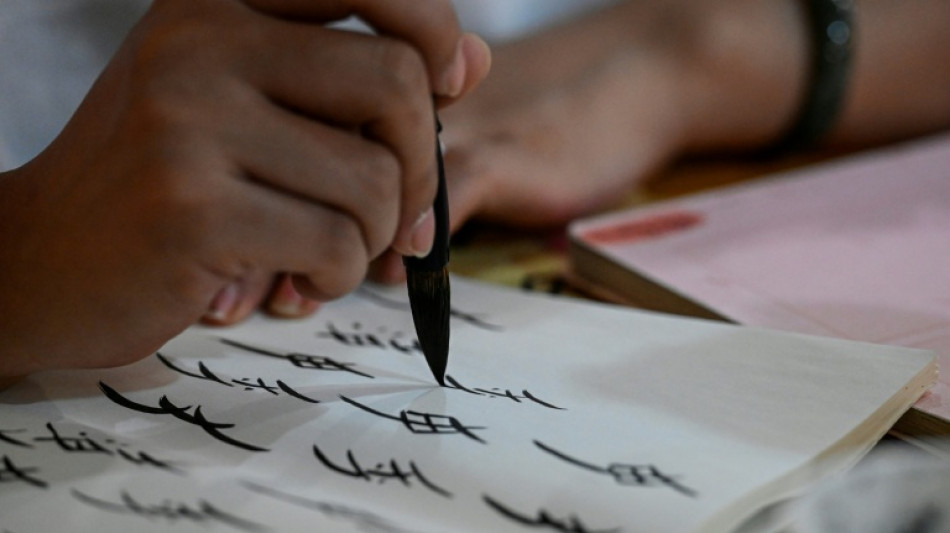
China's Gen Z women embrace centuries-old script / Photo: © AFP

 'New one' Klopp promises fresh approach as Germany reign begins

 Milne returns to New Zealand squad for India T20 series

 US-led Americas coalition backs sanctions against crime groups

 'Star Wars' fans and art lovers line up for new Lucas museum

 Trump renames AI 'super intelligence' as leaders jostle over dangers

 Oil prices retreat as markets welcome US-Iran talks

 US refusing to give Sudan's de facto leader visa for UN: diplomatic sources, UN

 Macron urges world to choose UN over 'law of the jungle'

 All-rounder Jacks stars as England beat Sri Lanka in 1st ODI
 Man City peg back Bayern to start Women's Champions League
 Trump beats 'America first' drum at UN as allies tread carefully
 Snedeker backs Spaun for Ryder Cup after Presidents snub

 French prosecutors probe secret filming of women with smart glasses

 Trump renames AI "super intelligence," rejects international oversight

 Trump rejects international regulation of AI

 How is the EU approaching record fuel prices?

 Sri Lanka's Colombage strikes on debut as England dismissed for 265 in first ODI

 Hurricane Polo strengthens to top category 5 off Mexico
 11 hurt as teen opens fire outside school in western Turkey

 UN chief says 'Big Oil' treats atmosphere as open sewer

 Tunisia says 2026 summer hottest on record

 England's Rashid out of Sri Lanka ODIs with hand injury
 Houthis accuse Saudi Arabia of deadly strikes as thousands flee

 Stocks climb as oil slides, AI buzz returns
 India cricketers win in style as Afghan savours 'special' Games silver

At a studio in central China's Hunan province, a teacher grips an ink brush, gently writing characters of a secret script created by women centuries ago and now being embraced by a new generation.
Nushu, meaning "women's script", emerged around 400 years ago. Barred from attending school, the women secretly learned Chinese characters and adapted them into Nushu, using the script to communicate with each other through letters, song and embroidery.
Passed down through generations of women in the remote and idyllic county of Jiangyong, it is now gaining popularity nationwide among Chinese women who view it as a symbol of strength.
Student Pan Shengwen said Nushu offered a safe way for women to communicate with each other.
"It essentially creates a sanctuary for us," the 21-year-old told AFP.
"We can express our thoughts, confide in our sisters and talk about anything."
Compared to Chinese characters, Nushu words are less boxy, more slender and shaped like willow leaves.
"When writing... your breathing must be calm, and only then can your brush be steady," Pan said.
On Instagram-like Xiaohongshu, the hashtag "Nushu" has beenviewedover 73.5 million times -- mostly featuring young women sharing tattoos and other modern work incorporating the old script.
Student He Jingying told AFP she had been enrolled in a Nushu class by her mother and that writing it brought her "a deep sense of calm".
"It feels like when the brush touches the paper, a kind of strength flows into you."
- Against 'injustice' -
Nushu is more than just a writing system -- it represents the lived experiences of rural women from the county, Zhao Liming, a professor at Beijing's Tsinghua University, told AFP.
"It was a society dominated by men," said Zhao, who has been studying Nushu for four decades.
"Their works cried out against this injustice," she said.
The words are read in the local dialect, making it challenging for native Chinese speakers not from the region to learn it.
Teacher He Yuejuan said the writing is drawing more attention because of its elegance and rarity.
"It seems to be quite highly regarded, especially among many students in the arts," He told AFP outside her gallery, which sells colourful merchandise, including earrings and shawls with Nushu prints.
As a Jiangyong native, He said Nushu was "part of everyday life" growing up.
After passing strict exams, she became one of 12 government-designated "inheritors" of Nushu and is now qualified to teach it.
- 'Really special' -
An hour's drive away, around a hundred Nushu learners packed into a hotel room to attend a week-long workshop organised by local authorities trying to promote the script.
Zou Kexin, one of the many participants, told AFP she had read about Nushu online and wanted to "experience it in person".
"It's a unique writing system belonging to women, which makes it really special," said Zou, 22, who attends a university in southwestern Sichuan province.
Animation student Tao Yuxi, 23, one of the handful of men attending the workshop, told AFP he was learning Nushu to gain inspiration for his creative work.
He said his aunt was initially confused about why he was learning Nushu, as it is not typically associated with men.
As it represents part of China's cultural heritage, Nushu has to be passed down, he said.
"It's something that everyone should work to preserve -- regardless of whether they are women or men."
S.Spengler--VB