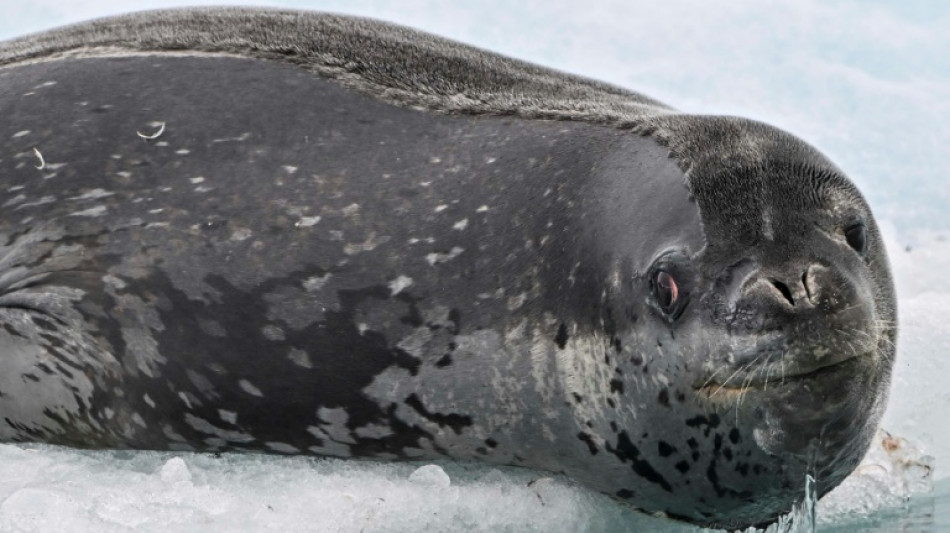
Seals sing 'otherworldly' songs structured like nursery rhymes / Photo: © AFP/File

 Schoolgirl Yu, 13, fastest again in bid for third Asian Games gold

 Oil prices fall after Trump hails 'good' talks with Iran

 AI political ads warp reality ahead of US midterms

 Kenneth Branagh embraces action hero role -- to get in shape

 'New one' Klopp promises fresh approach as Germany reign begins

 Milne returns to New Zealand squad for India T20 series
 US-led Americas coalition backs sanctions against crime groups

 'Star Wars' fans and art lovers line up for new Lucas museum

 Trump renames AI 'super intelligence' as leaders jostle over dangers

 Oil prices retreat as markets welcome US-Iran talks

 US refusing to give Sudan's de facto leader visa for UN: diplomatic sources, UN

 Macron urges world to choose UN over 'law of the jungle'

 All-rounder Jacks stars as England beat Sri Lanka in 1st ODI

 Man City peg back Bayern to start Women's Champions League

 Trump beats 'America first' drum at UN as allies tread carefully

 Snedeker backs Spaun for Ryder Cup after Presidents snub

 French prosecutors probe secret filming of women with smart glasses

 Trump renames AI "super intelligence," rejects international oversight

 Trump rejects international regulation of AI

 How is the EU approaching record fuel prices?

 Sri Lanka's Colombage strikes on debut as England dismissed for 265 in first ODI

 Hurricane Polo strengthens to top category 5 off Mexico

 11 hurt as teen opens fire outside school in western Turkey

 UN chief says 'Big Oil' treats atmosphere as open sewer

 Tunisia says 2026 summer hottest on record

When male leopard seals dive down into icy Antarctic waters, they sing songs structured like nursery rhymes in performances that can last up to 13 hours, scientists said Thursday.
The Australian-led team of researchers compared the complexity of the songs composed by the big blubbery mammals to those of other animals -- as well as human musicians like the Beatles and Mozart.
Lucinda Chambers, a bioacoustics PhD student at Australia's University of New South Wales, told AFP that people are often surprised when they hear the "otherworldly" hoots and trills sung by leopard seals.
"It kind of sounds like sound effects from an '80s sci-fi" movie, said the lead author of a new study in the journal Scientific Reports.
During the spring breeding season, male leopard seals dive underwater and perform their songs for two minutes before returning to the surface for air. They then repeat this performance for up to 13 hours a day, according to the study.
The researchers determined that all leopard seals share the same set of five "notes" which are impossible to distinguish between individuals.
However each seal arranges these notes in a unique way to compose their own personal song.
"We theorise that they're using that structure as a way to broadcast their individual identity, kind of like shouting their name out into the void," Chambers said.
The researchers believe the males use these songs to woo potential female mates -- and ward off rivals.
- 'Songbirds of the ocean' -
The team studied recordings of 26 seals captured by study co-author Tracey Rogers off the coast of Eastern Antarctica throughout the 1990s.
"They're like the songbirds of the Southern Ocean," Rogers, who is also from the University of New South Wales, said in a statement.
"During the breeding season, if you drop a hydrophone into the water anywhere in the region, you'll hear them singing."
The team analysed how random the seals' sequences of notes were, finding that their songs were less predictable than the calls of humpback whales or the whistles of dolphins.
But they were still more predictable than the more complex music of the Beatles or Mozart.
"They fall into the ballpark of human nursery rhymes," Chambers said.
This made sense, because the songs need to be simple enough so that each seal can remember their composition to perform it every day, she explained.
She compared it to how "nursery rhymes have to be predictable enough that a child can memorise them".
But each seal song also needs to be unpredictable enough to stand out from those of the other males.
Leopard seals, which are the apex predator in Antarctic waters, swim alone and cover vast distances. They likely evolved their particular kind of song so that their message travels long distances, the researchers theorised.
Varying pitch or frequency might not travel as far in their environment, Chambers said.
Female seals also sing sometimes, though the scientists do not know why.
Chambers suggested it could be to teach their pups how to sing -- exactly how this talent is passed down is also a mystery. But she added that this behaviour has never been observed in the wild.
The females could also just be communicating with each other, she said.
C.Bruderer--VB