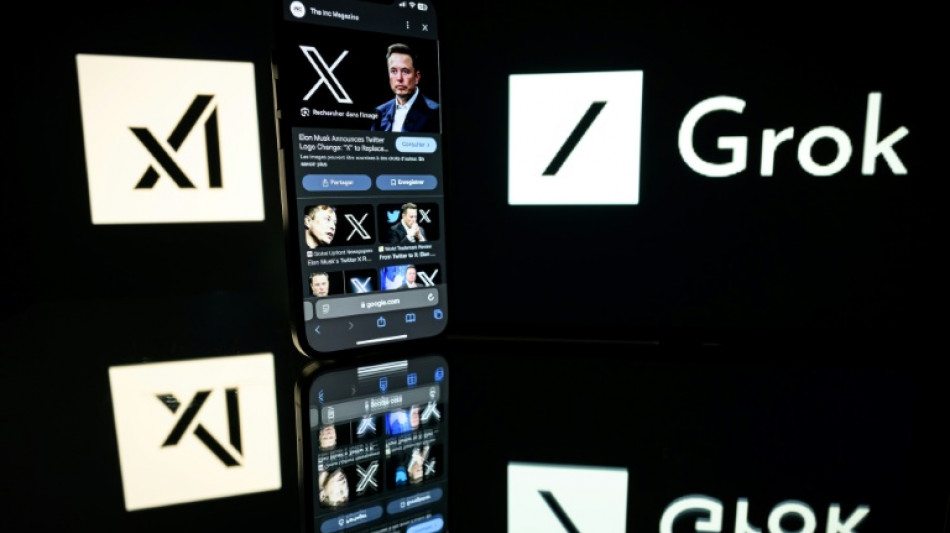
Grok shows 'flaws' in fact-checking Israel-Iran war: study / Photo: © AFP

 South African election results renew debate over identity-based voting

 South African voters report smoother local election but declining IEC trust

 Dolly Parton museum and Nashville hotel open after singer’s death

 George and Amal Clooney attend New York political-comedy reading

 British buyers pay substantial premiums for period-home appearance

 Thomas Markle released to house arrest after child-abuse-image charge

 Dawn of War 4 developers chose Adeptus Mechanicus for tactical variety

 Italy face unbeaten South Africa in Turin Nations Championship match

 ChatGPT interactive interface feature tested across six custom tools

 Freshways milk-price cut deepens pressure on UK dairy farms

 Labour and National remain virtually tied as New Zealand vote count advances

 The Good Daughter adapts Karin Slaughter thriller with Rose Byrne and Meghann Fahy

 Heavy-lift drone evacuates wounded Ukrainian soldier from frontline kill zone

 Morrison says West Brom recovered after pressure from successive derby losses

 Britain considers 2027 state visit for Ukraine’s Zelensky

 Arizona Democrats Secure Historic Trifecta with New Legislative Leadership

 Carney Welcomes U.S. Trade Reversal After Democratic Midterm Victory

 Armenian FM Discusses EU Accountability for Palestinian Rights in Madrid
Elon Musk's AI chatbot Grok produced inaccurate and contradictory responses when users sought to fact-check the Israel-Iran conflict, a study said Tuesday, raising fresh doubts about its reliability as a debunking tool.
With tech platforms reducing their reliance on human fact-checkers, users are increasingly utilizing AI-powered chatbots -- including xAI's Grok -- in search of reliable information, but their responses are often themselves prone to misinformation.
"The investigation into Grok's performance during the first days of the Israel-Iran conflict exposes significant flaws and limitations in the AI chatbot's ability to provide accurate, reliable, and consistent information during times of crisis," said the study from the Digital Forensic Research Lab (DFRLab) of the Atlantic Council, an American think tank.
"Grok demonstrated that it struggles with verifying already-confirmed facts, analyzing fake visuals, and avoiding unsubstantiated claims."
The DFRLab analyzed around 130,000 posts in various languages on the platform X, where the AI assistant is built in, to find that Grok was "struggling to authenticate AI-generated media."
Following Iran's retaliatory strikes on Israel, Grok offered vastly different responses to similar prompts about an AI-generated video of a destroyed airport that amassed millions of views on X, the study found.
It oscillated -- sometimes within the same minute -- between denying the airport's destruction and confirming it had been damaged by strikes, the study said.
In some responses, Grok cited the a missile launched by Yemeni rebels as the source of the damage. In others, it wrongly identified the AI-generated airport as one in Beirut, Gaza, or Tehran.
When users shared another AI-generated video depicting buildings collapsing after an alleged Iranian strike on Tel Aviv, Grok responded that it appeared to be real, the study said.
The Israel-Iran conflict, which led to US air strikes against Tehran's nuclear program over the weekend, has churned out an avalanche of online misinformation including AI-generated videos and war visuals recycled from other conflicts.
AI chatbots also amplified falsehoods.
As the Israel-Iran war intensified, false claims spread across social media that China had dispatched military cargo planes to Tehran to offer its support.
When users asked the AI-operated X accounts of AI companies Perplexity and Grok about its validity, both wrongly responded that the claims were true, according to disinformation watchdog NewsGuard.
Researchers say Grok has previously made errors verifying information related to crises such as the recent India-Pakistan conflict and anti-immigration protests in Los Angeles.
Last month, Grok was under renewed scrutiny for inserting "white genocide" in South Africa, a far-right conspiracy theory, into unrelated queries.
Musk's startup xAI blamed an "unauthorized modification" for the unsolicited response.
Musk, a South African-born billionaire, has previously peddled the unfounded claim that South Africa's leaders were "openly pushing for genocide" of white people.
Musk himself blasted Grok after it cited Media Matters -- a liberal media watchdog he has targeted in multiple lawsuits -- as a source in some of its responses about misinformation.
"Shame on you, Grok," Musk wrote on X. "Your sourcing is terrible."
C.Bruderer--VB