'Fake' Rubens masterpiece debate reignited by new book / Photo: © AFP

 Barca sign Croatia goalkeeper Livakovic
 Rain delays England's bid to put off-field incidents behind them
 World record holder Sawe withdraws from Berlin Marathon

 Driven by faith, activists stand up to fellow Jews to protect Palestinians
 Therapy Culture Performance: How the Lindsay Clancy Trial Sparked a Trend of Viral Maternal Distress
 Norway's King Harald, 89, in 'extremely serious' condition

 How a glacier collapse may have caused Nepal-Tibet disaster

 Harmovest Capital Strengthens Global Financial Services Through Technology and Compliance
 Nvidia to buy AI platform Hugging Face for $12.9 bn: report
 Palace intrigue in Uganda as succession battle heats up

 'Housing First' approach gets Swedish city's homeless off streets

 Czech duo Muchova and Mensik win US Open mixed doubles title
 Japan's 'polka dot queen' artist Yayoi Kusama dies aged 97

 Nepal-Tibet disaster: what we know
 China deploys record number of ships around Taiwan as pressure grows
 Ruthless Bayern target treble as rivals reboot on Bundesliga return
 What experts know so far about Nepal's deadly floods
 UEFA set to withdraw FIFA boycott threat ahead of Champions League draw

 Sumo moves to beat Japan summer heat as temperatures rise
 'Be more honest': Markets crave clarity from cryptic Fed chair
 Climate change leaves its mark on America's largest reservoir

 CIA director warned Russia not to attack NATO members: US media
 Search for missing after Nepal-Tibet floods kills at least 160
 Meta, US states agree $18 bn settlement in landmark teen safety case

 What scientists know so far about Nepal's deadly floods

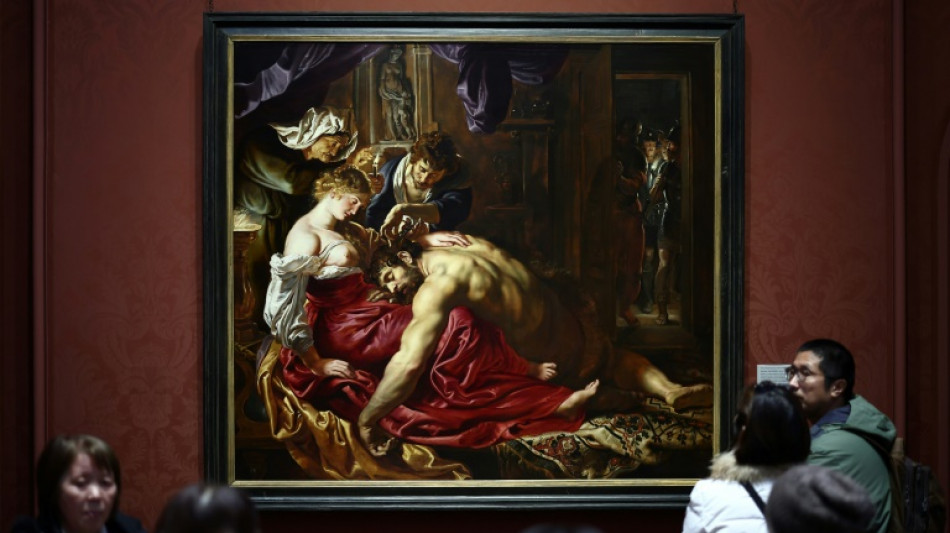
Gaudy colours, messy brushwork, even a set of missing toes. The debate about the authenticity of a Rubens's masterpiece "Samson and Delilah" will be reignited next week with the release of a book alleging the painting hanging in London's National Gallery is really a copy.
The work by the 17th century Flemish master Peter Paul Rubens was purchased by the gallery in 1980 for £2.5 million ($3.1 million), then the second-highest price ever paid for a painting at auction.
Every year tens of thousands of visitors view the work, lauded by the world-famous gallery for the artist's use of "highly contrasting light and shade and deep rich colour work".
It's not a view shared, however, by Greek painter and art historian Euphrosyne Doxiadis whose book "NG6461: The Fake Rubens" comes out next week.
Although the National Gallery remains convinced of the painting's authenticity, Doxiadis is adamant that it cannot have been painted by Rubens.
"Rubens was meant to have painted a Samson and Delilah... (but) this painting in the National Gallery is certainly not it," she told AFP by telephone from Greece.
Based on the Old Testament story of the Israelite hero Samson, the painting depicts the moment an accomplice of his treacherous lover Delilah cuts off his hair, the source of his warrior power.
Rubens completed the canvas around 1609, but it mysteriously went missing for nearly three centuries before resurfacing in Paris in 1929.
After changing hands, it was eventually resold to the National Gallery
Doxiadis, 78, said she "instantly" spotted problems with the painting on seeing it four decades ago.
- 'Detective' hunt -
"In 1985, I was wandering around alone and I saw it and I thought it was just a bad copy that they'd borrowed," she said.
Doxiadis, who studied at London's Slade School of Fine Art, said the painting's "cartoon" colours were the biggest red flag.
"Above all it was the lack of colour harmony, it was just gaudy... (and) the drawing, the composition were totally out of sync," she said.
"Also I didn't notice at the time but the foot of Samson is out of the picture -- the toes are missing," she said, adding: "It's a joke!"
Her theory is consistent with previously expressed doubts.
Contemporaneous reproductions show three soldiers in the doorway rather than the five in the National Gallery work.
It was several years after she first laid eyes on "Samson and Delilah" that Doxiadis learned that far from being an acknowledged copy, the painting had been acquired by the London institution for a vast sum.
That discovery so shocked her that she launched a 40-year "detective" hunt.
"When I started this whole research I never thought I'd be lucky enough to find out who painted this copy but I did," she said.
Her findings point to the work of three separate hands at the San Fernando Fine Art Royal Academy in Madrid.
- 'Dictatorship of experts' -
"It had become one of the rules of the academy that the students would do copies from old masters. It began in the early 19th century and went on until around 1910," she said.
Doxiadis said it was not intended to be a fake but after it was sold in Paris in good faith, the new owner succeeded in having it "authenticated" by an expert, sealing its status as an original "masterpiece".
Publishers were reluctant to take Doxiadis's book on although the independent London-based Eris press, distributed by Columbia University Press, eventually came to her rescue.
"There's a dictatorship of experts ... Everyone was closing doors because they didn't want to get involved with something so controversial."
The publicly owned National Gallery has not reacted to the book although it told AFP in a statement the work had "long been accepted by leading Rubens scholars as a masterpiece by Peter Paul Rubens".
"A technical examination of the picture was presented in an article in the National Gallery's Technical Bulletin in 1983. The findings remain valid," it added.
Doxiadis said she remained motivated by a sense of outrage on behalf of the artist and concern that the price tag had been funded by taxpayers' money.
"NG6461: The Fake Rubens", whose title refers to the painting's inventory number, will be published on Wednesday.
A.Zbinden--VB