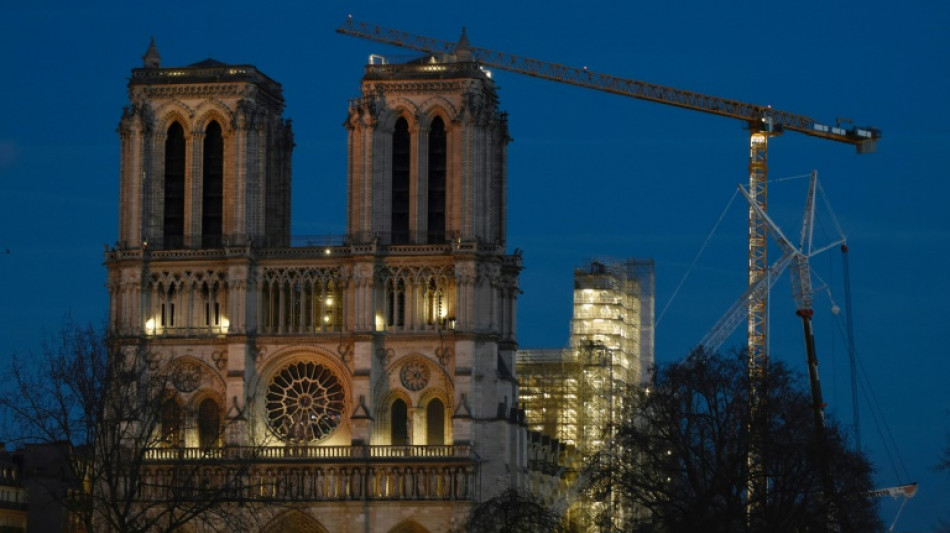
Paris fire exposes hidden iron holding up Notre-Dame / Photo: © AFP/File

 Cambodia no 'safe haven' for cyberscams, PM says

 North Korea weightlifter sets three world records for Asian Games gold

 A Full Moon for Every Child: STARTRADER's STARCARES Brings Support to SOS Children's Village Ho Chi Minh City

 Meta leans into AI, smart glasses amid privacy pushback

 Battered Duerer masterpiece up for five-year revamp

 Trump met with Venezuela's interim leader at UN

 Malaysia furore after Najib wins conditional house arrest

 Italy hope for new dawn under Mancini

 Mongolian herders enlist new tech against harsher, drier climate

 Tata turmoil shines light on India succession woes

 World Cup 'not enough' as Spain begin next chapter

 Meta acts against 3.7 mn scammers' accounts with Singapore police help

 Australia PM says draft social media rules about taking back control

 Voting opens in Alaska's annual Fat Bear Week

 MLS coach axed for telling female ref 'It's a man's game'

 US refuses to give Sudan's de facto leader visa for UN

 Man City hold Bayern to start Women's Champions League, Arsenal win late

 Trump threatens Iran with 'hell' but reveals fresh talks

 Trump signs security deal with Greenland, Denmark at UN

 Trump threatens Iran with 'hell' but unveils fresh talks

 Chile's Atacama Desert blossoms with life after El Nino rains

 Sri Lanka hands 220-year jail terms to 15 convicted of Easter bombings

 Typhoon Dujuan leaves 7 dead in Japan from landslides, flooding: media

 Ganna and Borghini lead Italy to mixed relay gold at cycling worlds

 Drug cocktail killed former child star Hayden Panettiere: coroner

The fire that engulfed Notre-Dame four years ago has revealed a long-hidden secret about the Paris landmark: it was the first Gothic cathedral in which iron staples were used extensively throughout construction.
It took near destruction and a massive restoration project which is still in progress for a team of archaeologists to discover the iron reinforcements.
The construction of the famous cathedral in the heart of the French capital began in 1160 and was not completed until almost a century later.
It was the tallest building of its time, with vaults reaching up to 32 metres (105 feet), according to a study published in the journal PLOS ONE on Wednesday.
Maxime L'Heritier, an archaeologist at University Paris 8 and the study's lead author, told AFP that some elements of the building's construction remained unknown, even after all these centuries.
It was not clear how the builders "dared -- and succeeded -- in putting up such thin walls to such a height," he said.
Lacking much documentation from more than 900 years ago, "only the monument can speak" about its construction, he added.
The blaze on April 15, 2019, exposed iron staples used to hold the cathedral's stone blocks together.
Some appeared in the frame of the building, others fell smouldering to the ground in the heat of the blaze.
- 'Much more dynamic ' -
The cathedral could be riddled with more than a thousand iron staples, the study said.
There are staples of varying sizes, ranging from 25 to 50 centimetres (10 to 20 inches) long, some weighing up to a few kilos.
They were found in many different parts of the cathedral, including in the walls of the nave, the choir tribunes and in parts of the cornice.
"This is the first truly massive use of iron in a Gothic cathedral, in very specific places," L'Heritier said.
Iron staples have been used in construction since Antiquity, including in Rome's Colosseum and Greek temples.
But in those cases they were simply used to keep large stone blocks secure on the lower floors.
Notre-Dame has a "much more dynamic conception of architecture," L'Heritier said.
From the very beginning, the builders used the iron staples to make the cathedral's stands in the early 1160s. Their successors continued their innovative use on the upper parts of the walls over the next 50 to 60 years.
Iron would go on to be used in this way in numerous cathedrals across France.
More than 200 scientists are working on restoring Notre-Dame, whose iconic spire is expected to back in place by the end of this year.
The reconstruction project is on track to be completed by the end of next year, France's culture ministry told AFP last month.
This means the tourist landmark, which previously saw 12 million annual visitors, will not be open when Paris hosts the Olympic Games in July and August 2024.
M.Furrer--BTB