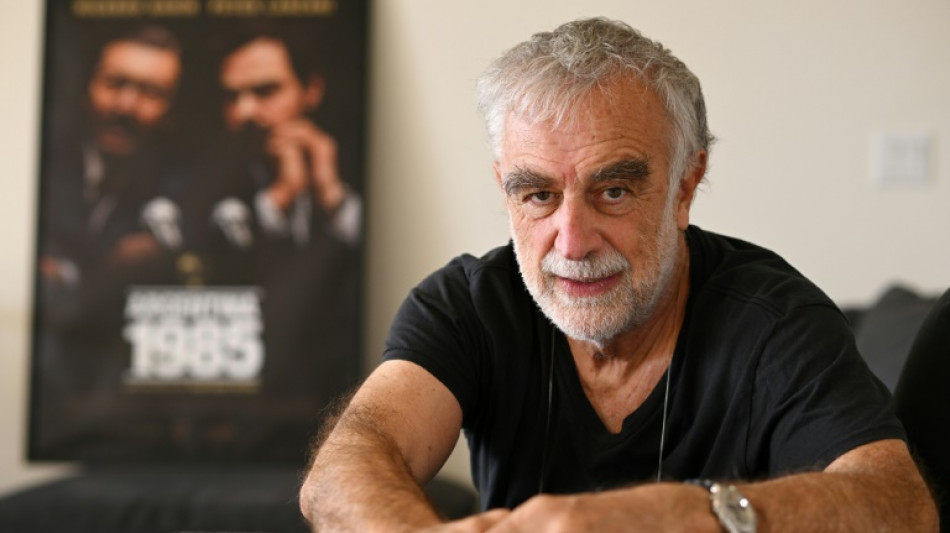
Oscar hopeful 'Argentina, 1985' offers lessons on democracy: prosecutor / Photo: © AFP

 Outgoing UN chief makes climate push at New York summit
 AI risks, Iran war to take center stage at UN
 Badminton no.1 An tells dad to keep it down at Asian Games
 Runaway leader Antonelli eyeing third straight win

 Schoolgirl Yu, 13, fastest again in bid for third Asian Games gold

 Oil prices fall after Trump hails 'good' talks with Iran

 AI political ads warp reality ahead of US midterms
 Kenneth Branagh embraces action hero role -- to get in shape

 'New one' Klopp promises fresh approach as Germany reign begins

 Milne returns to New Zealand squad for India T20 series

 US-led Americas coalition backs sanctions against crime groups

 'Star Wars' fans and art lovers line up for new Lucas museum

 Trump renames AI 'super intelligence' as leaders jostle over dangers

 Oil prices retreat as markets welcome US-Iran talks

 US refusing to give Sudan's de facto leader visa for UN: diplomatic sources, UN
 Macron urges world to choose UN over 'law of the jungle'

 All-rounder Jacks stars as England beat Sri Lanka in 1st ODI

 Man City peg back Bayern to start Women's Champions League
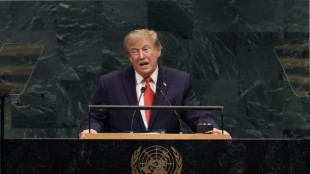 Trump beats 'America first' drum at UN as allies tread carefully

 Snedeker backs Spaun for Ryder Cup after Presidents snub
 French prosecutors probe secret filming of women with smart glasses

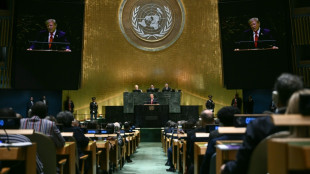 Trump renames AI "super intelligence," rejects international oversight
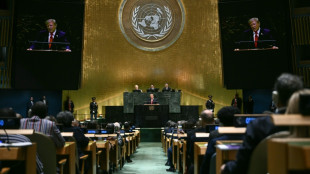 Trump rejects international regulation of AI

 How is the EU approaching record fuel prices?

 Sri Lanka's Colombage strikes on debut as England dismissed for 265 in first ODI
Luis Moreno Ocampo was just 32 years old and had no trial experience when he was summoned to prosecute Argentina's generals in 1985 after a disastrous military dictatorship -- a story retold in an Oscar-nominated film.
Moreno Ocampo, who went on to become the first prosecutor of the International Criminal Court, says "Argentina, 1985" can help teach global audiences about the risks of losing democracy -- and the importance of public opinion.
"You've got to win your case in court. But then it's a battle for the memory," the 70-year-old Ocampo told AFP in an interview in Malibu, California, where he currently lives.
"I won the battle... in 1985. But (with this movie), Santiago Mitre and Ricardo Darin are winning the battle for memory in 2023, and that's unique."
Mitre is the director of "Argentina, 1985," one of five nominees for the Academy Award for best international feature.
It tells the story of one of the most important trials in the country's history, and puts the focus on the tensions as the Latin American nation groped its way back to democracy after seven years of murderous military government from 1976 to 1983.
Moreno Ocampo (Peter Lanzani), who himself hailed from a traditional military family, is appointed by lead prosecutor Julio Strassera (Darin) to help try nine of the uniformed men who had ordered thousands of killings and disappearances.
The trial led to the convictions of six men including former dictator Jorge Videla and key junta member Emilio Massera, who were jailed for life.
The proceedings, compared to the Nuremberg trials after World War II, also sharply divided Argentines -- and even Moreno Ocampo's own family.
"The movie shows how my mother was against me," said Moreno Ocampo, who is now a visiting professor at the University of Southern California and a senior fellow at Harvard.
"My mother went to church with the dictator general Videla!"
But as one of the film's most painful scenes reveals, the harrowing first testimony of the trial -- that of a woman who is forced by her captors to give birth handcuffed in the back seat of a patrol car -- changed her mind.
"The next day she called me... She told me: 'I still love General Videla, but you are right, he has to go to jail'."
- Torture -
"Argentina, 1985" shows how the military regime set up detention, torture and extermination camps, with people being thrown alive into the sea from airplanes, shot or detained indefinitely.
Some 30,000 Argentines disappeared, and it is estimated that hundreds of babies born in captivity were given to other families, including military families.
Moreno Ocampo says holding those responsible to account is vital if a country is to come to terms with its past and become a stable and secure democracy -- something he says Brazil, for example, did not do.
"They did not investigate the past... this has an impact. In Brazil, they feared that the military could get involved in a coup in the near future," he explained.
"The problem is not the military, because they follow orders. It's the elites -- if your elites support a coup, you have a problem," he says.
"It's something that Brazil, and even the United States, hasn't understood," he adds, referring to the 2021 assault on the US Capitol in the waning days of Donald Trump's presidency.
"When journalists ask me how to avoid coups d'etat... the issues are not those involved in the sedition, the issue is who was supporting them," he told AFP.
"The elite supporting civilian sedition, like in Washington -- they are the problem."
- 'Power of youth' -
Argentina has won two Oscars previously, both for films that tackled the years of military terror: "The Official Story" in 1986 and "The Secret in Their Eyes" in 2010.
Moreno Ocampo -- who will attend the Oscars on Sunday -- says he hopes that this year's offering, with its focus on the role young people played in achieving justice, will bring the four-decade-old story of Argentina's emergence from dictatorship to a new audience.
"My 23-year-old son didn't know what had happened. Now he's learning," he said.
"This film is about the risk of (losing) democracy. But it's also about the power of youth -- how young people are the ones who change the world and how you have to continue to battle for justice.
"Justice is a never-ending job."
W.Lapointe--BTB