Codebreakers find, decipher lost letters of Mary, Queen of Scots / Photo: © LASRY/BIERMANN/TOMOKIYO/AFP

 South African election results renew debate over identity-based voting

 South African voters report smoother local election but declining IEC trust

 Dolly Parton museum and Nashville hotel open after singer’s death

 George and Amal Clooney attend New York political-comedy reading

 British buyers pay substantial premiums for period-home appearance

 Thomas Markle released to house arrest after child-abuse-image charge

 Dawn of War 4 developers chose Adeptus Mechanicus for tactical variety

 Italy face unbeaten South Africa in Turin Nations Championship match

 ChatGPT interactive interface feature tested across six custom tools

 Freshways milk-price cut deepens pressure on UK dairy farms

 Labour and National remain virtually tied as New Zealand vote count advances

 The Good Daughter adapts Karin Slaughter thriller with Rose Byrne and Meghann Fahy

 Heavy-lift drone evacuates wounded Ukrainian soldier from frontline kill zone

 Morrison says West Brom recovered after pressure from successive derby losses

 Britain considers 2027 state visit for Ukraine’s Zelensky

 Arizona Democrats Secure Historic Trifecta with New Legislative Leadership

 Carney Welcomes U.S. Trade Reversal After Democratic Midterm Victory

 Armenian FM Discusses EU Accountability for Palestinian Rights in Madrid

 Trump and Vance Pursue Secret Diplomacy with Iran Amid Military Pressure

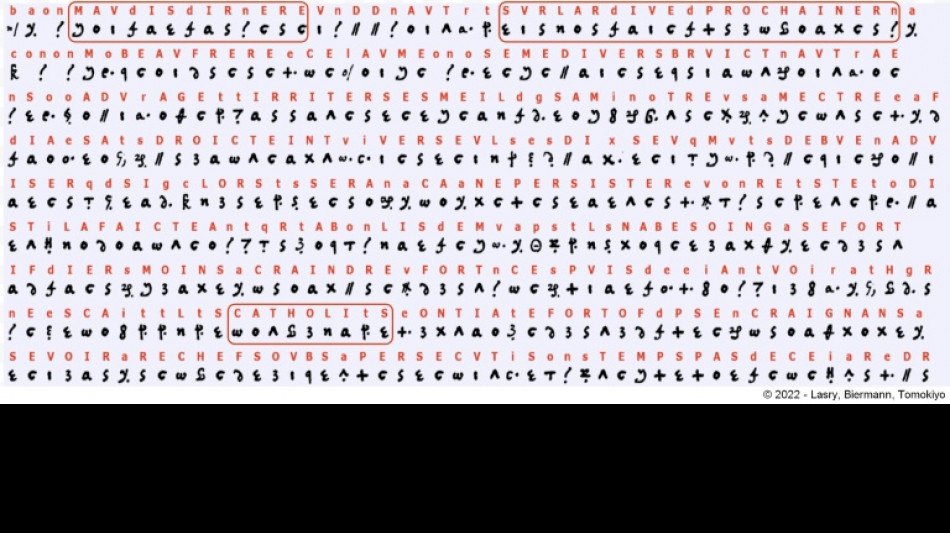
An international team of codebreakers said Wednesday they have found and deciphered the long lost secret letters of 16th-century monarch Mary, Queen of Scots, one of the most argued-over figures in British history.
The long-rumoured missing letters, which were found mislabelled in the digital archive of a French library, were hailed by excited historians as the most significant discovery about the Scottish queen in a century.
Mary Stuart, a Catholic, wrote the coded letters from 1578 to 1584 while she was imprisoned in England due to the perceived threat she posed to her Protestant cousin Queen Elizabeth I.
Mary was beheaded in 1587 after being found guilty of plotting to assassinate Elizabeth I, marking the end of a dramatic life since portrayed in numerous movies and books.
But Mary was far from the minds of the three codebreakers who discovered more than 50 of her letters containing around 50,000 never-before-seen words.
They are members of the DECRYPT project, an international, cross-disciplinary team scouring the world's archives to find coded historical documents to decipher.
The trio were trawling through the digitised archive of France's national library, known as the BnF, when they stumbled onto enciphered documents labelled as being from Italy in the first half of the 16th century.
"If someone wanted to look for Mary Stuart material in the BnF, that's the last place they would go," said French computer scientist and cryptographer George Lasry, the lead author of a new study in the journal Cryptologia.
Lasry told AFP that deciphering the code "was like peeling an onion," for the trio, which also includes German music professor Norbert Biermann and Japanese physicist Satoshi Tomokiyo.
- The telltale 'spymaster' -
First, the codebreakers realised the text was not in Italian, but French.
It also used feminine forms, indicating a woman. Phrases like "my liberty" and "my son" suggested it was an imprisoned mother.
Then came the breakthrough word: "Walsingham".
Francis Walsingham was Elizabeth I's principal secretary and "spymaster".
Some historians believe it was Walsingham who later "entrapped" Mary in 1586 into supporting the foiled Babington Plot to assassinate Queen Elizabeth I, Lasry said.
Eight of the 57 letters found by the codebreakers were already in Britain's archives because Walsingham had a spy in the French embassy from mid-1583, Lasry said.
Most of Mary's letters are addressed to Michel de Castelnau Mauvissiere, the French ambassador to England and a supporter of Mary.
Mary was "too smart" to mention any assassination plot in the newly unearthed letters, Lasry said.
Instead the letters show her diplomatically pleading her case, gossiping, complaining of illnesses and perceived antagonists, and expressing distress when her son, King James VI of Scotland, was abducted.
Lasry said he could not help but feel empathy for the queen "because it's a tragedy -- you know she's going to be executed".
- 'Historical sensation' -
Historians praised both the code breaking and historical research of the trio, expressing keenness to get stuck into the letters.
"This discovery is a literary and historical sensation," said John Guy, a British historian who wrote a Mary Stuart biography on which a 2018 film starring Saoirse Ronan was based.
"Fabulous! This is the most important new find on Mary, Queen of Scots for 100 years," Guy said in a statement.
Steven Reid, a Scottish history expert at Glasgow University, said it was "the largest discovery of new Marian evidence in the modern era".
He told AFP it would likely alter existing biographies of Mary's life, adding that the cipher could help produce more accurate versions of her other coded letters.
Nadine Akkerman, a professor of early modern literature at Leiden University in the Netherlands, said that for historians it was "like uncovering buried treasure".
Some of Mary's letters are still believed to be missing, with the researchers saying a physical inspection of the BnF's undigitised stock of original documents could be next.
K.Thomson--BTB