The art teacher who showed the world China's protests / Photo: © AFP/File

 Trump renames AI 'super intelligence' as leaders jostle over dangers

 Oil prices retreat as markets welcome US-Iran talks
 US refusing to give Sudan's de facto leader visa for UN: diplomatic sources, UN
 Macron urges world to choose UN over 'law of the jungle'
 All-rounder Jacks stars as England beat Sri Lanka in 1st ODI

 Man City peg back Bayern to start Women's Champions League
 Trump beats 'America first' drum at UN as allies tread carefully
 Snedeker backs Spaun for Ryder Cup after Presidents snub

 French prosecutors probe secret filming of women with smart glasses

 Trump renames AI "super intelligence," rejects international oversight
 Trump rejects international regulation of AI

 How is the EU approaching record fuel prices?

 Sri Lanka's Colombage strikes on debut as England dismissed for 265 in first ODI
 Hurricane Polo strengthens to top category 5 off Mexico
 11 hurt as teen opens fire outside school in western Turkey

 UN chief says 'Big Oil' treats atmosphere as open sewer
 Tunisia says 2026 summer hottest on record
 England's Rashid out of Sri Lanka ODIs with hand injury
 Houthis accuse Saudi Arabia of deadly strikes as thousands flee

 Stocks climb as oil slides, AI buzz returns
 India cricketers win in style as Afghan savours 'special' Games silver

 La Liga president hits out at Real Madrid refereeing 'conspiracy' claims

 MEXC Launches “Real Stocks, Real Friends” with Rewards for Bringing Friends to Wall Street

 Mbappe continues media push for Ballon d'Or recognition
 Stocks rise on AI buzz, oil prices cool

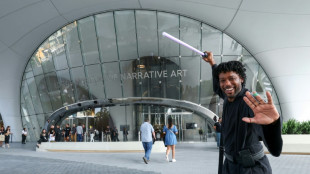
Just a few months ago, he was an ordinary Chinese art teacher who posted his personal thoughts and paintings online.
When demonstrations erupted against Beijing's hardline zero-Covid policy, the 30-year-old known on Twitter as "Teacher Li" became the go-to source for videos, some of them real-time.
With images or talk of protest wiped out on Chinese social networks by government censors, thousands of people turned to Li, who lives in Italy, to make their voices heard.
"I never expected it," said Li, who asked AFP not to reveal his full name because of threats against him.
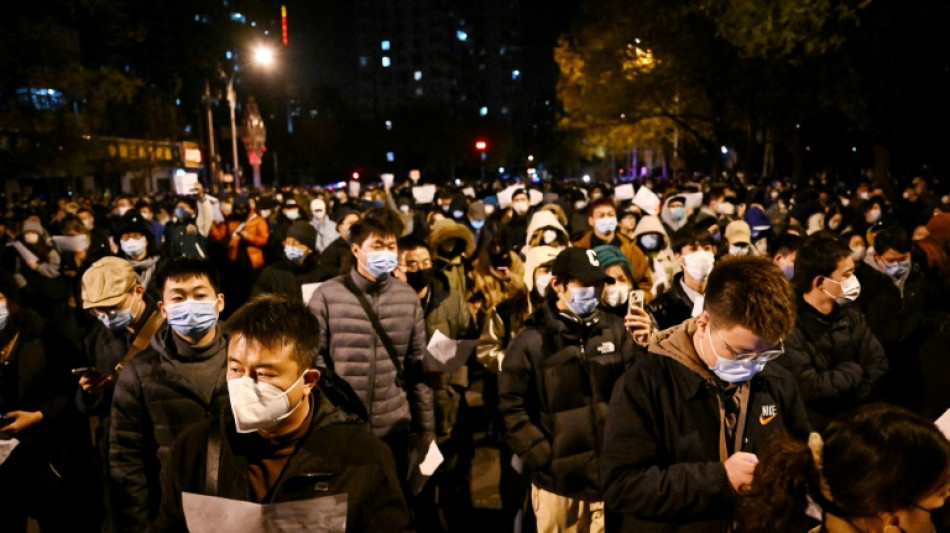
Following three years of widespread lockdowns, mass testing, travel restrictions, and forced isolation for Covid cases and contacts, discontent against Beijing's measures finally boiled over last month.
The demonstrations that flared up nationwide on the weekend of November 26 to 27 were the most widespread since pro-democracy rallies in 1989.
Angry protesters demanded answers after a fire in the northwestern city of Urumqi killed 10 people, with virus curbs blamed for hampering rescue efforts.
In some demonstrations, rage against the restrictions gave rise to calls for President Xi Jinping to resign.
From the living room of his non-descript apartment where he has a workstation comprising a colourful keyboard and a curved screen, Li became a one-man newsroom marshalling a flurry of citizen journalists on the ground.
His followers, who leapt from 150,000 on November 23 to 830,000 now, sent him footage or information that he in turn transmitted to the world via his Twitter account.
China's "Great Firewall" makes it impossible for most internet users to access Twitter, Facebook and other international platforms.
Living in a city in Italy which he asked AFP not to name, Li used his Twitter account to become the link between the protesters and the world.
With rallies flaring up across China, including Beijing and Shanghai, Li said he was receiving about 30 to 40 contributions every second, and "it wasn't possible to keep up".
"For our generation or for Twitter users, this is something that is happening for the first time in 30 years, so many people are excited and emotional," he said.
The bespectacled painter spent the whole day in front of his screen, skipping meals to sift through the unending stream of contributions.
On November 27, he published 399 posts.
His Twitter feed provided a valuable glimpse of the extraordinary developments on the ground, particularly as journalists in China were hampered themselves by Covid travel restrictions.
Li said he felt no choice but to react.
"When you see people on the streets, you see them holding up white paper, shouting slogans, you don't have time to consider, all you can do is do your bit to record what they are doing," he said.
"The more you record, the more it acts as an additional layer of protection for them because then people around the world see it.
"You don't think about consequences for yourself because in reality people are themselves facing more direct threats than you."
China's vast security apparatus moved swiftly against the protesters, deploying a heavy police presence while boosting online censorship and surveillance.
But on Wednesday the government also announced a nationwide rolling back of the harshest zero-Covid restrictions, a rare apparent concession to the public's frustration.
- 'Small account' -
Li moved to Italy a few years ago to further his studies in art.
To his students and video contributors, he is known as Teacher Li.
On Twitter, his name is "Teacher Li is not your teacher" -- and his profile picture is a drawing of one of the four cats that share his home with him.
In his apartment, his easel stands unused as running his Twitter account has taken over his waking hours. For days on end, he stays in, taking breaks only to feed his cats and himself.
Used to sharing his personal thoughts or art online, Li began venturing into social issues -- which, like politics, can be sensitive topics in China.
Earlier this year, after writing about the case of a trafficking victim found chained by her neck in a shack, his account on China's social network Weibo was blocked for 180 days.
Undeterred, Li set up a total of 52 new accounts, all of which were shut down, the quickest in 10 minutes.
He refused to give up, saying: "It's my right to speak out."
"I have already given in by a lot, I'm not criticising the government... but I'm still being deprived of my right to speak. So blasting through 52 accounts became a form of performance art for me," he said.
Finally at the end of April, he shifted to Twitter.
His followers on Weibo numbered around 90,000 at the time, he said, adding that he "was a small account but even such a voice wasn't permitted".
- Trust and threats -
Some followed Li to Twitter, and when videos of violent protests at China's largest iPhone factory started circulating on November 23, he posted videos recorded by people at the scene.
That was followed by footage of demonstrations in Urumqi after the fire, and elsewhere over the weekend.
Li transmitted videos sent by contributors, accompanied by a brief text on what was being depicted, where it was happening and when.
He believes that letting the images speak for themselves helped him gain people's confidence.
"People in China are very afraid that their opinion will be misused by what are described as external forces. They fear that it will be exaggerated and publicised and turned into a rumour. But I don't do that," he said.
Li acknowledged there have been occasions where he had to remove posts that contained wrong information.
"But people are indulgent with me, because they know I'm working alone," he said.
A breaking event would bring simultaneous contributions from different sources, he said, allowing him to ascertain its veracity.
As he publishes what Chinese state media ignores, Li has drawn scrutiny -- no longer just from online censors.
Detractors have accused him of defaming or humiliating his country or of being a government informer gathering details about protestors.
There have also been threats offline.
"The police came to my home (in China). I know that my family is being affected. I am being affected online. This is very immense pressure," he said.
- 'Worth it' -
But he said he won't give up.
"This account is now very important -- it's a window for people within China to know what's going on in their own country, and it is also a window for Chinese abroad and foreigners to understand China... So I must persevere."
For now, Li believes his actions and those of his contributors have borne fruit.
"On whether it's worth it, it is. Because this has changed the situation in China –- from zero-Covid to a changing attitude.
"And the population is realising that they can reasonably express their requests. This is very meaningful.
"In view of the future and happiness of thousands or tens of thousands of families, my little self is not important."
O.Bulka--BTB