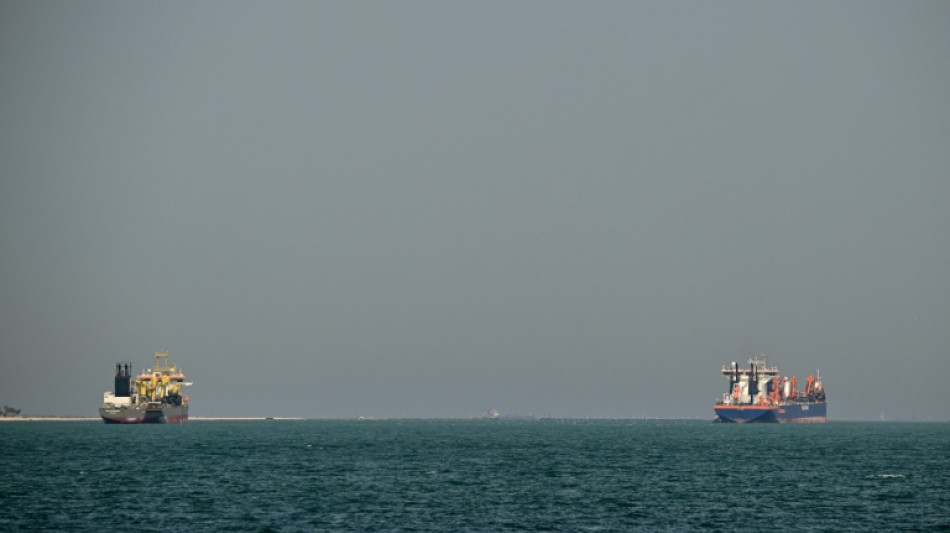
What cargo ships are passing Hormuz strait? / Photo: © AFP/File

 Verstappen edges Russell in final practice in Azerbaijan

 English, Spanish, Italian, German football leagues call for FIFA reform

 Pope arrives in France on first official visit in 18 years

 Pope arrives in France on first state visit in 18 years

 Heavy fighting, internet disruption as Ethiopia conflict rages

 From transit to consumption: drug use surges in Mozambique

 Chicago teams, Guardians and Padres all book MLB playoff berths

 Bijan Robinson destroys Packers in 35-14 win for Falcons

 Harimoto hails new era as Japan dethrone table tennis kings China

 India rape cases turn focus back onto women's safety

 Rebellious Afghan taxi drivers defy ban on music

 Brazil candidates mount digital armies for fierce online campaign

 Nepal PM says floods 'a warning to the world' about climate change

 Trump hosts Xi for state dinner as pomp masks tensions
 Scheffler and Burns give US 3-2 Presidents Cup lead

 Hollywood stars among 100 arrested in NY anti-Netanyahu protest

 Klopp denied on Germany debut as Portugal win in Nations League

 Rich nations should foot climate bill, says Nepal minister

 Wellalage and Mendis star as Sri Lanka level England series in thriller

 Felix gives Portugal win over Wales as Ronaldo misfires

 Wellalage and Mendis star as Sri Lanka level England ODI series

 Guyana urges Venezuela at UN to respect ICJ's ruling on Essequibo region

 Argentina coach says Messi deserves to go out on own terms

 Xi sets red lines for Trump despite lavish White House welcome

 Cowboys, Ravens happy with footing for first Rio NFL clash

Just a trickle of cargo ships and tankers -- most of them Iranian -- have made it through the Strait of Hormuz since Iranian forces blocked the crucial trade route in the Middle East war.
Here are facts and figures about vessels that have passed through the 167-kilometre (104-mile) long strait since the war broke out with US-Israeli strikes on Iran on February 28.
- 95% shipping drop -
From March 1 to 19, commodities carriers made just 114 crossings, according to analytics firm Kpler -- a decrease of 95 percent from peacetime.
Of these, 69 crossings were by oil tankers and more than half were loaded, Kpler data showed, with most travelling east out of the strait.
Traffic "is being led mostly by bulk carriers, tankers and container ships," said Richard Meade, editor of leading shipping intelligence journal Lloyd's List, in a briefing on Thursday.
"But we have seen a bit of an uptick in gas carriers moving over the last week."
- Iranian, Greek, Chinese ships -
Most of the ships passing the strait are owned or flagged in Iran, said Bridget Diakun, an analyst at data company Lloyd's List Intelligence.
After that, Greek ships accounted for 18 percent of crossings and Chinese ones 10 percent in recent days, she said.
"Although Iran is continuing to control the Strait and exit its own oil, everything else is largely still at a standstill," said Meade.
- 35 sanctioned ships -
Overall since the war started, around a third of the ships transiting the strait were under US, EU or UK sanctions, according to an AFP analysis of passage data.
Of the oil and gas tankers, more than half were under sanctions.
Since March 16 "anything heading westbound has been shadow fleet, gas carriers or tankers... they absolutely dominate the traffic going through," Diakun told the Lloyds briefing.
- Oil to China -
Commodities analysts at JPMorgan bank said in a report released Monday that most of the oil passing through the strait was headed for Asia, principally China.
Data in the report indicated it was receiving more than a million barrels day from Hormuz -- far below the pre-war level of nearly five million.
Cichen Shen, Asia Pacific editor at Lloyd's List, said there were indications online that Chinese authorities were working on "some sort of exit plan" for their big tankers stuck in the region.
- 1.3 mn barrels of Iran oil -
The JPMorgan analysts said overall 98 percent of the observable oil traffic through the strait was Iranian, averaging 1.3 million barrels a day "in early March".
A fifth of the world's oil and liquefied natural gas passes through the strait in peacetime.
- Indian, Pakistani ships -
"There are indications that some ships are transiting under Iranian 'approval', with some vessels following a route through the Strait closer to the Iranian coastline than normal," including Indian and Pakistani vessels, marine consultancy Clarksons said in a note.
Meade of Lloyds List added: "Several governments, including China, but (also) India, Pakistan, Iraq, Malaysia, they're all in direct talks with Tehran, coordinating vessel transits" with Iran's Revolutionary Guards.
- Alternative routes surge -
Shipping companies are carving out other ways to get their cargos through the region. Major shipping firm CMA CGM said it was moving freight across Gulf countries by rail and road to avoid the strait.
"Gulf maritime traffic patterns indicate early signs of global rebalancing," said marine intelligence group Windward in a report.
In recent days transit volumes through the Bab el-Mandeb strait off east Africa surged 280 percent, and 70 percent through the Suez Canal, it said, indicating that "shipping is adapting through alternative corridors."
G.Frei--VB